MCQ
When an object is accelerated:
  • A
    Its direction must be constant
  • B
    Its velocity is necessarily changing
  • C
    Its velocity is constant
  • D
    Its speed is necessarily changing

Answer

  1. Its velocity is necessarily changing

Explanation:

Acceleration is the time rate of change of velocity.

Need a full question paper?

Generate a complete, print-ready paper with questions like this in minutes — across 16+ boards, with answer keys.
Start Generating Free

Similar questions

A closed organ pipe has a fundamental frequency of $1.5\, kHz$. The number of overtones that can be distinctly heard by a person with this organ pipe will be : (Assume that the highest frequency a person can hear is $20,000\, Hz$)
A barometer kept in an elevator reads 76cm when it is at rest. If the elevator goes up with increasing speed, the reading will be:
  1. zero.
  2. 76cm.
  3. < 76cm.
  4. > 76cm.
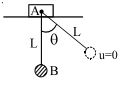
$A$ small ball $B$ of mass $m$ is suspended with light inelastic string of length $L$ from $a$ block $A$ of same mass $m$ which can move on smooth horizontal surface as shown in the figure. The ball is displaced by angle $\theta$ from equilibrium position & then released. Tension in string when it is vertical, is
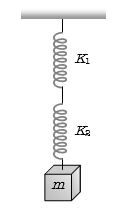
A mass $M$ is suspended by two springs of force constants $K_1$ and $K_2$ respectively as shown in the diagram. The total elongation (stretch) of the two springs is
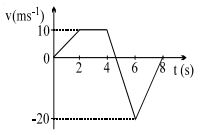
The figure shows a velocity-time graph of a particle moving along a straight line  If the particle starts from the position $x_0=-15\,m$ , then its position at $t=2\,s$ will be   ........ $m$
Three liquids with masses ${m_1},\,{m_2},\,{m_3}$ are thoroughly mixed. If their specific heats are ${c_1},\,{c_2},\,{c_3}$ and their temperatures ${T_1},\,{T_2},\,{T_3}$ respectively, then the temperature of the mixture is
If the mass of earth is $80$ times of that of a planet and diameter is double that of planet and $‘g’$ on earth is $9.8\,m/{s^2}$, then the value of $‘g’ $ on that planet is ........ $m/{s^2}$
An elevator cable can have a maximum stress of $7 \times 10^7\,N/m^2$ for appropriate safety factors. Its maximum upward acceleration is $1.5\,m/s^2$ . If the cable has to support the total weight of $2000\,kg$ of a loaded elevator, the minimum area of crosssection of the cable should be ....... $cm^2$  $(g = 10\,m/s^2)$
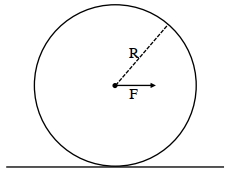
A horizontal force $F$ is applied at the center of mass of a cylindrical object of mass $m$ and radius $R$, perpendicular to its axis as shown in the figure. The coefficient of friction between the object and the ground is $\mu$. The center of mass of the object has an acceleration $a$. The acceleration due to gravity is $g$. Given that the object rolls without slipping, which of the following statement($s$) is(are) correct?

$(A)$ For the same $F$, the value of $a$ does not depend on whether the cylinder is solid or hollow

$(B)$ For a solid cylinder, the maximum possible value of $a$ is $2 \mu g$

$(C)$ The magnitude of the frictional force on the object due to the ground is always $\mu m g$

$(D)$ For a thin-walled hollow cylinder, $a=\frac{F}{2 m}$
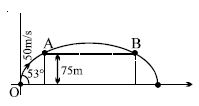
At $t = 0$ a projectile is fired from a point $O$(taken as origin) on the ground with a speed of $50\,\, m/s$ at an angle of $53^o$ with the horizontal. It just passes two points $A \& B$ each at height $75 \,\,m$ above horizontal as shown. The horizontal separation between the points $A$ and $B$ is ........ $m$