Question
When an object is in motion, its position changes with time. So, the quantity that describes how fast is the position changingm w.r.t. time and in what direction is given by average velocity. It is defined as the change in position or displacement $(\triangle\text{x})$ divided by the time interval $(\triangle\text{t})$ in which that displacement occur. However, the quantity used to describe the rate of motion over the actual path, is average speed. It defined as the total distance travelled by the object divided by the total time taken.
  1. A $250m$ long train is moving with a uniform velocity of $45\ kmh^{-1}.$ The time taken by the train to cross a bridge of length $750m$ is:
  1. $56s$
  2. $68s$
  3. $80s$
  4. $92s$
  1. A truck requires 3hr to complete a journey of $150\ km$. What is average speed?
  1. $50\ km/h$
  2. $25\ km/h$
  3. $15\ km/h$
  4. $10\ km/h$
  1. Average speed of a car between points $A$ and $B$ is $20\ m/s$, between $B$ and $C$ is 15m/s and between $C$ and $D$ is $10\ m/s.$ What is the average speed between $A$ and $D$, if the time taken in the mentioned sections is $20s, 10s$ and $5s,$ respectively?
  1. $17.14\ m/s$
  2. $15\ m/s$
  3. $10\ m/s$
  4. $45\ m/s$
  1. A cyclist is moving on a circular track of radius 40m completes half a revolution in $40s.$ Its average velocity is:
  1. $\text{Zero}$
  2. $2\text{ms}^{-1}$
  3. $4\pi\text{ms}^{-1}$
  4. $8\pi\text{ms}^{-1}$
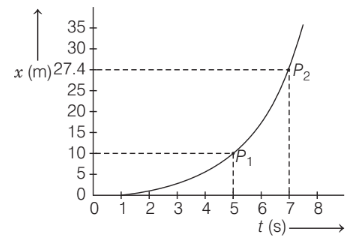
  1. In the following graph, average velocity is geometrically represented by:
  1. Length of the line $P_1 P_2.$
  2. Slope of the straight line $P_1 P_2.$
  3. Slope of the tangent to the curve at $P_1.$
  4. Slope of the tangent to the curve at $P_2.$

Answer

  1. (c) $80s$
Explanation:
Total time taken $=\frac{\text{Total distance}}{\text{Speed}}$
$\text{t}=\frac{250+750}{45\times\frac{5}{18}}=80\text{s}$
  1. (a) $50\ km/h$
Explanation:
Average speed $=\frac{\text{Total distance}}{\text{Total time}}$
$=\frac{150}{3}=50\text{km}/\text{h}$
  1. (a) $17.14\ m/s$ 
Explanation:
Total distance $(d = tv)$
$= 20 × 20 + 15 × 10 + 10 × 5 = 600\ m$
Total time $= 20 + 10 + 5 = 35\ s$
Therefore, average speed
$=\frac{600}{35}=17.14\text{m}/\text{s}$
  1. (b) $2\text{ms}^{-1}$
Explanation:
Given, $R = 40m $ and $t = 40s$
Average velocity $=\frac{\text{Total distance}}{\text{Time taken}}$
$=\frac{2\text{R}}{\text{t}}=\frac{2\times40}{40}=2\text{ms}^{-1}$
  1. (b) Slope of the straight line $P_1 P_2.$
Explanation:
From the position-time graph, average velocity is geometrically represented by the slope of curve, i.e. slope of straight line $P1 P2.$

Need a full question paper?

Generate a complete, print-ready paper with questions like this in minutes — across 16+ boards, with answer keys.

Start Generating Free

Similar questions

If you are walking on the moon, can you hear the sound of stones cracking behind you? Can you hear the sound of your own footsteps?
Read the passage given below and answer the following questions from 1 to 5. The proportional region within the elastic limit of the stress-strain curve is of great importance for structural and manufacturing engineering designs. The ratio of stress and strain, called modulus of elasticity, is found to be a characteristic of the material. Experimental observation show that for a given material, the magnitude of the strain produced is same whether the stress is tensile or compressive. The ratio of tensile (or compressive) stress $(\sigma)$ to the longitudinal strain $(\in)$ is defined as Young’s modulus and is denoted by the symbol Y. $\text{Y}=\frac{\sigma}{\in}$ Since strain is a dimensionless quantity, the unit of Young’s modulus is the same as that of stress i.e., $N-m^{-2}$ or Pascal (Pa). As steel has more modulus of elasticity than copper brass and aluminum hence steel is preferred in heavy-duty machines and in structural designs. Wood, bone, concrete and glass have rather small Young’s moduli. Answer the following.
  1. If stress strain changes then young’s modulus is:
  1. Also changes.
  2. Remains constant.
  3. Either changes or remains constant depends on amount of stress and strain.
  4. None of these.
  1. SI unit of young’s modulus is:
  1. $N-m^{-2}​​​​​​​$
  2. Pascal (Pa).
  3. $N-m^{-2}​​​​​​​$​​​​​​​ or Pascal (Pa).
  4. None of these
  1. Which of the following is more elastic
  1. Aluminum
  2. Steel
  3. Wood
  4. Glass
  1. Defines young’s modulus. Give its SI unit and dimensions.
  1. Why steel is more preferred in heavy industries than copper and brass?
The ear-ring of a lady shown in has a 3cm long light suspension wire.
  1. Find the time period of small oscillations if the lady is standing on the ground.
  2. The lady now sits in a merry-go-round moving at 4m/s in a circle of radius 2m. Find the time period of small oscillations of the ear-ring.
The magnetic moment of the assumed dipole at the earth's centre is $8.0 \times 10^{22}A-m^2$. Calculate the magnetic field B at the geomagnetic poles of the earth. Radius of the earth is 6400km.
A slide projector has to project a 35mm slide (35mm × 23mm) on a 2m × 2m screen at a distance of 10m from the lens. What should be the focal length of the lens in the projector?
Indian style of cooling drinking water is to keep it in a pitcher having porous walls. Water comes to the outer surface very slowly and evaporates. Most of energy needed for evaporation is taken from the water itself and the water is cooled down. Assume that a pitcher contains 10kg of water and 0.2g of water comes out per second. Assuming no backward heat transfer from the atmosphere to the water, calculate the time in which the temperature decrease by 5°C. Specific heat capacity of water $= 4200\ J\ kg^{-1} \ ^\circ C^{-1} $ and latent heat of vaporization of water $= 2.27 \times 10^6 J kg^{-1}.$
When we rub our hands they become warm. Have we supplied heat to the hands?
Cathode rays are passing through a discharge tube. In the tube, there is:
  1. An electric field but no magnetic field.
  2. A magnetic field but no electric field.
  3. An electric as well as a magnetic field.
  4. Neither an electric nor a magnetic field.
You are holding a cage containing a bird. Do you have to make less effort if the bird flies from its position in the cage and manages to stay in the middle without touching the walls of the cage? Does it make a difference whether the cage is completely closed or it has rods to let air pass?
Would you prefer a material with a high melting point or a low melting point to be used as a cathode in a diode?