MCQ
When charged particle enters-a uniform magnetic field, its $K.E:$
  • Remains constant
  • B
    Increases
  • C
    Decreases
  • D
    Becomes zero

Answer

Correct option: A.
Remains constant

Need a full question paper?

Generate a complete, print-ready paper with questions like this in minutes — across 16+ boards, with answer keys.

Start Generating Free

Similar questions

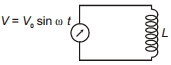
There is no resistance in the inductive circuit. Kirchhoff 's voltage law for the circuit is
One $kg$ of water, at $20\,^oC$, is heated in an electric kettle whose heating element has a mean (temperature averaged) resistance of $20\, \Omega $. The rms voltage in the mains is $200\, V$. Ignoring heat loss from the kettle, time taken for water to evaporate fully, is close to.......... $\min$ [Specific heat of water $= 4200\, J/kg\, ^oC$), Latent heat of water $= 2260\, k\,J/kg$]
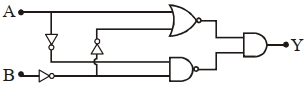
In the logic circuit shown in the figure, if input $A$ and $B$ are $0$ to $1$ respectively, the output at $Y$ would be ' $x ^{\prime}$. The value of $x$ is...........
In a crystal, the atoms are located at the position of
A plano-convex lens (focal length $f_2,$ refractive index $\mu _2,$ radius of curvature $R$ ) fits exactly into a plano-concave lens (focal length $f_1,$ refractive index $\mu _1,$ radius of curvature $R$ ). Their plane surfaces are parallel to each other. Then, the focal length of the combination will be
An electric kettle takes $4\, A$ current at $220\,V.$ How much time will it take to boil $1\,\, kg$ of water circuits are consequences of from temperature $20\,^o C\, ?$ The temperature of $(a)$ conservation of energy and electric charge boiling water is $100\,^o C.$ ............... $min$
The transconductance of a triode amplifier is 2.5 mili mho having plate resistance of 20 KW, amplification 10. Find the load resistance
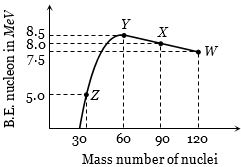
Binding energy per nucleon verses mass number curve for nuclei is shown in the figure. $W, X, Y$ and $Z$ are four nuclei indicated on the curve. The process that would release energy is
A particle $A$ has charge $ + q$ and a particle $B$ has charge $ + \,4q$ with each of them having the same mass $m$. When allowed to fall from rest through the same electric potential difference, the ratio of their speed $\frac{{{v_A}}}{{{v_B}}}$ will become
A $750\, Hz,$ $20$ $V$ (rms ) source is connected to a resistance of $100\, \Omega$ an inductance of $0.1803\, H$ and a capacitance of $10\mu ,$ $F$ all in series. The time in which the resistance (heat capacity $2 J /{ }^{\circ} C$ ) will get heated by $10^{\circ} C$. (assume no $105 s$ of heat to the surroundings) is close to$.....s$