MCQ
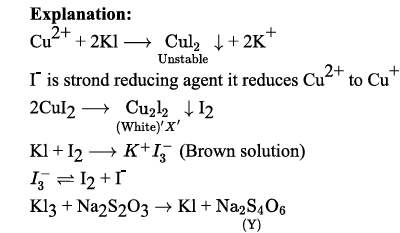
When Cu2+ ion is treated with KI, a white precipitate, X appears in solution. The solution is titrated with sodium thiosulphate, the compound Y is formed. X and Y respectively are
  • A
    $X = Cul _2 Y = Na _2 S_4 O _6$
  • B
    $X = Cu _2 l _2 Y = Na _2 S_4 O _5$
  • C
    $X = Cul _2 Y = Na _2 S_4 O _3$
  • D
    $X = Cu _2 l _2 Y = Na _2 S_4 O _6$

Need a full question paper?

Generate a complete, print-ready paper with questions like this in minutes — across 16+ boards, with answer keys.

Start Generating Free

Similar questions

$\mathop {{C_4}{H_7}OCl}\limits_{\left( x \right)} \,\xrightarrow{{N{H_3}}}{C_4}{H_9}ONH_2\xrightarrow{{B{r_2} + KOH}}C{H_3} - C{H_2} - C{H_2} - N{H_2}$ Compound $x$ is
Within each pair of elements of $F\;and \;Cl$ , $S\;and \;Se$, and $Li\;and \;Na$, respectively, the elements that release more energy upon an electron gain are
What is the work done when $1\, mole$ of a gas expands isothermally and reversibly from $25\, L$ to $250\, L$ at a temperature of $300\, K$?....$J$
STATEMENT-$1$: Molecules that are not superimposable on their mirror images are chiral because

STATEMENT-$2$: All chiral molecules have chiral centres.

The group having isoelectronic species is :
An element has successive ionization enthalpies as $940\, (first), 2080, 3090, 4140, 703 0, 7870,16000$ and $19500\, kJ \,mol^{-1}.$ To which group of the periodic table does  this element belong?
Among the flouride of $II\  A$ which is maximum soluble in water and has minimum melting point respectively
Which is not a reducing suger?
Arrange the following in the order of their decreasing electrode potential $Mg, K, Ba, Ca$
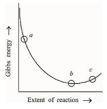
Consider the graph of $G i b b s$ free energy $G$ vs Extent of reaction. The number of statement/s from the following which are true with respect to points $(a), (b)$ and $(c)$ is $.................$

$A.$Reaction is spontaneous at $(a)$ and $(b)$

$B.$Reaction is at equilibrium at point $(b)$ and nonspontaneous at point $(c)$

$C.$Reaction is spontaneous at $(a)$ and nonspontaneous at $(c)$

$D.$Reaction is non-spontaneous at $(a)$ and $(b)$