Question
When fractional distillation method is used ? Explain the method.

Answer

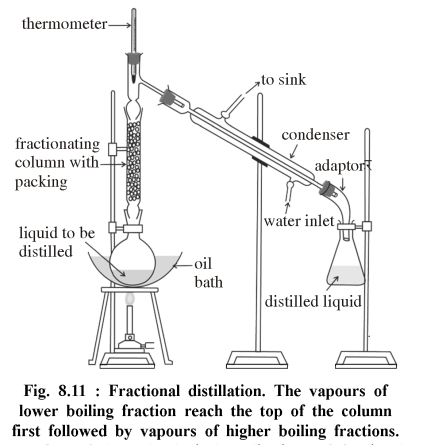
 If the difference in boiling points of two liquids is not much, simple distillation cannot be used to separate them. The vapours of such liquids are formed within the same temperature range and are condensed simultaneously. The technique of fractional distillation is used in such cases. In this technique, vapours of a liquid mixture are passed through a fractionating column before condensation. The fractionating column is fitted over the mouth of the round bottom flask (Fig. 8.11).
Vapours of the liquid with higher boiling point condense before the vapours of the liquid with lower boiling point. The vapours rising up in the fractionating column become richer in more volatile component. By the time the vapours reach to the top of the fractionating column, these are rich in the more volatile component. Fractionating columns are available in various sizes and designs. A fractionating column provides many surfaces for heat exchange between the ascending vapours and the descending condensed liquid. Some of the condensing liquid in the fractionating column obtains heat from the ascending vapours and revaporises. The vapours thus become richer in low boiling component. The vapours of low boiling component ascend to the top of the column. On reaching the top, the vapours become pure in low boiling component and pass through the condenser and the pure liquid is collected in a receiver. After a series of successive distillations, the remaining liquid in the distillation flask gets enriched in high boiling component. Each successive condensation and vaporisation unit in the fractionating column is called a theoretical plate. Commercially, columns with hundreds of plates are available.
ImageOne of the technological applications of fractional distillation is to separate different fractions of crude oil in petroleum industry.
Apart from this, the mixture of benzene (boiling point $80^{\circ} C$ ) and toluene (boiling point $110^{\circ} C$ ) can also be separated by this method and refined spirit formed by mixture of ethyl alcohol and water can be formed by fractional distillation.

Need a full question paper?

Generate a complete, print-ready paper with questions like this in minutes — across 16+ boards, with answer keys.
Start Generating Free

Similar questions

For the equilibrium,
$
2 NOCl(g) \rightleftharpoons 2 NO(g)+Cl_2(g)
$
the value of the equilibrium constant, $K _{ c }$ is $3.75 \times 10^{-6}$ at 1069 K . Calculate the $K _{ p }$ for the reaction at this temperature?
In a container of 5 L volume, in a vessel at 1250 K temperature following reaction takes place :
$
CO(g)+H_2 O(g) \rightleftharpoons CO_2(g)+H_2(g)
$
Initially one-one mole of CO and $H _2 O$ is taken and at equilibrium 0.4 mole $H _2 O$ remains then calculate equilibrium constant.
Name the classes of hydrides to which $\mathrm{H}_2 \mathrm{O}, \mathrm{B}_2 \mathrm{H}_6$ and NaH belong.
Identify the redox reactions out of the following reactions and identify the oxidising and reducing agents in them.
$\text{PCl}_3(\text{l})+3\text{H}_2\text{O}(\text{l})\xrightarrow{ \ \ \ \ \ \ \ \ }3\text{HCl(aq)}+\text{H}_3\text{PO}_3\text{(aq)}$
If one liter solution is made by dissolving 22.4 gm of $C _6 H _5 COOH$ and benzene, find formality of this solution.
Identify (A), (B), (C) and (D) and give their chemical formulae.
$\text{(A)}+\text{NaOH}\xrightarrow{\ \\ \ \ \\ \ \ \\ \ \ }\text{NaCl}+\text{NH}_3+\text{H}_2\text{O}$
$\text{(B)}+\text{NaCl}\xrightarrow{\ \\ \ \ \\ \ \ \\ \ \ }\text{(C)}+\text{NH}_4\text{Cl}$
$\text{(C)}\xrightarrow{\text{Heat}}\text{Na}_2\text{CO}_3+\text{H}_2\text{O}+\text{(D)}$
Name the indicator used in redox titration involving $\mathrm{K}_2 \mathrm{Cr}_2 \mathrm{O}_7$ as an oxidising agent.
Eka-aluminium and eka-silicon were the names given by Mandeleev for the then unknown elements gallium and germanium respectively. A recently discovered element was first named as eka-mercury. What is its atomic number? Write its group number, electronic configuration, IUPAC and official names.
A sample of drinking water was found to be severely contaminated with chloroform, $\mathrm{CHCl}_3$, supposed to be carcinogenic in nature. The level of contamination was 15ppm (by mass).
Express this in percent by mass.
Nucleophiles and electrophiles are reaction intermediates having electron rich and electron deficient centres respectively. Hence, they tend to attack electron deficient and electron rich centres respectively. Classify the following species as electrophiles and nucleophiles.
  1. $\text{H}_3\text{CO}^-$
  2. $\ \ \ \ \ \ \ \ \ \ \ \ \ \text{O}\\\ \ \ \ \ \ \ \ \ \ \ \ \ ||\\\text{H}_3\text{C}-\text{C}-\text{O}^-$
  3. $\ \dot{}\\\text{Cl}$
  4. $\text{Cl}_2\text{C}:$
  5. $(\text{H}_3\text{C})_3\text{C}^+$
  6. $\text{Br}^-$
  7. $\text{H}_3\text{COH}$
  8. $\text{R}-\text{NH}-\text{R}$