Questions

2 Marks Questions

Take a timed test

26 questions · self-marked practice — reveal the answer and mark yourself.

Question 12 Marks
On estimating sulphur by Carius method, 0.5825 gm of $BaSO _4$ is formed from 0.2175 gm of a substance. Find percentage of sulphur in substance.
Answer
Mass of organic compound $=0.2175 g$
Mass of obtained $BaSO _4=0.5825 g$
Molecular mass of $BaSO _4=137+32+64=233 gm$
Hence $233 gm BaSO Ba _4=32 gm$ sulphur.
Hence in $0.5825 gm BaSO _4$, quantity of sulphur
$=\frac{32}{233} \times 0.5825 gm$
Hence $\%$ of sulphur in 0.2175 gm substance
$
=\frac{32 \times 0.5825}{233} \times \frac{100}{0.2175}=36.78
$
View full question & answer
Question 22 Marks
While analyzing an organic compound in Dumas' method, 0.30 grams of organic compound is obtained at 300 K temperature and 756 mm . At pressure 32.4 mm , nitrogen is obtained. Find percentage of nitrogen in compound.
Answer
$\frac{P_1 V_1}{T_1}=\frac{P_2 V_2}{T_2}$
Hence, volume of Nitrogen on S.T.P.
$
\begin{array}{l}
=\frac{P_1 \times V_1}{T_1} \times \frac{273}{760} mm \\
=\frac{756 \times 32.4}{300} \times \frac{273}{760} mm \\
=29.3 mm
\end{array}
$
$\begin{array}{l}\text { % of nitrogen in compound } \\ \qquad \begin{aligned} & =\frac{28}{22400} \times \frac{\text { Volume of } N _2 \text { on STP }}{\text { Weight of compound }} \times 100 \\ \quad & =\frac{28}{22400} \times \frac{29.3}{0.30} \times 100=12.20\end{aligned}\end{array}$
View full question & answer
Question 32 Marks
When fractional distillation method is used ? Explain the method.
Answer
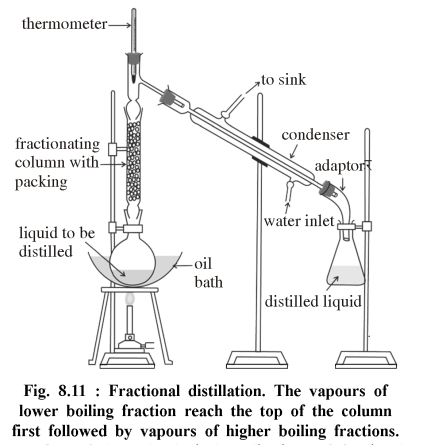
 If the difference in boiling points of two liquids is not much, simple distillation cannot be used to separate them. The vapours of such liquids are formed within the same temperature range and are condensed simultaneously. The technique of fractional distillation is used in such cases. In this technique, vapours of a liquid mixture are passed through a fractionating column before condensation. The fractionating column is fitted over the mouth of the round bottom flask (Fig. 8.11).
Vapours of the liquid with higher boiling point condense before the vapours of the liquid with lower boiling point. The vapours rising up in the fractionating column become richer in more volatile component. By the time the vapours reach to the top of the fractionating column, these are rich in the more volatile component. Fractionating columns are available in various sizes and designs. A fractionating column provides many surfaces for heat exchange between the ascending vapours and the descending condensed liquid. Some of the condensing liquid in the fractionating column obtains heat from the ascending vapours and revaporises. The vapours thus become richer in low boiling component. The vapours of low boiling component ascend to the top of the column. On reaching the top, the vapours become pure in low boiling component and pass through the condenser and the pure liquid is collected in a receiver. After a series of successive distillations, the remaining liquid in the distillation flask gets enriched in high boiling component. Each successive condensation and vaporisation unit in the fractionating column is called a theoretical plate. Commercially, columns with hundreds of plates are available.
ImageOne of the technological applications of fractional distillation is to separate different fractions of crude oil in petroleum industry.
Apart from this, the mixture of benzene (boiling point $80^{\circ} C$ ) and toluene (boiling point $110^{\circ} C$ ) can also be separated by this method and refined spirit formed by mixture of ethyl alcohol and water can be formed by fractional distillation.
View full question & answer
Question 42 Marks
Explain chromatography with diagram.
Answer
Thin layer chromatography : Thin layer chromatography (TLC) consists of separating the components of a mixture on a thin layer of a adsorbent. In this technique, appropriate measurements of glass are placed on a plate of adsorbent (silica gel or alumina). We dry it thinly (approx. 0.2 mm thin). This is called layer chromatography plate. A small dot of the solution of mixture is placed in jar filled with eluent to some 2 cm height (Fig. 8.17). As the temperature of the leachate increases on the plate, the components of the mixture also rise up the plate along with the leachate but their rise varies depending on degree of adsorption. The speed of compound also varies depending on degree of adsorption. The speed of compounds also varies, due to which they get separated. The relative adsorption of different compounds is represented by Retardation factor $\left( R _{ F }\right)$.
The ratio of the distance travelled by a compound in a particular solvent system to the distance travelled by solvent is called retardation coefficient of that compound.
Hence $R _{ F }=\frac{\begin{array}{c}\text { Distance travelled by the compound } \\ \text { from baseline }(x)\end{array}}{\text { Distance travelled by solvent }}+$
or $\quad R _{ F }=\frac{x}{y}$
The $R_F$ value of each compound in a particular solvent system is fixed. Therefore, the compound can be identified if the $R_F$ value is known.
Image
View full question & answer
Question 52 Marks
Write the method of analysis of oxygen in organic compounds.
Answer
The percentage of oxygen in an organic compound is usually found by difference between the total percentage composition (100) and the sum of the percentages of all other elements. However, oxygen can also be estimated directly as follows :
A definite mass of an organic compound is decomposed by heating in a stream of nitrogen gas. The mixture of gaseous products containing oxygen is
passed over red-hot coke when all the oxygen is converted to carbon monoxide. This mixture is passed through warm iodine pentoxide $\left( I _2 O _5\right)$ when carbon monoxide is oxidised to carbon dioxide producing iodine.
$\begin{array}{l}
\left.2 C+O_2 \xrightarrow{1373 K} 2 CO\right] \times 5......(i) \\
\left.I_2 O_5+5 CO \longrightarrow I_2+5 CO_2\right] \times 2.......(ii)
\end{array}$
On making the amount of CO produced in equation
(i) equal to the amount of CO used in equation (ii) by multiplying the equations (i) and (ii) by 5 and 2 respectively; we find that each mole of oxygen liberated from the compound will produce two moles of carbon dioxide. Thus 88 g carbon dioxide is obtained if 32 g oxygen is liberated.
Calculation :
Let the mass of organic compound taken be mg Mass of carbon dioxide produced be $m _1 g$
$\therefore m _1 g$ carbon dioxide is obtained from $\frac{32 \times m _1}{88} g O _2$
$\therefore$ Percentage of oxygen $=\frac{32 \times m _1 \times 100}{88 \times m } \%$
View full question & answer
Question 62 Marks
How the phosphorus is analysed in organic compound? Explain.
Answer
For the estimation of phosphorus. When the quantity of organic compound is heated with fumed nitric acid, the phosphorus present in it gets oxidized into phosphoric acid $\left( H _3 PO _4\right)$. On adding ammonia and ammonium molybdate solution, a precipitate of ammonium phosphomolybdate $\left[\left( NH _4\right)_3 PO _4 \cdot 12 MoO _3\right]$ is obtained or by adding magnesia mixture to phosphoric acid it is precipitated in form of $MgNH _4 PO _4$, on the combustion of which $Mg _2 P _2 O _7$ is obtained.
Let the mass of organic compound $= m _1 g$ and the mass of ammonium phosphomolybdate is $m _1 g$. Molar mass of $\left( NH _4\right)_3 PO _4 \cdot 12 MoO _3=1877 gm$
Hence $\%$ of phosphorus $=\frac{31 \times m _1 \times 100}{1877 \times m } \%$
When phosphorus is analysed in form of $Mg _2 P _2 O _7$,
then $\%$ of phosphorus $=\frac{62 \times m_1 \times 100}{222 \times m}$
Here mass of $Mg _2 P _2 O _7=222 u$
Mass of organic compound $= m _1 g$
Mass of formed $Mg _2 P _2 O _7= m$, and mass of two phosphorus atoms in $Mg _2 P _2 O _7$ is 62 .
View full question & answer
Question 72 Marks
Give the method to detect sulphur in organic compound and how it is detected when nitrogen and sulphur both are present in compound.
Answer
Test of Sulphur : The test of sulphur is done by following processes :
(i) Formation of black precipitate on adding lead acetate $\left[\left( CH _3 COO \right)_2 Pb\right]$ solution by acidifying Lassaigne's solution with acetic acid determines the presence of sulphur.
$Na _2 S+\left( CH _3 COO \right)_2 Pb \longrightarrow \underset{\begin{array}{c}\text { Lead sulphide } \\ \text { (Black ppt) }\end{array}}{ PbS +2 CH _3 COONa }$
(ii) When Lassaigne's solution react with sodium nitroprusside solution, violet colour appears which confirms the presence of sulphur.
$Na _2 S+ \underset{\text{Sodium nitroprusside}}{Na _2\left[ Fe ( CN )_5 NO \right]} \longrightarrow \underset{\text{Violet colour}}{Na _4\left[ Fe ( CN )_5 NOS \right]}$
(iii) When nitrogen and sulphur both elements are present in Lassaigne's solution, then sodium thiocyane is formed which on heating with dil HCl and acidic $FeCl _3$ solution blood red colour is obtained.
$\begin{aligned} Na + C + N + S \longrightarrow & NaCNS \\ 3 NaCNS + FeCl _3 \longrightarrow & {[ Fe ( CNS )]_3+3 NaCl } \\ \begin{array}{l}\text { Sodium } \\ \text { thiocyanate }\end{array} & \begin{array}{l}\text { Red colour } \\ \text { (Ferric thiocyanate) }\end{array}\end{aligned}$
If Lassaigne's solution is formed in excess of sodium then thiocyanate decomposes to cyanide and sulphide ions and these ion gives general test.
$NaCNS+2 Na \longrightarrow NaCN+Na_2 S$
View full question & answer
Question 82 Marks
How will you test for phosphorus in any organic compound?
Answer
When organic compound is heated with sodium peroxide (oxidant), then the phosphorus present in compound, convert to phosphate. Then the solution is boiled in $HNO _3$, ammonium molybdate solution is added from which yellow solution or precipitate is obtained, which confirms the presence of phosphorus.
View full question & answer
Question 92 Marks
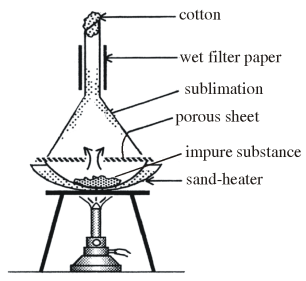
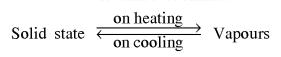
What do you meant by sublimation?
View full question & answer
Question 102 Marks
What do you meant by hyperconjugation? Explain it and explain hyperconjugation in ethyl carbocation.
Answer
In hyperconjugation, resonance of $\sigma$ bond exist. Hence it is also known as $\sigma$ bond resonance. In this delocalization of electrons occurs in $C - H$ bond of the alkyl group directly bonded to the atom of an unsaturated system or the atom having unshared orbital. Therefore, the $\sigma$ electrons of $C - H$ bond of alkyl group show partial conjugation with the adjacent unsaturated body or unshared orbital. It is a permanent effect.
In ethyl carbocation following structures are obtained by hyperconjugation :
Image
View full question & answer
Question 112 Marks
What is free radical? Explain and state the stability strength for free alkyl radicals.
Answer
Those neutral intermediate species (atoms or groups) which have odd number of electrons are called free radicals. They are formed by homolytic cleavage and are unstable and reactive. They have unpaired electrons. The stability order of alkyl free radicals are as :
Image
View full question & answer
Question 122 Marks
(a) In following pair of compounds which isomers exist :
(i) Butanoic acid and 2-Methylpropanoic acid
(ii) pent-1-yne and 3-methyl but-1-yne
(b) Draw the chain isomerism of following compounds :
(i) 2-Bromobutane
(ii) Pent-1-ene
View full question & answer
Question 132 Marks
Give an example of position isomer of aromatic compounds.
Answer
Ortho, meta and para-chlorophenols are position isomers of each other in which the position of chlorine is different.
Image
View full question & answer
Question 142 Marks
How many possible carboxylic acid isomers of molecular formula $C _5 H _{10} O _2$ exist?
Answer
Three carboxylic acid isomers of molecular formula $C _5 H _{10} O _2$ is possible :
Image
View full question & answer
Question 152 Marks
What do you meant by isomerism? Classify it.
Answer
Two or more compounds having same molecular formula but possess different properties, are known as isomers and this property is known as isomerism. It can be classified as :
Image
View full question & answer
Question 162 Marks
Give the possible alkyl alcohols of molecular formula $C _4 H _{10}$.
Answer
Molecular formula $C _4 H _{10}$ have four alkyl alcohols (alkanols) which are as follows:
Image
View full question & answer
Question 172 Marks
Give the possible alkyne isomers of molecular formula of $C _5 H _8$.
Answer
Molecular formula $C _5 H _8$ have three alkyne isomers which are as follows :
Image
View full question & answer
Question 192 Marks
How the 3-D formula of any organic compound is donated? Explain.
Answer
Some conventions are used to show 3D formulas of organic compounds on paper.
Examples : To see a 2D-structure in a 3Dstructure, the solid and dash wedge formula is used. In 3D-formulas solid wedge represents the bond which is projected from the plane of paper towards the viewer and dashed wedge represents the bond going in the opposite direction, i.e. away from the viewer. The bond located in the plane of the paper is represented by simple line (-). The 3D-formula of methane molecule is shown as :
Image
View full question & answer
Question 212 Marks
Write the IUPAC name of following condensed formulas :
(i) $\left( CH _2 COBr \right)_2 CH \left( CH _3\right)$
(ii) $\left( CH _3\right)_2 CHCOCH _2- CH \left( C _2 H _5\right)_2$
(iii) $C H _3- CH ( CHO )- CH \left( CH _3\right) CH _2 C H O$
(iv) $CH _2( OH ) CH ( Cl ) CH _2 COOH$
View full question & answer
Question 222 Marks
Write the IUPAC name of the following compounds :
Image
Answer
(i) 3-ethylpent-1-en-4-yne
(ii) 3-ethylhexa-2, 4-diene
(iii) 3-methylhexa-1, 4-diyne
(iv) 3-isopropyl hex-4-en-1-yne
View full question & answer
Question 232 Marks
Write IUPAC name of following compounds :
(i) 1, 3-diethyl-2, 3-dimethylbutane
(ii) 2-ethyl-3-isobutylpentane
(iii) 2, 5-diisopropylhexane
(iv) 1, 1-dimethyl-2, 2-diethylpropane
View full question & answer
Question 242 Marks
Write the name of following compounds using derive system :
Image
Answer
(i) Isopropyl carbinol
(ii) t-butyl-n-propyl acetic acid
(iii) Triethyl acetaldehyde
(iv) Ethylmethyl ethelene
View full question & answer
Question 252 Marks
Write the structural formula of following compounds :
(i) Neopentyl isocyanide
(ii) Isopentyl alcohol
(iii) Ethylisopropyl ketone
(iv) Isopropyl methyl acetylene
View full question & answer
Question 262 Marks
What do you meant by homologous series? Explain with example.
Answer
The series of organic compound in which a specific functional group is present and the chemical properties of all compounds are same and these molecular formula have difference of $> CH _2$ are known as homologous series and the members of this series are homologue of each other.
Image
View full question & answer