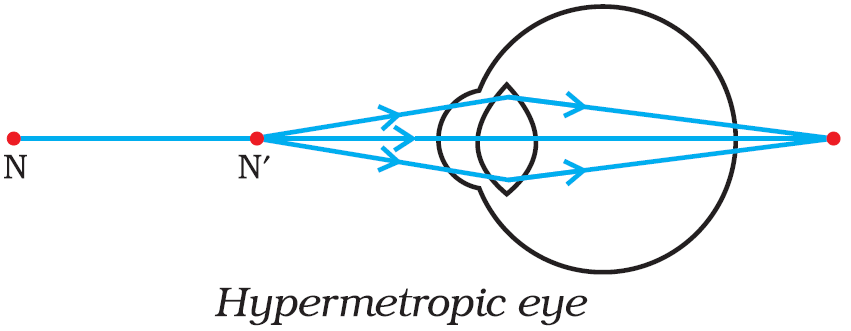
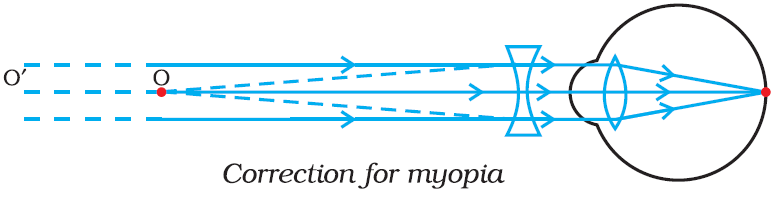
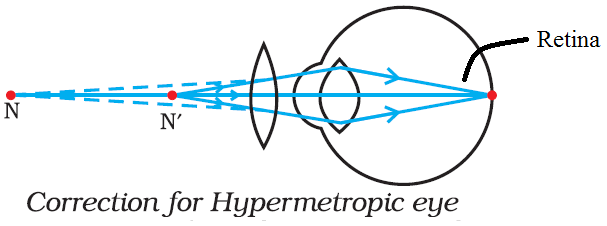
Question
When do we consider a person to be myopic or hypermetropic? Explain using diagrams how the defects associated with myopic and hypermetropic eye can be corrected?

Need a full question paper?

Generate a complete, print-ready paper with questions like this in minutes — across 16+ boards, with answer keys.

Start Generating Free

Similar questions

A 2kW heater, a 200W TV and three 100W lamps are all switched on from 6m. to 10p.m. What is the total cost at Rs.5.50per kWh?
What is a solenoid? Draw the pattern of magnetic field lines of:
  1. A current carrying solenoid.
  2. A bar magnet. List two distinguishing features between the two fields.
How can we explain the reddish appearance of sun at sunrise or sunset? Why does it not appear red at noon?
  1. Define focal length of a spherical lens.
  2. A divergent lens has a focal length of 30 cm. At what distance should an object of height 5 cm from the optical centre of the lens be placed so that its image is formed 15 cm away from the lens? Find the size of the image also.
  3. Draw a ray diagram to show the formation of image in the above situation.
  1. One-half of a convex lens is covered with a black paper. Will such a lens produce an image of the complete object? Support your answer with a ray diagram.
  2. An object 5 cm high is held 25 cm away from a converging lens of focal length 10 cm.
  1. Draw the ray diagram.
  2. Calculate the position and size of the image formed.
  3. What is the nature of the image?
a. List four characteristics of the image formed by a convex lens when an object is placed between its optical centre and principal focus.
b. Size of the image of an object by a concave lens of focal length 20 cm is observed to be reduced to $\frac{1}{3} \mathrm{rd}$ of its size. Find the distance of the object from the lens.
  1. What is a solenoid? Draw a sketch of the pattern of field lines of the magnetic field through and around a current carrying solenoid.
  2. Consider a circular loop of wire lying in the plane of the table. Let the current pass through the loop clockwise. Apply the right hand rule to find out the direction of the magnetic field inside and outside the loop.
How can three resistors of resistances 2 Ω, 3 Ω, and 6 Ω be connected to give a total resistance of (a) 4 Ω, (b) 1 Ω?
  1. With the help of a suitable circuit diagram prove that the reciprocal of the equivalent resistance of a group of resistances joined in parallel is equal to the sum of the reciprocals of the individual resistances.
  2. In an electric circuit, two resistors of $12\Omega$ each are joined in parallel to a 6V battery. Find the current drawn from the battery.
  1. What is meant by saying that the potential difference between two points is 1 volt? Name a device that helps to measure the potential difference across a conductor.
  2. Why does the connecting cord of an electric heater not glow hot while the heating element does?
  3. Electrical resistivities of some substances at $20^{0}\text{C}$ are given below:
Silver $1.60\times10^{-8} \Omega \text{ m}$
Copper $1.62\times10^{-8} \Omega \text{ m}$
Tungsten $5.20\times10^{-8} \Omega \text{ m}$
Iron $10.0\times10^{-8} \Omega \text{ m}$
Mercury $94.0\times10^{-8} \Omega \text{ m}$
Nichrome $100\times10^{-6} \Omega \text{ m}$

Answer the following questions in relation to them:
  1. Among silver and copper, which one is a better conductor? Why?
  2. Which material would you advise to be used in electrical heating devices? Why?