Question
When do we consider a person to be myopic or hypermetropic? Explain using diagrams how the defects associated with myopic and hypermetropic eye can be corrected?

Answer

When a person is unable to clearly see distant objects, he is considered a myopic person. Such a person is suffering from myopia. This happens when image is formed in front of the retina. When a person is unable to clearly see a nearby object, he is considered a hypermetropic person. Such a person is suffering from hypermetropia. This happen when image is formed behind the retina.
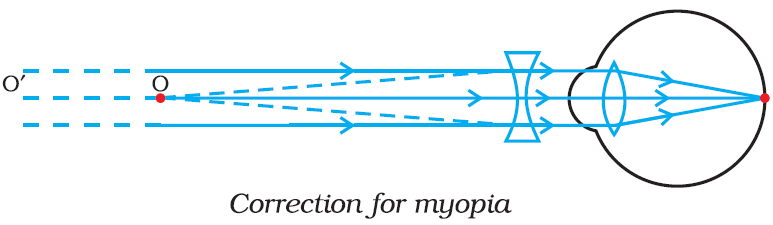
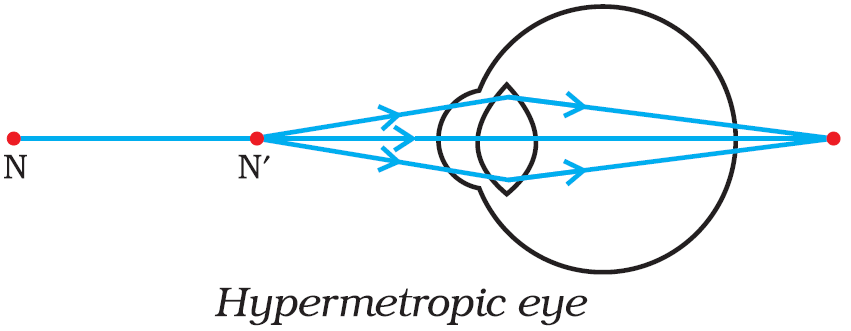
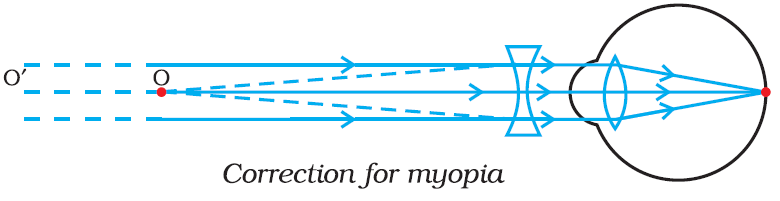
Correction of Myopia: A person suffering from myopia needs to use a concave lens of suitable focal length. The concave lens diverges the rays coming from infinity. After refraction from the concave lens, the rays appear to be coming from the far point of this person’s eye. Due to this, a clear image of distant object is made on the retina of that person. That is how a myopic person is able to clearly see distant objects; with the help of suitable concave lens.
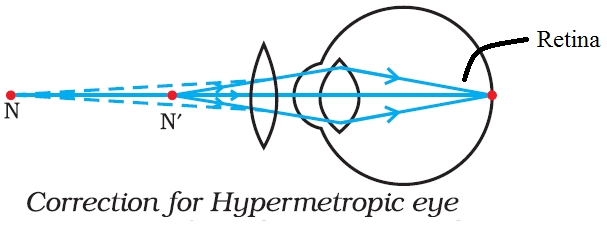
Correction of Hypermetropia: A hypermetropic person needs to use a convex lens of suitable focal length. The convex lens converges the light rays coming from a nearby object. As a result, these light rays appear to be coming from the near point of this person’s eyes. Due to this, a clear image of nearby object is made on the retina of that person. That is how a hypermetropic person is able to clearly see nearby objects; with the help of suitable convex lens.
Need a full question paper?

Generate a complete, print-ready paper with questions like this in minutes — across 16+ boards, with answer keys.

Start Generating Free

Similar questions

How do Mendel’s experiments show that.
  1. Traits may be dominant or recessive?
  2. Inheritance of two traits is independent of each other?
Evolution has exhibited a greater stability of molecular structure when compared with morphological structures. Comment on the statement and justify your opinion.
Construct ray diagrams to illustrate the formation of a virtual image using:
  1. A converging lens, and.
  2. A diverging lens.
Explain the cleansing action of soap. Draw diagrams to illustrate your answer.
A liquid X of colour Y circulates in the human body only in one direction: from body tissues to the heart. Among other things, liquid X contains germs from cells and dead cells. The liquid X is cleaned of germs and dead cells by a special type of white blood cells called Z. This cleaned liquid is then put into blood circulatory system in subclavian veins.
  1. What is (i) liquid X and (ii) colour Y?
  2. What are Z.
  3. The liquid X is somewhat similar to a component of blood. Name this component.
  4. Why is liquid X not red?
Explain the mechanism of photosynthesis.
How are fats digested in our bodies? Where does this process take place?
The liquid connective tissue A circulates in our body continuously without stopping. This tissue contains a pigment B which imparts it a colour C. The tissue A consists of four components D, E, F and G. The component D fights infection and protects us from diseases. The component E helps in the clotting of tissue A if a person gets a cut. The component F is a liquid which consists mainly of water with many substances dissolved in it and component G carries oxygen from the lungs to all the parts of the body.
  1. What is (i) tissue A, (ii) pigment B and (iii) colour C?
  2. Name (i) D, (ii) E, (iii) F and (iv) G.
  3. Name one substance (other than oxygen) which is transported by tissue A in the human body.
  4. Which two components of tissue A are the cells without nucleus?
  5. Name any two organisms (animals) which do not have liquid like A in their body.
A student wants to project the image of a candle flame on the walls of school laboratory by using a lens:
  1. Which type of lens should he use and why?
  2. At what distance in terms of focal length ‘f’ of the lens should he place the candle flame so as to get.
  1. A magnified.
  2. A diminished image respectively on the wall?
  1. Draw ray diagram to show the formation of the image each case.
Define magnetic field lines. Describe an activity to draw a magnetic field line outside a bar magnet from one pole to another pole.