Question
When do we consider a person to be myopic or hypermetropic? Explain using diagrams how the defects associated with myopic and hypermetropic eye can be corrected?

Answer


When a person is unable to clearly see distant objects, he is considered a myopic person. Such a person is suffering from myopia. This happens when image is formed in front of the retina.
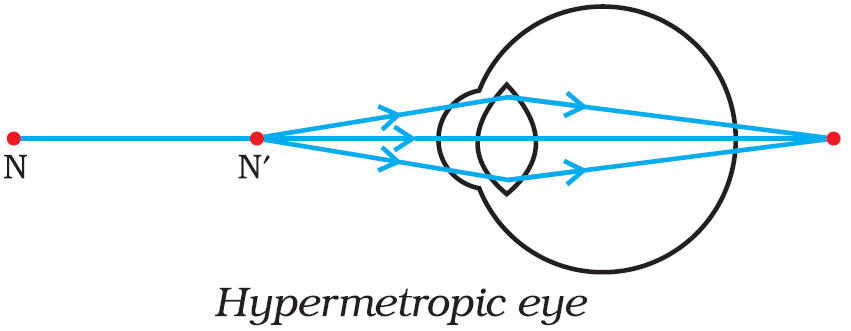
When a person is unable to clearly see a nearby object, he is considered a hypermetropic person. Such a person is suffering from hypermetropia. This happen when image is formed behind the retina.
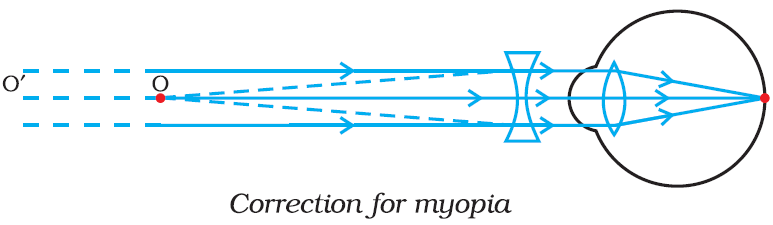
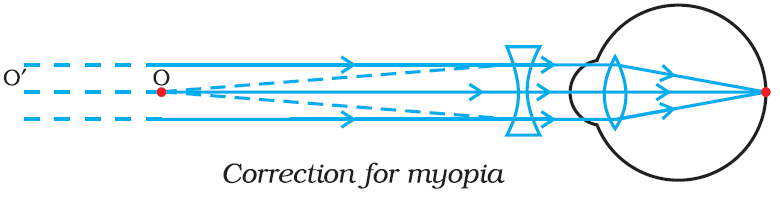
Correction of Myopia: A person suffering from myopia needs to use a concave lens of suitable focal length. The concave lens diverges the rays coming from infinity. After refraction from the concave lens, the rays appear to be coming from the far point of this person’s eye. Due to this, a clear image of distant object is made on the retina of that person. That is how a myopic person is able to clearly see distant objects; with the help of suitable concave lens.
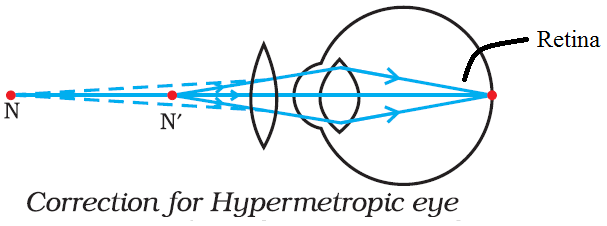
Correction of Hypermetropia: A hypermetropic person needs to use a convex lens of suitable focal length. The convex lens converges the light rays coming from a nearby object. As a result, these light rays appear to be coming from the near point of this person’s eyes. Due to this, a clear image of nearby object is made on the retina of that person. That is how a hypermetropic person is able to clearly see nearby objects; with the help of suitable convex lens.
Need a full question paper?

Generate a complete, print-ready paper with questions like this in minutes — across 16+ boards, with answer keys.

Start Generating Free

Similar questions

Give your view point about the conservation of natural resources.
Explain the following terms related to spherical lenses:
  1. Centres of curvature.
  2. Principal axis.
  3. Optical centre.
  4. Principal focus.
At what distance from a concave lens of focal length 20 cm, should a 6 cm tall object be placed so that it forms an image at 15 cm from the lens? Also determine the size of the image formed.
Write laws of refraction. Explain the same with the help of ray diagram, when a ray of light passes through a rectangular glass slab.
  1. State two properties of carbon which lead to a very large number of carbon compounds.
  2. Why does micelle formation take place when soap is added to water? Why are micelles not formed when soap is added to ethanol?

Image
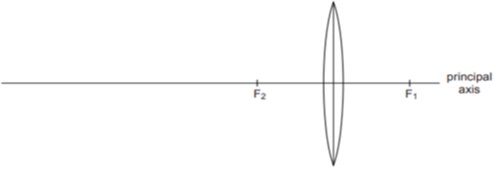
The above image shows a thin lens of focal length $5 m$.
(i) What is the kind of lens shown in the above figure?
(ii) If a real inverted image is to be formed by this lens at a distance of $7 m$ from the pole, then show with calculation where should the object be placed?
(iii) Draw a neatly labelled diagram of the image formation mentioned in (ii)

  1. Suggest an explanation for the fact that the chemicals produced by endocrine glands arc usually in the form of small molecules.
  2. Write any three endocrine glands and chemically produced by them.
What are carboxylic acids? Give the common names, IUPAC names and structural formula of first four members of the homologous series.
There are four tiny organisms A, B, C and D. The organism A is a parasitic protozoan which causes a disease known as kala-azar. The organism B is a microscopic single-celled animal which causes malaria disease in human beings. The organism C is a unicellular animal which can change its body shape according to need, it has no fixed shape. The organism D is also a unicellular animal which is slipper-shaped having a large number of tiny hair all around its body.
  1. Name the organisms A, B, C and D.
  2. Name one characteristic body feature of organism A.
  3. Name the insect which carries organism B and transmits it from one person to another.
  4. What name is given to the asexual method of reproduction of (i) organism A, and (ii) organism B?
  5. Where do organisms C and D live?
Describe the structure of diamond. Draw a simple diagram to show the arrangement of carbon atoms in diamond.
With the help of a labelled circuit diagram illustrate the pattern of field lines of the magnetic field around a current carrying straight long conducting wire. How is the right hand thumb rule useful to find direction of magnetic field associated with a current carrying conductor?