Question
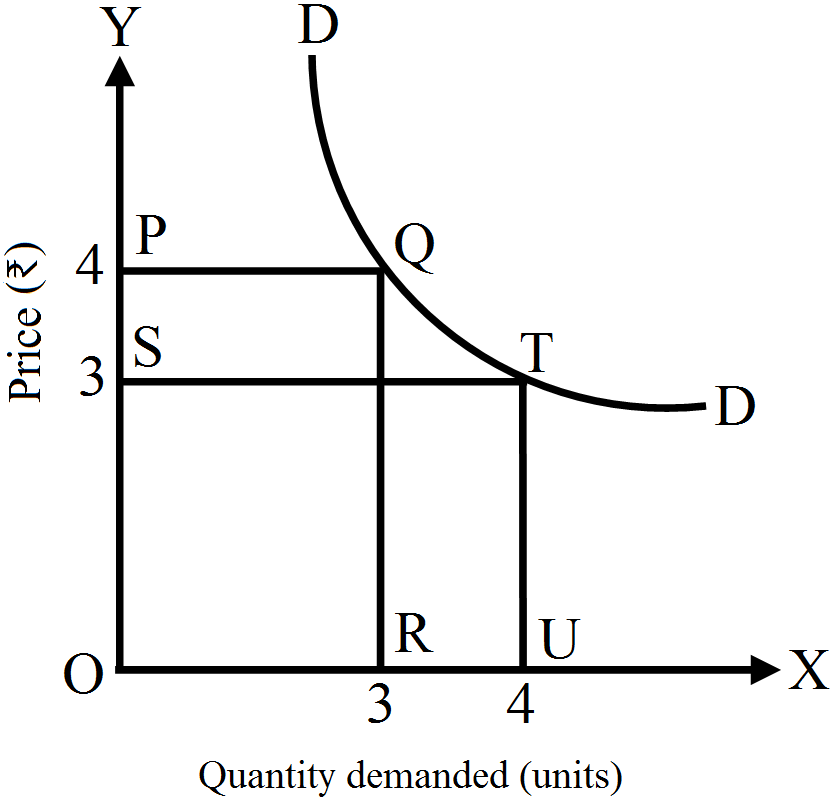
When does a demand curve take the shape of a rectangular hyperbola?
Answer

If the equation of a demand curve takes the form pq = e, where e is constant, irrespective of the values of p and q, then the demand curve that we get is a rectangular hyper- bola, implying that on each and every point on the curve, the area underlying is the same. In the graph depicted above, point Q on the demand curve corresponds to area enclosed by rectangle OPOR which is 12 units [OP × OR = 4 × 3] Also, point T on the demand curve corresponds to area enclosed by rectangle OSTU which is again 12 units (OS× OU = 3 × 4). Therefore, demand curve DD is a rectangular hyperbola.

Need a full question paper?

Generate a complete, print-ready paper with questions like this in minutes — across 16+ boards, with answer keys.

Start Generating Free

Similar questions

Explain with the help of a diagram, how equilibrium level of income in an economy is determined by saving and investment curves? Will there always be full employment at equilibrium level of income?
How is equilibrium price of commodity determined? What happens if the market price is more than the equilibrium price?
Assuming that no resource is equally efficient in production of all goods, name the curve which shows production potential of the economy. Explain, giving reasons, its properties.
Are the following a part of a country's 'net domestic product at market price'? Explain:
  1. Net indirect taxes.
  2. Net exports.
  3. Net factor income from abroad.
  4. Consumption of fixed capital.
Explain the effect of the following on demand for a good:
  1. Rise in income.
  2. Rise in prices of related goods.
If the demand curve of a commodity shifts to the right and the supply curve shifts to the left, what will be the effect on equilibrium price and quantity? Illustrate with a diagram.
What are the alternative definitions of money supply in India?
How is S and I approach derived from AD and AS approach of income determination. Use diagram.
In an economy S = - 50 + 0.5 Y is the saving function (where S = saving and Y = national income) and investment expenditure is 7000. Calculate:
  1. Equilibrium level of national income.
  2. Consumption expenditure at equilibrium level of national income.
Explain the equilibrium level of income with the help of saving and investment curves. If savings exceed planned investment, what changes will bring about the equality between them?

OR

Explain with the help of a diagram and using Saving = Investment approach the determination of equilibrium output and income level in an economy. What happens when the economy is not in equilibrium and saving exceeds investment?