Question
 A magnetic field can be produced by moving, charges or electric currents. The basic equation governing the magnetic field due to a current distribution is the Biot-Savart law. Finding the magnetic field resulting from a current distribution involves the vector product, and is inherently a calculas problem when the distance from the current to the field point is continuously changing. According to this law, the magnetic field at a point due to a current element of length $\text{d}\vec{\text{I}}$ carrying current I, at a distance r from the element is $\text{dB}=\frac{\mu_0}{4\pi}\frac{\text{I}(\text{d}{\vec{\text{I}}\times\vec{\text{r}}})}{\text{r}^3}$

Biot-Savart law has certain similarities as well as difference with Coloumb's law for electrostatic field e.g., there is an angle dependence in Biot-Savart law which is not present in electrostatic case.

  1. The direction of magnetic field $\text{d}\vec{\text{B}}$ due to a current element $\text{Id}\vec{\text{l}}$ at a point of distance $\vec{\text{r}}$ from it, when a current I passes through a long conductor is in the direction
  1. Of position vector $\vec{\text{r}}$ of the point.
  2. Of current element $\text{Id}\vec{\text{l}}$
  3. Perpendicular to both $\text{d}\vec{\text{l}}$ and $\vec{\text{r}}$
  4. Perpendicular to $\text{d}\vec{\text{l}}$ only.
  1. The magnetic field due to a current in a straight wire segment of length Lat a point on its perpendicular bisector at a distance r (r >> L)
  1. Decreases as $\frac{1}{\text{r}}$

  2. Decreases as $\frac{1}{\text{r}^2}$

  3. Decreases as $\frac{1}{\text{r}^3}$

  4. approaches a finite limit as $\text{r}\rightarrow\infty$
  1. Two long straight wires are set parallel to each other. Each carries a current i in the same direction and the separation between them is 2r. The intensity of the magnetic field midway between them is:
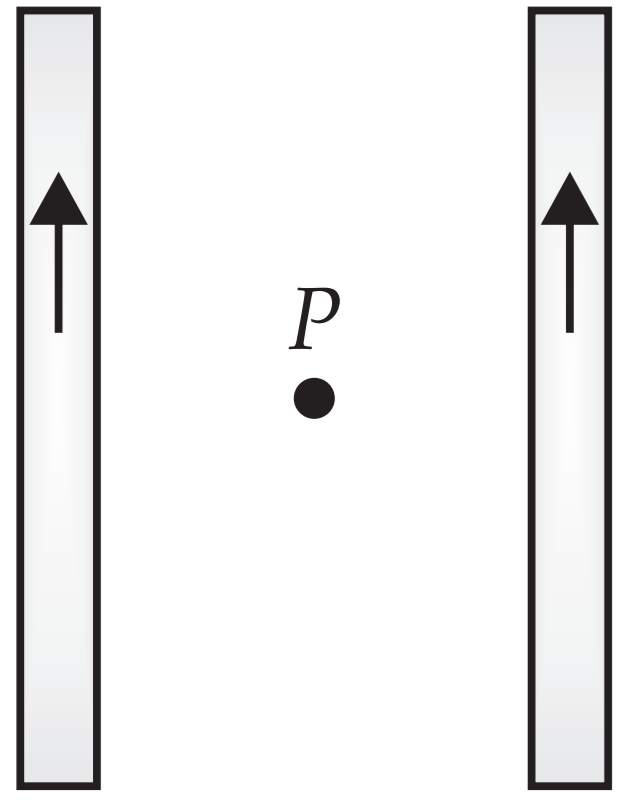
  1. $\mu_0\frac{\text{i}}{\text{r}}$

  2. $4\mu_0\frac{\text{i}}{\text{r}}$

  3. $\text{Zero}$

  4. $\mu_0\frac{\text{i}}{\text{4r}}$

  1. A long straight wire carries a current along the z-axis for any two points in the x - y plane. Which of the following is always false?
  1. The magnetic fields are equal.
  2. The directions of the magnetic fields are the same.
  3. The magnitudes of the magnetic fields are equal.
  4. The field at one point is opposite to that at the other point.
  1. Biot-Savart law can be expressed alternatively as:
  1. Coulomb's Law.
  2. Ampere's circuital law.
  3. Ohm's Law.
  4. Gauss's Law. 

Answer

  1. (c) Perpendicular to both $\text{d}\vec{\text{l}}$ and $\vec{\text{r}}$

Explanation:

According to Biot-Savart's law, the magnetic induction due to a current element is given by,

$\text{d}\vec{\text{B}}=\frac{\mu_0}{4\pi}\frac{\text{Id}\vec{\text{l}\times\text{r}}}{\text{r}^3}$

This is perpendicular to both $\text{d}\vec{\text{l}}$ and $\vec{\text{r}}.$

  1. (b) Decreases as

Explanation:

From Biot-savart's law, $\text{dB}=\frac{\mu_0}{4\pi}\frac{\text{Idl}}{\text{r}^2}\text{i.e. dB}\propto\frac{1}{\text{r}^2}$

  1. (c) $\text{Zero}$

Explanation:

$\text{B}=\frac{\mu_0}{2\pi}.\frac{\text{i}}{\text{r}}-\frac{\mu_0}{2\pi}.\frac{\text{i}}{\text{r}}=0$

  1. (a) The magnetic fields are equal.
  1. (b) Ampere's circuital law.

Explanation:

Biot-Savart law can be expressed alternatively as Ampere circuital law.

Need a full question paper?

Generate a complete, print-ready paper with questions like this in minutes — across 16+ boards, with answer keys.

Start Generating Free

Similar questions

A uniform magnetic field of 0.20 × 10-3 T exists in the space. Find the change in the magnetic scalar potential as one moves through 50cm along the field.

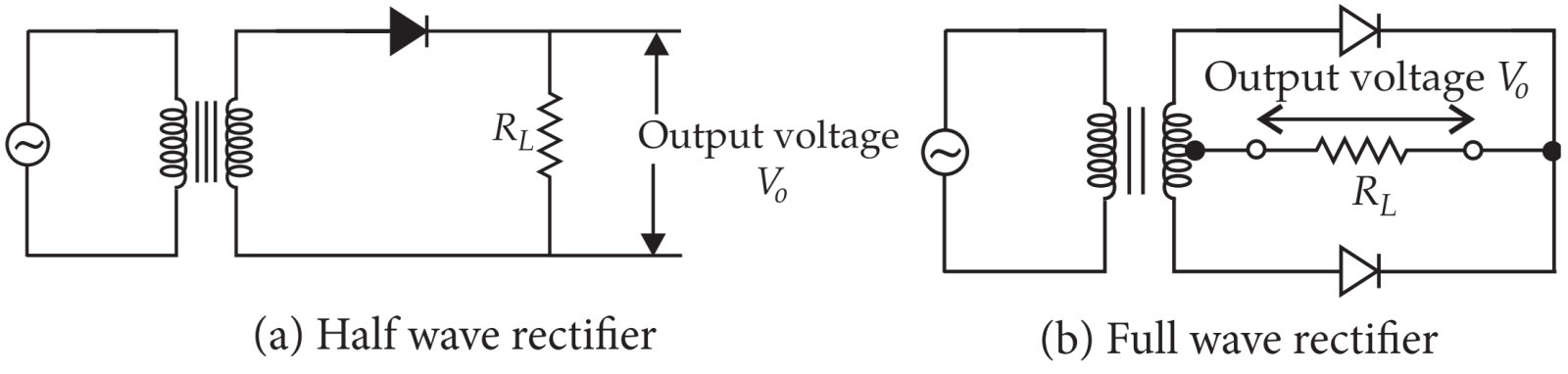
Rectifier is a device which is used for converting alternating current or voltage into direct current or voltage. Its working is based on the fact that the resistance of p-n junction becomes low when forward biased and becomes high when reverse biased. A half-wave rectifier uses only a single diode while a full wave rectifier uses two diodes as shown in figures (a) and (b).

  1. If the rms value of sinusoidal input to a full wave rectifier is $\frac{\text{V}_0}{\sqrt{2}}$ then the rms value of the rectifier's output is:
  1. $\frac{\text{V}_0}{\sqrt{2}}$

  2. $\frac{\text{V}_0^2}{\sqrt{2}}$

  3. $\frac{\text{V}_0^2}{2}$

  4. $\sqrt{2}\text{V}_0^2$

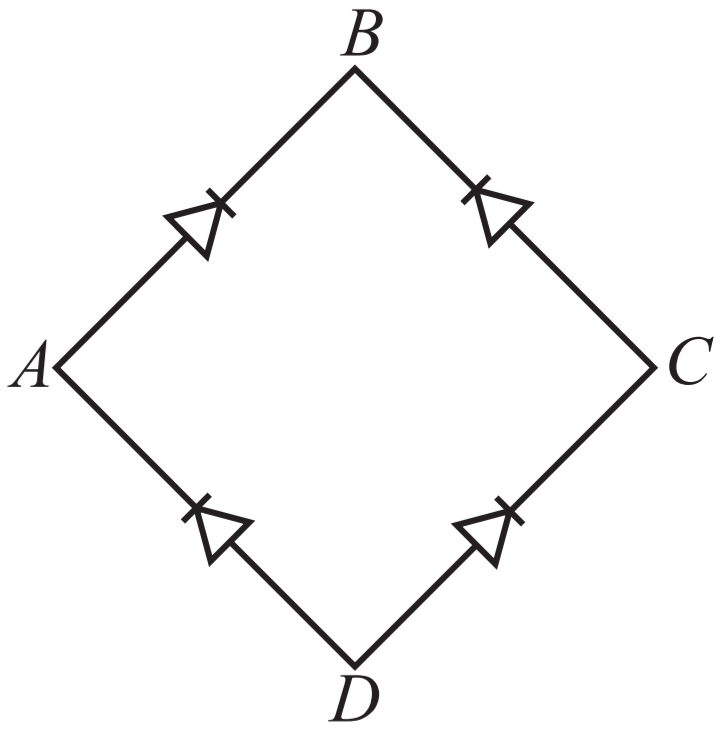
  1. In the diagram, the input ac is across the terminals A and C. The output across B and D is:

  1. Same as the input.
  2. Half wave rectified.
  3. Zero.
  4. Full wave rectified.
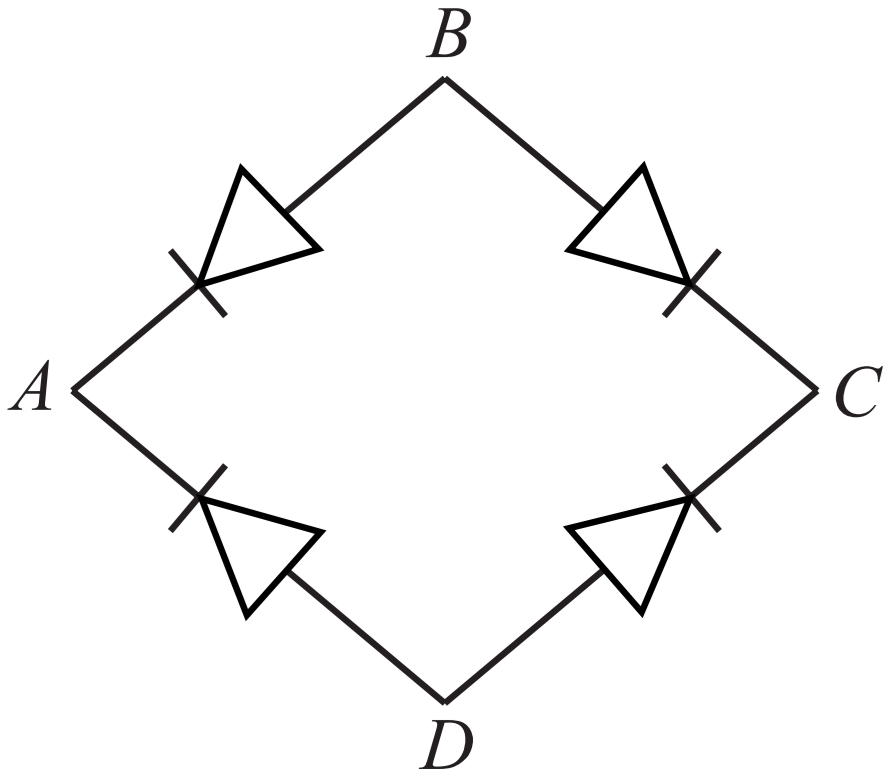
  1. A bridge rectifier is shown in figure. Alternating input is given across A and C. If output is taken across BD, then it is:

  1. Zero.
  2. Same as input.
  3. Half wave rectified.
  4. Full wave rectified.
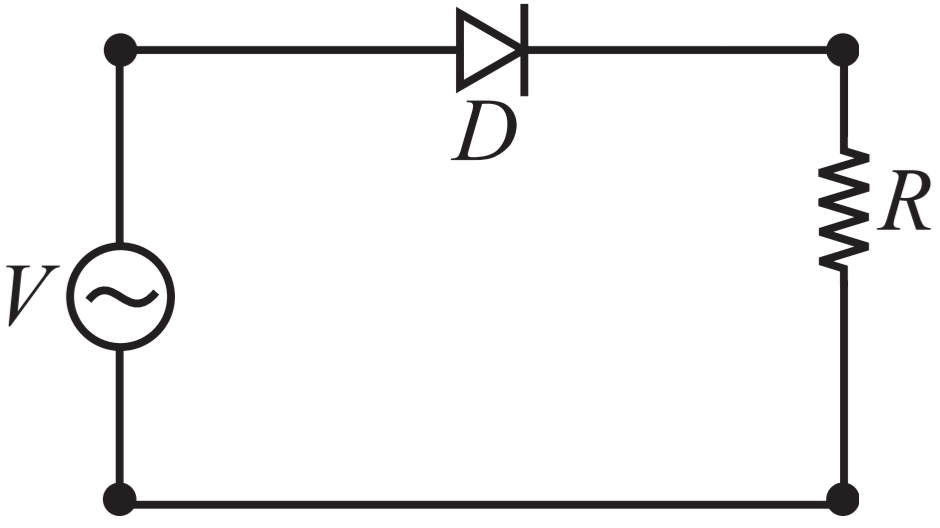
  1. A p-n junction (D) shown in the figure can act as a rectifier. An alternating current source (V) is connected in the circuit. The current (I) in the resistor (R) can be shown by:

  1. With an ac input from 50Hz power line, the ripple frequency is:
  1. 50Hz in the de output of half wave as well as full wave rectifier.
  2. 100Hz in the de output of half wave as well as full wave rectifier.
  3. 50Hz in the de output of half wave and I 00Hz in de output of full wave rectifier.
  4. 100Hz in the de output of half wave and 50Hz in the de output of full wave rectifier.
A bird while flying takes a left turn, where does it get the centripetal force from?
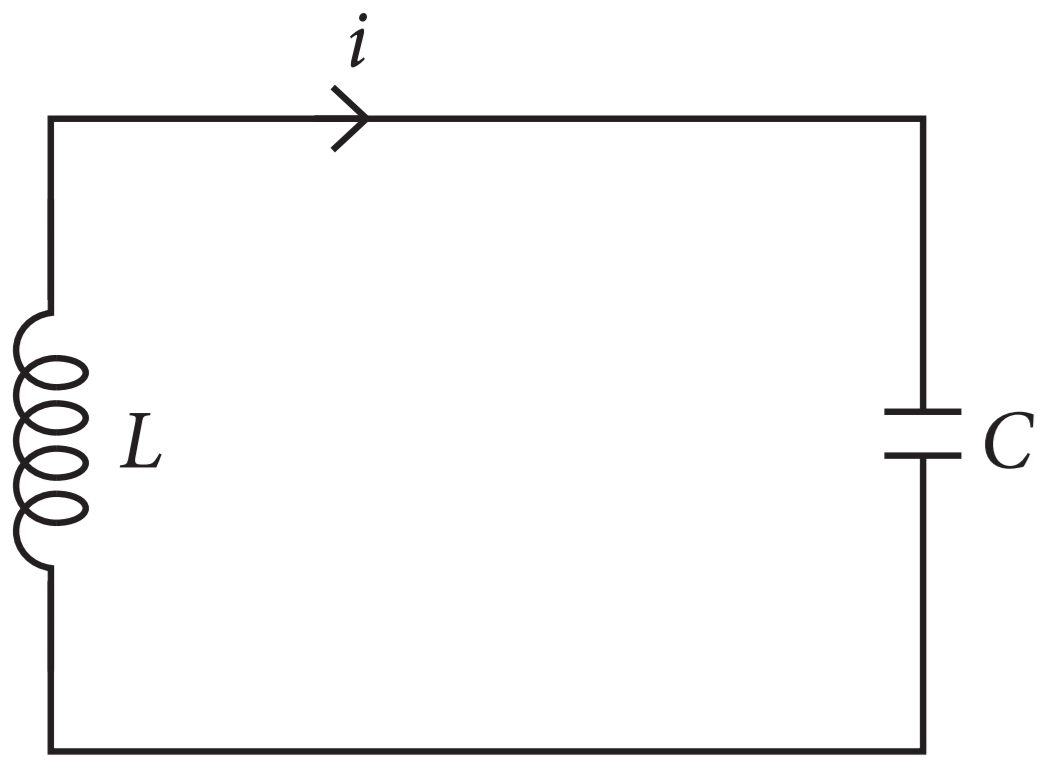
An LC circuit also called a resonant circuit, tank circuit or tuned circuit is an electric circuit consisting of an inductor represented by the letter Land a capacitor, represented by the letter C connected together. An LC circuit is an idealized model since it assumes there is no dissipation of energy due to resistance. An LC circuit contains a 20mH inductor and a $50\mu\text{F}$ capacitor with an initial charge of 10mC. The resistance of the circuit is negligible. Let the instant the circuit is closed bet = 0.

  1. The total energy stored initially is:
  1. 5J
  2. 3J
  3. 10J
  4. 1J
  1. The natural frequency of the circuit is:
  1. 159.24Hz
  2. 200.12Hz
  3. 110.25Hz
  4. 95Hz
  1. At what time is the energy stored completely electrical?
  1. $0, 5\text{T}, 9\text{T}$
  2. $0,\text{T}, 2\text{T}, 3\text{T}$
  3. $\frac{\text{T}}{2},\frac{\text{5T}}{2},\frac{\text{9T}}{2}$
  4. $0,\frac{\text{T}}{2},{\text{T}},\frac{\text{3T}}{2}$
  1. At what time is the energy stored completely magnetic?
  1. $\frac{\text{T}}{2},\frac{\text{3T}}{2},\frac{\text{T}}{4}$
  2. $\frac{\text{T}}{3},\frac{\text{T}}{9},\frac{\text{T}}{12}$
  3. $0, 2\text{T}, 3\text{T}$
  4. $\frac{\text{T}}{4},\frac{\text{3T}}{4},\frac{\text{5T}}{4}$
  1. The value of XL is:
  1. $20\Omega$
  2. $40\Omega$
  3. $60\Omega$
  4. $50\Omega$
A collision experiment is done on a horizontal table kept in an elevator. Do you expect a change in the results if the elevator is accelerated up or down because of the noninertial character of the frame?
A police jeep is chasing a culprit going on a motorbike. The motorbike crosses a turning at a speed of 72km/h. The jeep follows it at a speed of 90km/h, crossing the turning ten seconds later than the bike. Assuming that they travel at constant speeds, how far from the turning will the jeep catch up with the bike?
Electrons oscillating in a circuit give rise to radiowaves. A transmitting antenna radiates most effectively the radiowaves of wavelength equal to the size of the antenna. The infrared waves incident on a substance set into oscillation all its electrons, atoms and molecules. This increases the internal energy and hence the temperature of the substance.
  1. If vg, vx and vm are the speeds of gamma rays, X-rays and microwaves respectively in vacuum, the
  1. vg > vx > vm
  2. vg < vx < vm
  3. vg > vx > vm
  4. vg = vx = vm
  1. Which of the following wi II deflect in electric field?
  1. X-rays.
  2. $\gamma-\text{rays}.$
  3. Cathode rays.
  4. Ultraviolet rays.
  1. $\gamma-\text{rays}$ are detected by:
  1. Point contact diodes.
  2. Thennopiles.
  3. Ionization chamber.
  4. Photocells.
  1. The frequency of electromagnetic wave, which best suited to observe a particle ofradius 3 × 10⁻⁴cm is the order of,
  1. 1015Hz
  2. 1014 Hz
  3. 1013Hz
  4. 1012Hz
  1. We consider the radiation emitted by the human body. Which one of the following statements is true?
  1. The radiation emitted is in the infrared region.
  2. The radiation is emitted only during the day.
  3. The radiation is emitted during the summers and absorbed during the winters.
  4. The radiation emitted lies in the ultraviolet region and hence it is not visible.
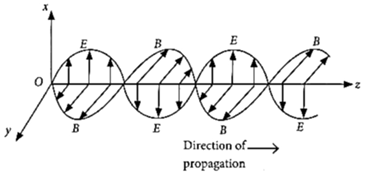
A stationary charge produces only an electrostatic field while a charge in uniform motion produces a magnetic field, that does not change with time. An oscillating charge is an example of accelerating charge. It produces an oscillating magnetic field, which in turn produces an oscillating electric fields and so on. The oscillating electric and magnetic fields regenerate each other as a wave which propagates through space.
Image
(i). Magnetic field in a plane electromagnetic wave is given by $\vec{B}= B _0 \sin ( kx +\omega t ) \hat{j} T$Expression for corresponding electric field will be (Where c is speed of light.)
(a) $\vec{E}= B _0 c \sin ( kx +\omega t ) \hat{k} V / m$
(b) $\vec{E}=- B _0 c \sin ( kx -\omega t ) \hat{k} V / m$
(c) $\vec{E}=- B _0 c \sin ( kx +\omega t ) \hat{k} V / m$
(d) $\vec{E}=\frac{B_0}{c} \sin ( kx +\omega t ) \hat{k} V / m$

(ii) The electric field component of a monochromatic radiation is given by $\vec{E}=2 E _0 \hat{i} \cos kz \cos \omega t$. Its magnetic field $\vec{B}$ is then given by
(a) $-\frac{2 E_0}{c} \hat{j} \sin kz \sin \omega t$
(b) $\frac{2 E_0}{c} \hat{j} \sin kz \sin \omega t$
(c) $\frac{2 E_0}{c} \hat{j} \sin kz \cos \omega t$
(d) $\frac{2 E_0}{c} \hat{j} \cos kz \cos \omega t$

(iii) A plane em wave of frequency 25 MHz travels in a free space along x -direction. At a particular point in space and time, $E =(6.3 \hat{j}) V / m$. What is magnetic field at that time?
(a) $0.089 \mu T$
(b) $0.124 \mu T$
(c) $0.021 \mu T$
(d) $0.095 \mu T$

OR

A plane electromagnetic wave travels in free space along $x$-axis. At a particular point in space, the electric field along $y$-axis is $9.3 V m ^{-1}$. The magnetic induction (B) along z -axis is
(a) $3.1 \times 10^{-8} T$
(b) $3 \times 10^{-5} T$
(c) $3 \times 10^{-6} T$
(d) $9.3 \times 10^{-6} T$

(iv) A plane electromagnetic wave travelling along the $x$-direction has a wavelength of 3 mm . The variation in the electric field occurs in the $y$-direction with an amptitude $66 V m ^{-1}$. The equations for the electric and magnetic fields as a function of $x$ and $t$ are respectively
$\begin{aligned} \text { a) } E_y & =11 \cos 2 \pi \times 10^{11}\left(t-\frac{x}{c}\right), & \text { b) } E_y & =66 \cos 2 \pi \times 10^{11}\left(t-\frac{x}{c}\right), \\ B_y & =11 \times 10^{-7} \cos 2 \pi \times 10^{11}\left(t-\frac{x}{c}\right) & B_z & =2.2 \times 10^{-7} \cos 2 \pi \times 10^{11}\left(t-\frac{x}{c}\right) \\ \text { c) } E_x & =33 \cos \pi \times 10^{11}\left(t-\frac{x}{c}\right), & \text { d) } E_y & =33 \cos \pi \times 10^{11}\left(t-\frac{x}{c}\right), \\ B_x & =11 \times 10^{-7} \cos \pi \times 10^{11}\left(t-\frac{x}{c}\right) & B_z & =1.1 \times 10^{-7} \cos \pi \times 10^{11}\left(t-\frac{x}{c}\right)\end{aligned}$
A sphere of diameter 10 cm is charged so that the electric field intensity on its surface becomes $5 \times 10^6$ Volt per meter. What will be the force exerted on a charge of $5 \times 10^{-2}$ micro Coulomb located at a distance 25 cm from the centre of the circle?