MCQ
When enthalpy and entropy change for a chemical reaction are $ - 2.5\, \times {10^3}\,cal$ and $7.4\,cal$ ${\deg ^{ - 1}}$ respectively. Predict the reaction at $298\,K$ is
  • Spontaneous
  • B
    Reversible
  • C
    Irreversible
  • D
    Non-spontaneous

Answer

Correct option: A.
Spontaneous
(a) When $\Delta H$ $= -ve, $ $\Delta S$ $= +ve$  and $\Delta G$ $= -ve $ than reaction is spontaneous .

Need a full question paper?

Generate a complete, print-ready paper with questions like this in minutes — across 16+ boards, with answer keys.

Start Generating Free

Similar questions

When two pairs of electrons are shared, bond is
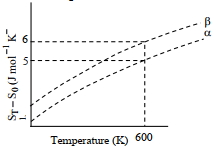
The entropy versus temperature plot for phases $\alpha$ and $\beta$ at 1 bar pressure is given. $S_{\mathrm{T}}$ and $S_0$ are entropies of the phases at temperatures $\mathrm{T}$ and $0 \mathrm{~K}$, respectively.

(image)

The transition temperature for $\alpha$ to $\beta$ phase change is $600 \mathrm{~K}$ and $C_{p, \beta}-C_{p, \alpha}=1 \mathrm{~J} \mathrm{~mol}^{-1} \mathrm{~K}^{-1}$. Assume $\left(C_{p, \beta}-C_{p, \alpha}\right)$ is independent of temperature in the range of 200 to $700 \mathrm{~K} . \mathrm{C}_{p, \alpha}$ and $C_{p, \beta}$ are heat capacities of $\alpha$ and $\beta$ phases, respectively.

($1$)The value of entropy change, $\mathrm{S}_\beta-\mathrm{S}_\alpha$ (in $\mathrm{J} \mathrm{mol}^{-1} \mathrm{~K}^{-1}$ ), at $300 \mathrm{~K}$ is. . . . . . .

[Use : $\ln 2=0.69$  Given : $S_\beta-S_\alpha=0$ at $\left.0 \mathrm{~K}\right]$

($2$) The value of enthalpy change, $\mathrm{H}_\beta-\mathrm{H}_\alpha$ (in $J$ mol ${ }^{-1}$ ), at $300 \mathrm{~K}$ is

Give the answer quetion ($1$) and ($2$)
Silicon is the $.........$ abundant element in the earth's crust:
Which of following salt does not give borax bead test 
For a reaction; $A + B \rightleftharpoons C + D$ , the initial concentration of $A$ and $B$ are equal but the equilibrium concentration of $C$ is twice that of equilibrium concentration of $A$. The $K_c$ is
Numbers of gram atoms of oxygen present in $0.8\,mol$ of $C_4H_6O_6$ would be
Group $13$ elements show $+1$ and $+3$ oxidation states. Relative stability of $+3$ oxidation state may be given as
In an estimation of bromine by Carius method,$1.6\, g$ of an organic compound gave $1.88 \,g$ of $AgBr$. The mass percentage of bromine in the compound is..........

(Atomic mass, $Ag =108, Br =80\, g\, mol ^{-1}$ )

Choose the correct option for free expansion of an ideal gas under adiabatic condition from the following :
Assign $A, B, C, D$ from given type of reaction.

${N_2}{O_3}\xrightarrow{{R.T.}}NO + N{O_2}$