Question
When germanium is doped with phosphorus, the doped material has(a) Excess positive charge(b) Excess negative charge(c) More negative current carriers(d) More positive current carriers


Answer

(c) More negative current carriers

Need a full question paper?

Generate a complete, print-ready paper with questions like this in minutes — across 16+ boards, with answer keys.
Start Generating Free

Similar questions

The minimum amount of energy required to emit electrons from a metal surface is called:
A p-type semiconductor is:
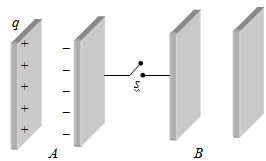
Consider the situation shown in the figure. The capacitor $A$ has a charge 4 on it whereas $B$ is uncharged. The charge appearing on the capacitor $B$ a long time after the switch is closed is
Optical fibres are related with(a) Communication (b) Light(c) Computer(d) None of these
       
An elementary particle of mass $m$ and charge $+e$ is projected with velocity $v$ at a much more massive particle of charge $Ze,$ where $Z > 0$. What is the closest possible approach of the incident particle
In a double slit arrangement fringes are produced using light of wavelength 4800 Å. One slit is covered by a thin plate of glass of refractive index 1.4 and the other with another glass plate of same thickness but of refractive index 1.7. By doing so the central bright shifts to original fifth bright fringe from centre. Thickness of glass plate is(a) 8 mm (b) 6 mm(c) 4 mm (d) 10 mm
       
One of the following wavelengths is absent and the rest are present in the X-rays coming from a Coolidge tube. Which one is the absent wavelength?
A charge of 5 C  is given a displacement of 0.5 m. The work done in the process is 10 J. The potential difference between the two points will be (a) 2 V(b) 0.25 V (c) 1V(d) 25 V    
       
Critical angle for light going from medium (i) to (ii) is q. The speed of light in medium (i) is v then speed in medium (ii) is(a) v(1- cosθ)(b) v/sinθ(c) v/cosθ(d) v(1- sinθ)
       
When we see an object, the image formed on the retina is:
  1. Real.
  2. Virtual.
  3. Erect.
  4. Inverted.