Question
A p-type semiconductor is:

Answer

  1. Uncharged.

Need a full question paper?

Generate a complete, print-ready paper with questions like this in minutes — across 16+ boards, with answer keys.
Start Generating Free

Similar questions

A proton and a neutron combine to give a deuterium nucleus.If $mo$​ and $mp$​ be the mass of neutron and proton respectively, then mass of deuterium nucleus is$:$
A parallel plate capacitor is charged and the charging battery is then disconnected. If the plates of the capacitor are moved further apart by means of insulating handles, then(a) The charge on the capacitor increases(b) The voltage across the plates decreases(c) The capacitance increases(d) The electrostatic energy stored in the capacitor increases


The ratio of the kinetic energy to the total energy of an electron in a Bohr orbit is(a) – 1(b) 2(c) 1 : 2(d) None of these
       
SI unit of the magnetic field is _________.
A copper disc of radius $0.1 m$ is rotated about its centre with $10$ revolutions per second in a uniform magnetic field of $0.1$ Tesla with its plane perpendicular to the field. The $\text{e.m.f.}$ induced across the radius of disc is
The magnitude of electric field $E$ in the annular region of a charged cylindrical capacitor
Examples of inorganic semiconductors is:
A candle placed 25 cm from a lens, forms an image on a screen placed 75 cm on the other end of the lens.  The focal length and type of the lens should be(a) + 18.75 cm and convex lens(b) – 18.75 cm and concave lens(c) + 20.25 cm and convex lens(d) – 20.25 cm and concave lens
   
   
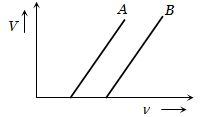
The stopping potential as a function of the frequency of the incident radiation is plotted for two different photoelectric surfaces $A$ and $B.$ The graphs show that work function of $A$ is
An electron is traveling along the x - direction. It encounters a magnetic field in the y - direction. Its subsequent motion will be: