Question

When hydrogen atom is in its first excited level, its radius is .... its ground state radius

(a) Half

(b) Same

(c) Twice

(d) Four times

Answer

(b) Same

Need a full question paper?

Generate a complete, print-ready paper with questions like this in minutes — across 16+ boards, with answer keys.

Start Generating Free

Similar questions

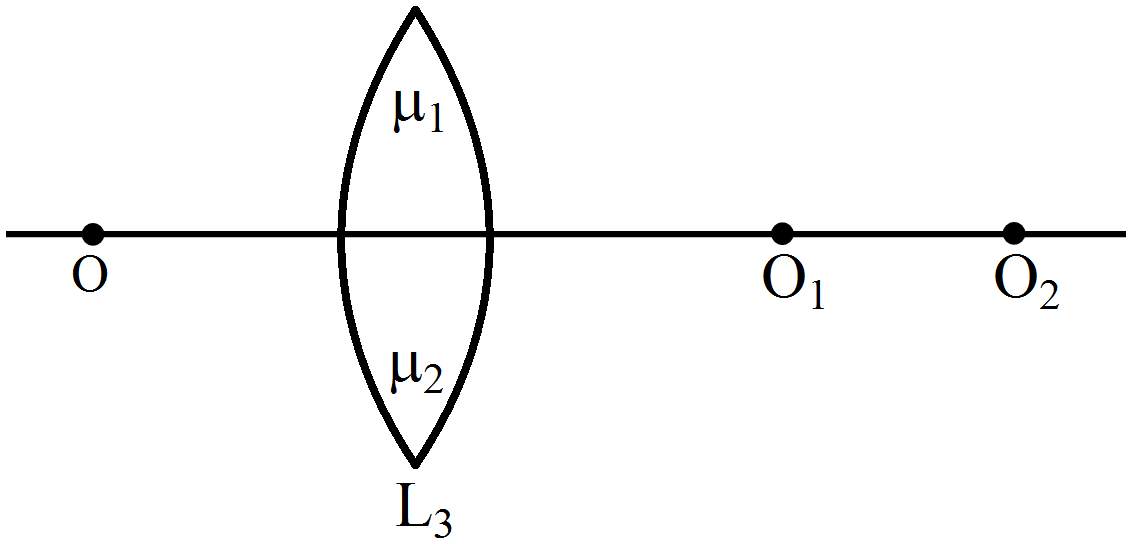
Consider three converging lenses L1, L2 and L3 having identical geometrical construction. The index of refraction of L1 and L2 are $\mu_1$ and $\mu_2$ respectively. The upper half of the lens L3 has a refractive index $\mu_1$ and the lower half has $\mu_2$. A point object O is imaged at O1 by the lens L1 and at O2 by the lens L2 placed in same position. If L3 is placed at the same place:

  1. There will be an image at O1
  2. There will be an image at O2
  3. The only image will form somewhere between O1 and O2
  4. The only image will form away from O2.

Which of the following particles will describe the smallest circle when projected with the same velocity perpendicular to a magnetic field?
  1. Electron
  2. Proton
  3. He+
  4. Li+

Assertion : Neutrons penetrate matter more readily as compared to protons.

Reason     : Neutrons are slightly more massive than protons.

(a) If both assertion and reason are true and the reason is the correct explanation of the assertion.

(b) If both assertion and reason are true but reason is not the correct explanation of the assertion.

(c) If assertion is true but reason is false.

(d) If the assertion and reason both are false.

The electron emitted in beta radiation originates from

(a) Inner orbits of atoms

(b) Free electrons existing in nuclei

(c) Decay of a neutron in a nucleus

(d) Photon escaping from the nucleus

The current in a coil changes from 4 ampere to zero in 0.1 s. If the average e.m.f. induced is 100 volt, what is the self inductance of the coil

(a) 2.5 H

(b) 25 H

(c) 400 H

(d) 40 H

The direction of electric field is from:
What is the atomic mass (u) of chlorine?

An eye specialist prescribes spectacles having a combination of convex lens of focal length 40 cm in contact with a concave lens of focal length 25 cm. The power of this lens combination in diopters is

(a) + 1.5

(b) – 1.5

(c) + 6.67

(d) – 6.67

The number of protons in an atom of atomic number Z and mass number A is:

A molecule with a dipole moment p is placed in an electric field of strength E. Initially the dipole is aligned parallel to the field. If the dipole is to be rotated to be anti-parallel to the field, the work required to be done by an external agency is

(a) – 2pE

(b) – pE

(c) pE       

(d) 2pE