Question
When is a body lying in a gravitation field in stable equilibrium?

Answer

A body in a gravitation field will be in stable equilibrium, if the vertical line through its centre of gravity passes through the base of the body.

Need a full question paper?

Generate a complete, print-ready paper with questions like this in minutes — across 16+ boards, with answer keys.
Start Generating Free

Similar questions

The distance covered by a body is found to be directly proportional to the square of time. Is the body moving with uniform velocity or uniform acceleration? If the distance travelled be directly proportional to time.
How does Bernoulli's principle help in understanding the flow of blood in vein?
Two sitars A and B, playing the note 'Dha' are slightly out of tune and produce beats of frequency 5Hz. Then tension of the string B is slightly increased and the beat frequency is found to decrease to 3Hz. What is the original frequency of B if the frequency of A is 427Hz?
What is stokes' law? Write its application of this formula.
An ideal Carnot engine uses an ideal gas. The source temperature is 500 K and the arrival temperature is 375 K . If the engine takes 500 K cal from the source per cycle then estimate (a) efficiency of engine (b) work done per cycle (c) per heat dissipated in bicycle access.
What is the center of mass? Is it necessary for an object to have mass at its center of mass?
An astronaut inside a small space ship orbiting around the earth cannot detect gravity. If the space station orbiting around the earth has a large size, can he hope to detect gravity?
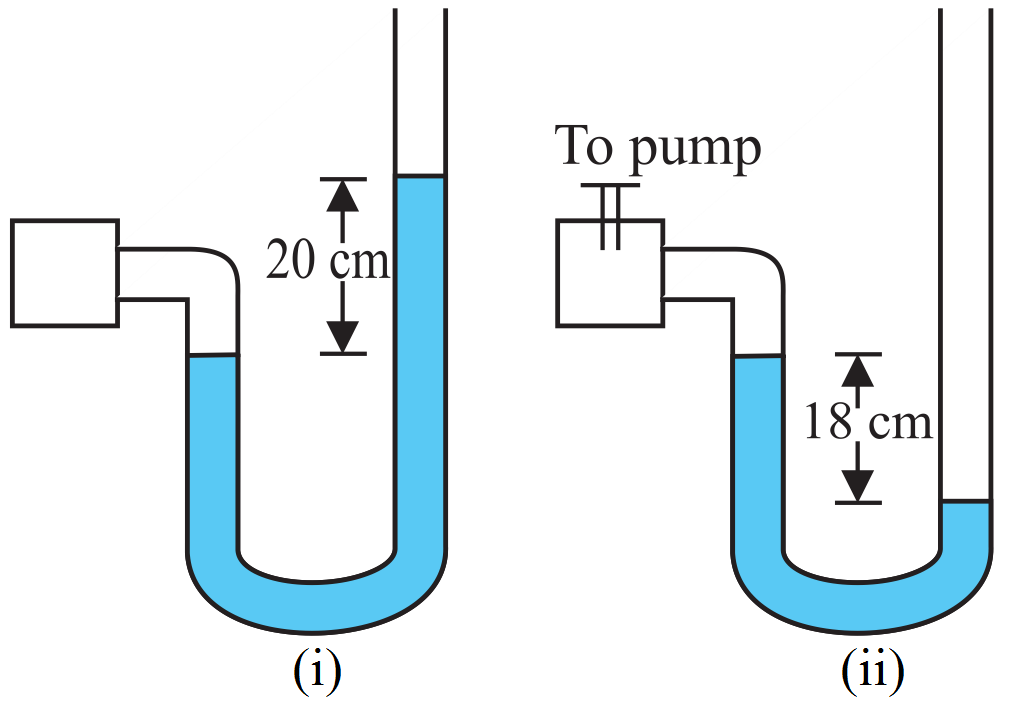
A manometer reads the pressure of a gas in an enclosure as shown in Fig.(a) When a pump removes some of the gas, the manometer reads as in Fig. (b) The liquid used in the manometers is mercury and the atmospheric pressure is $76cm$ of mercury. Give the absolute and gauge pressure of the gas in the enclosure for cases (i) and (ii) in units of cm of mercury. How would the levels change in case (i) if $13.6cm$ of water (immiscible with mercury) are poured into the right limb of the manometer? (Ignore the small change in volume of the gas.)
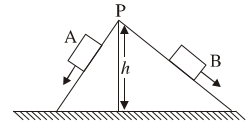
Two smooth inclined planes are shown in the figure. On these, two objects $A$ and $B$ of equal masses start sliding from rest from point $P$. Which object will reach the ground with greater speed?
Image
Define gravitational potential at a point.