MCQ
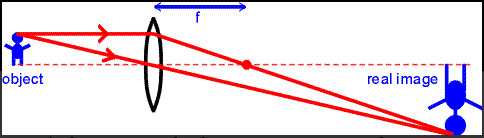
When is the real image formed?
  • A
    When the rays of light after reflection or refraction actually go away from some point.
  • When the rays of light after reflection or refraction actually meet at some point.
  • C
    When the sun rays after reflection or refraction actually meet at some point.
  • D
    When the rays of light after deflection actually meet at some point.
Answer

Correct option: B.
When the rays of light after reflection or refraction actually meet at some point.

Real image formed when the rays of light after reflection or refraction actually converge at some point and when objects are placed outside the focal length of a converging lens or outside the focal length of a converging mirror.

Need a full question paper?

Generate a complete, print-ready paper with questions like this in minutes — across 16+ boards, with answer keys.

Start Generating Free

Similar questions

A $p-n$ photodiode is fabricated from a semiconductor with a band gap of $2.5\,\, eV.$ It can detect a signal of wavelength
In a potentiometer experiment, the galvanometer shows no deflection when a cell is connected across 60 cm of the potentiometer wire. If the cell is shunted by a resistance of 6Ω, the balance is obtained across 50 cm of the wire. The internal resistance of the cell is
A semiconductor is a material with a small but non$-$zero band gap that behaves as an insulator at absolute zero but allows thermal excitation of electrons into its $.........$ at temperatures that are below its melting point.
The half life of polonium is $140\, days$. After how many days, $16 \,gm$ polonium will be reduced to $1 \,gm$ .........$days$(or $15\,g$ will decay)
When petrol drops from a vehicle fall over rain water on road surface, colours are seen because of:
In the circuit below $C_1=20 \,\mu F , C_2=40 \,\mu F$ and $C_3=50 \,\mu F$. If no capacitor can sustain more than $50 \,V$, then maximum potential difference between $X$ and $Y$ is .......... $V$
Assertion : Magnetic moment of an atom is due to both, the orbital motion and spin motion of every electron.
Reason : A charged particle produces a magnetic field.
Which of the following cannot be polarised?
The ${K_\alpha }$ $X$ - rays arising from a cobalt $(z = 27)$ target have a wavelength of $179\, pm$. The ${K_\alpha }$ $X$ - rays arising from a nickel target $(z = 28)$ is
The wavelength $\lambda_e$ of an electron and $\lambda_p$ of a photon of same energy $E$ are related by