Questions

4 Marks Questions

🎯

Test yourself on this topic

13 questions · timed · auto-graded

Question 14 Marks
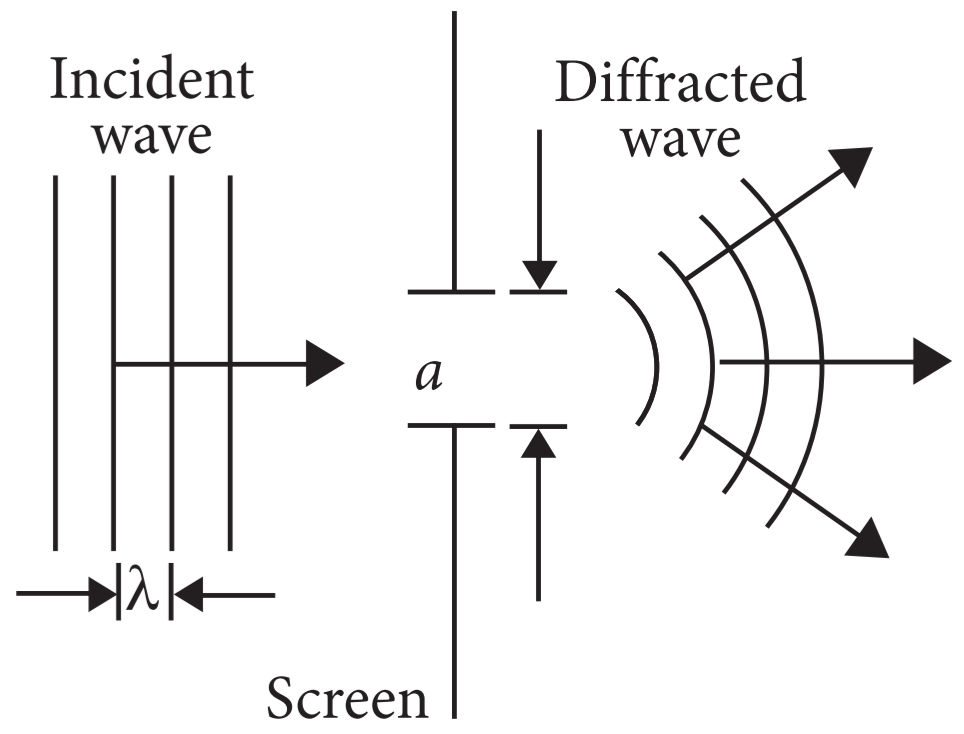
For a single slit of width "a", the first minimum of the interference pattem of a monochromatic light of wavelength$\lambda$. Occurs at an angle of$\frac{\lambda}{\text{a}}$. At the same angle of$\frac{\lambda}{\text{a}},$ we get a maximum for two narrow slits separated by a distance "a". Explain.
Answer
In the first case, the overlapping of the contributions of the wavelets from two halves of a single slit produces a minimum because corresponding wavelets from two halves have a path difference of $\frac{\lambda}{2}.$

In the second case, the overlapping of the wavefronts from the two slits produces first maximum because these wavefronts have the path difference of$\lambda$.

Alternate Answer

Condition for first minimum in single slit diffraction is, $\theta\approx\lambda/\text{a},$

Whereas in case of two narrow slits separated by distance a, first maximum occurs at angle $\theta \approx\lambda/\text{a}.$
View full question & answer
Question 24 Marks
Answer
  1. (c) 19.72

Explanation:

Given $\text{I}_1=\text{10 }\frac{\text{W}}{\text{m}^2}$ and $\text{I}_2=\text{25 }\frac{\text{W}}{\text{m}^2}$

$\frac{\text{I}_1}{\text{I}_2}=\frac{\text{a}^2_1}{\text{a}^2_2}=\frac{10}{25}\Rightarrow\frac{\text{a}_1}{\text{a}_2}=\frac{3.16}{5}$ or

$\text{a}_1=\frac{3.16}{5}\text{a}_2=0.6324\text{a}_2$

$\frac{\text{I}_\text{max}}{\text{I}_\text{min}}=\frac{(\text{a}_1+\text{a}_2)^2}{(\text{a}_1-\text{a}_2)^2}=\frac{[0.6324\text{a}_2+\text{a}_2]^2}{[0.6324\text{a}_2-\text{a}_2]^2}=19.724$

  1. (b) Excessively thin film.

Explanation:

In an excessively thin film, the thickness of the film is negligible. Thus the path difference between the reflected rays becomes $\frac{\lambda}{2}$ which produces a minima.

  1. (a) 2D

Explanation:

Since, $\beta=\frac{\lambda\text{D}}{\text{d}}$ for d = 2d,

$\beta'=\frac{\lambda\text{D}'}{2\text{d}}=\beta$ (Gives)

$\therefore$ D1 = 2D

  1. (b) Five

Explanation:

The condition for possible interference maxima on the screen is, $\text{d}\sin\theta=\text{n}\lambda$

where d is slit separation and $\lambda$ is the wavelength.

As $\text{d}=2\lambda$ (given)   $\therefore2\lambda\sin\theta=\text{n}\lambda$ or $2\sin\theta=\text{n}$

For number of interference maxima to be maximum,

$\sin\theta=1\ \ \ \therefore\ \ \ \text{n}=2$

The interference maxima will be formed when

$\text{n}=0,\pm1,\pm2$

Hence the maximum number of possible maxima is 5.

  1. (d) $\sqrt3\text{a}$

Explanation:

$\text{y}_1=\text{a}\sin\Big(\omega\text{t}\frac{\pi}{3}\Big)$ and $\text{y}_2=\text{a}\sin\omega\text{t}$

$\text{A}=\sqrt{\text{a}_1^2+\text{a}^2_2+2\text{a}_1\text{a}_2\cos\phi}$, where $\phi=\frac{\pi}{3}$

$=\sqrt{\text{a}^2+\text{a}^2+2\text{aa}\cos\frac{\pi}{3}}=\sqrt3\text{a}$

View full question & answer
Question 34 Marks
TV signals broadcast by Delhi studio cannot be directly received at Patna which is about 1000km away. But the same signal goes some 36000km away to a satellite, gets reflected and is then received at Patna. Explain.
Answer
To receive TV signals transmitted from Delhi in Patna directly, one has to use antennas of great height, which will cost much. On the other hand, transmission of signals With the help of satellites requires only high frequency waves and can be done easily.
View full question & answer
Question 44 Marks
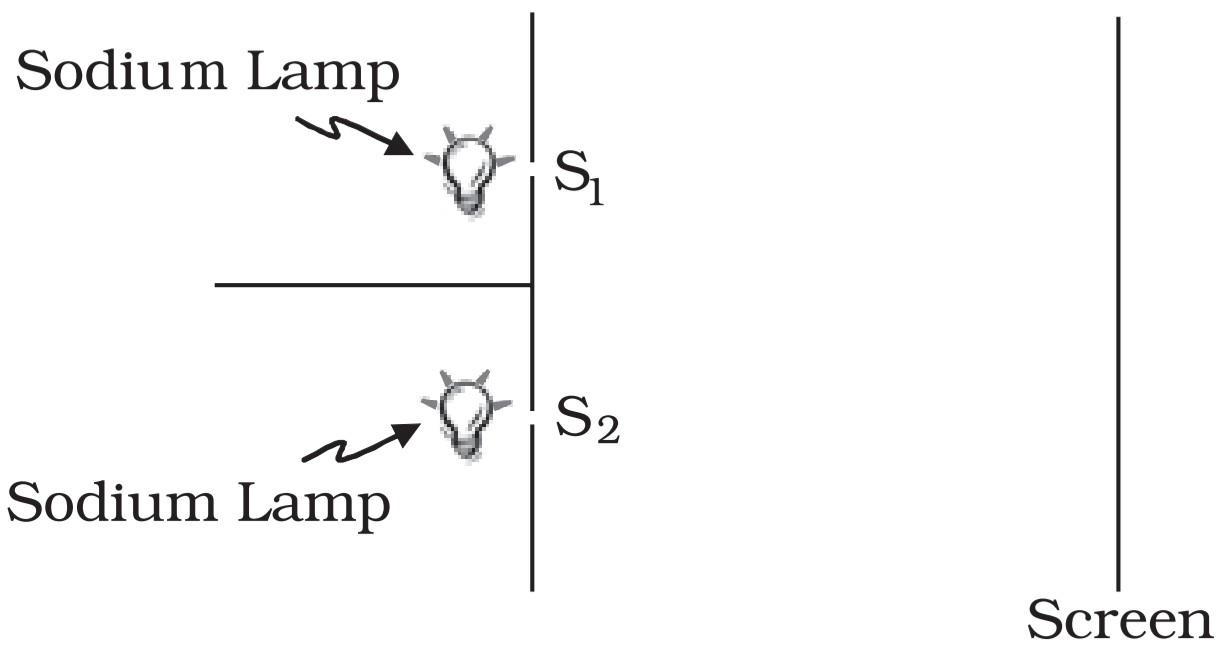
Why don't we have interference when two candles are placed close to each other and the intensity is seen at a distant screen? What happens if the candles are replaced by laser sources?
Answer
In order to get interference, the sources should be coherent, i.e. they should emit wave of the same frequency and a stable phase difference. Two candles that are placed close to each other are distinct and cannot be considered as coherent sources. Two independent sources cannot be coherent. So, two different laser sources will also not serve the purpose.
View full question & answer
Question 54 Marks
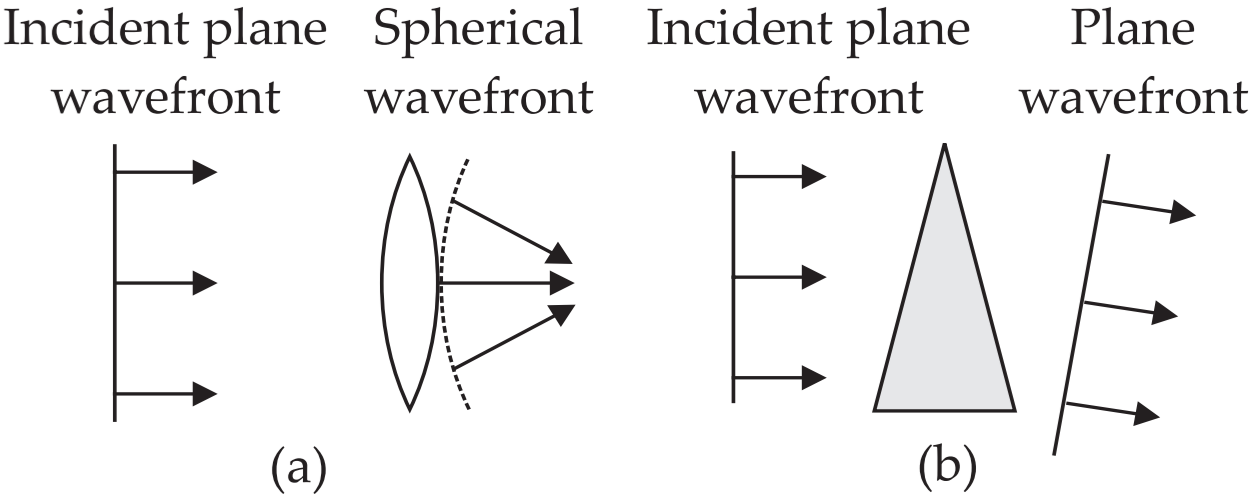
Huygen's principle is the basis of wave theory of light. Each point on a wavefront acts as a fresh source of new disturbance, called secondary waves or wavelets. The secondary wavelets spread out in all directions with the speed light in the given medium.
An initially parallel cylindrical beam travels in a medium of refractive index $\mu(\text{I})=\mu_0+\mu_2\text{I}$, where $\mu_0$ and $\mu_2$ are positive constants and I is the intensity of the light beam. The intensity of the beam is decreasing with increasing radius.

  1. The initial shape of the wavefront of the beam is:
  1. Planar.
  2. Convex.
  3. Concave.
  4. Convex near the axis and concave near the periphery.
  1. According to Huygens Principle, the surface of constant phase is:
  1. Called an optical ray.
  2. Called a wave.
  3. Called a wavefront.
  4. Always linear in shape.
  1. As the beam enters the medium, it will:
  1. Travel as a cylindrical beam.
  2. Diverge.
  3. Converge.
  4. Diverge near the axis and converge near the periphery.
  1. Two plane wavefronts oflight, one incident on a thin convex lens and another on the refracting face of a thin prism. After refraction at them, the emerging wavefronts respectively become.
  1. Plane wavefront and plane wavefront.
  2. Plane wavefront and spherical wavefront.
  3. Spherical wavefront and plane wavefront.
  4. Spherical wavefront and spherical wavefront.
  1. Which of the following phenomena support the wave theory of light?
  1. Scattering.
  2. Interference.
  3. Diffraction.
  4. Velocity of light in a denser medium is less than the velocity of light in the rarer medium.
  1. 1, 2, 3
  2. 1, 2, 4
  3. 2, 3, 4
  4. 1, 3, 4
View full question & answer
Question 64 Marks
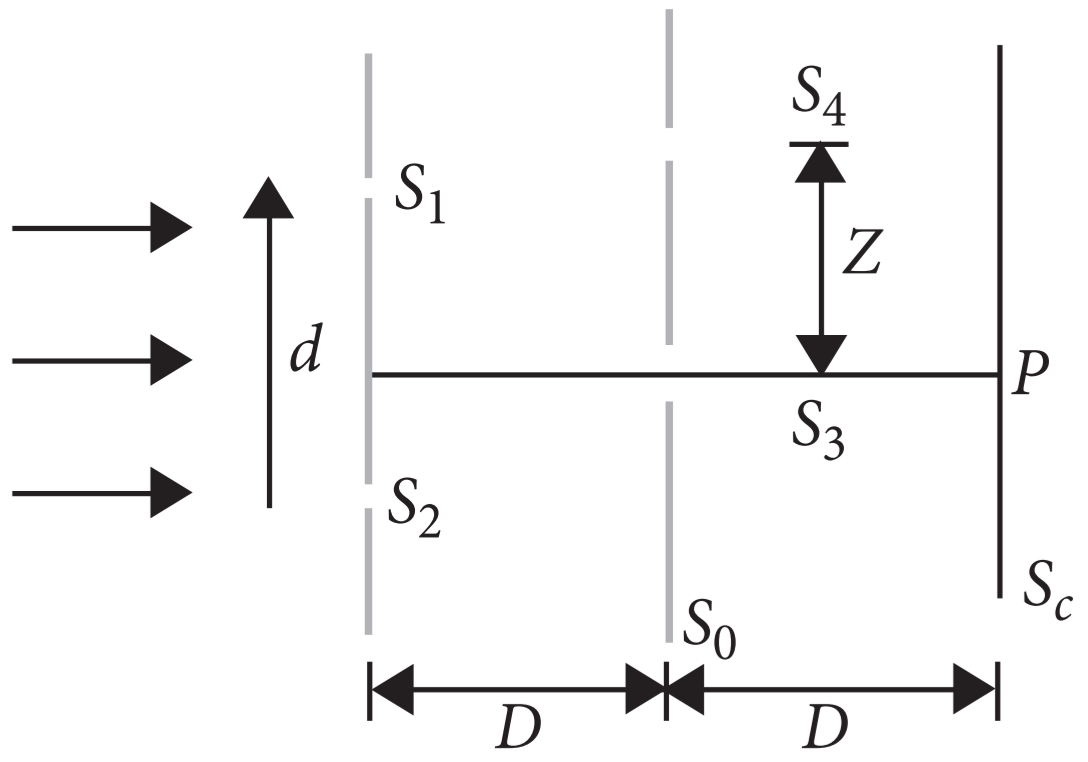
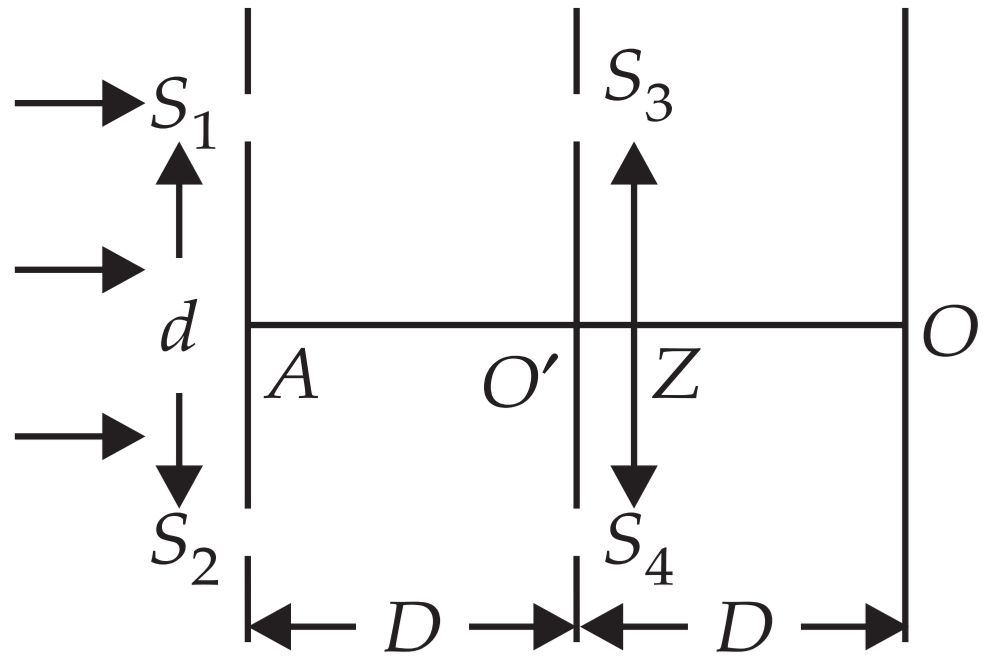
Consider the situation shown in figure. The two slits S1 and S1 placed symmetrically around the central line are illuminated by monochromatic light of wavelength $\lambda$. The separation between the slits is d. The light transmitted by the slits falls on a screen S0 place at a distance D from the slits. The slits S3 is at the central line and the slit S4 is at a distance from S3. Another screen Sc is placed a further distance D away from Sc.

  1. Find the path difference if $\text{z}=\frac{\lambda\text{D}}{2\text{d}}$.

  1. $\lambda$

  2. $\frac{\lambda}{2}$

  3. $\frac{3}{2\lambda}$

  4. $2\lambda$

  1. Find the ratio of the maximum to minimum intensity observed on Sc if $\text{z}=\frac{\lambda\text{D}}{\text{d}}$

  1. 4
  2. 2
  3. $\infty$

  4. 1
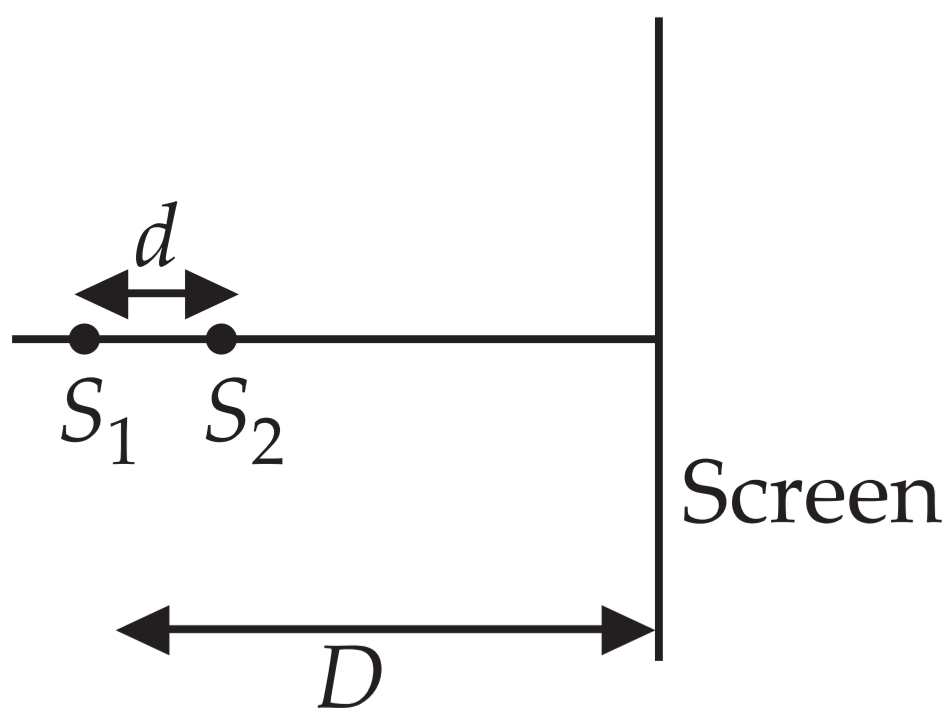
  1. Two coherent point sources S1 and S2 are separated by a small distanced as shown in figure. The fringes obtained on the screen will be:

  1. Concentric circles.
  2. Points.
  3. Straight lines.
  4. Semi-circles.
  1. ln the case of light waves from two coherent sources S1 and S2, there will be constructive interference at an arbitrary point P, if the path difference S1P - S2P is:
  1. $\Big(\text{n}+\frac{1}{2}\Big)\lambda$

  2. $\text{n}\lambda$

  3. $\Big(\text{n}-\frac{1}{2}\Big)\lambda$

  4. $\frac{\lambda}{2}$

  1. Two monochromatic light waves of amplitudes 3A and 2A interfering at a point have a phase difference of 60º. The intensity at that point will be proportional to:
  1. 5A2
  2. 13A2
  3. 7A2
  4. 19A2
Answer
  1. (b) $\frac{\lambda}{2}$

Explanation:

As $\text{z}=\frac{\lambda\text{D}}{2\text{d}}$

$\text{At}\text{ S}_4:\frac{\triangle\text{x}}{\text{d}}=\frac{\text{z}}{\text{D}}$

$\Rightarrow\triangle\text{x}=\frac{\lambda\text{D}}{2\text{d}}\frac{\text{d}}{\text{d}}=\frac{\lambda}{2}$

  1. (c) $\infty$

Explanation:

$\text{z}=\frac{\lambda\text{D}}{\text{d}}$

$\triangle​​\text{x}\text{ at}\text{ S}_4:\triangle\text{c}=\frac{\lambda\text{D}}{\text{d}}\frac{\text{d}}{\text{d}}=\lambda$

Hence, maxima at S4 as well as S3.

Resultant intensity at S4, I = 4I0

$\therefore\frac{\text{I}_\text{max}}{\text{I}_\text{max}}=\frac{\big[(4\text{I}_0)^\frac{1}{2}+4(4\text{I}_0)^\frac{1}{2}\big]^2}{\big[(4\text{I}_0)^\frac{1}{2}-(4\text{I}_0)^\frac{1}{2}\big]^2}=\infty$

  1. (a) Concentric circles.

Explanation:

When the screen is placed perpendicular to the line joining the sources, the fringes will be concentric circles.

  1. (b) $\text{n}\lambda$

Explanation:

Constructive interference occurs when the path difference (S1P - S2P) is an integral multiple of $\lambda$.

or $\text{S}_1\text{P}-\text{S}_2\text{P}=\text{n}\lambda$, where $\text{n}=0.1,2,3,.....$

  1. (d) 19A2

Explanation:

Here, $\text{A}_1=3\text{A},\text{A}_2=2\text{A}$ and $\phi=60^\circ$

The resultant amplitude at a point is

$\text{R}=\sqrt{\text{A}^2_1+\text{A}^2_2+2\text{A}_1\text{A}_2\cos\phi}$

$=\sqrt{(3\text{A})^2+(2\text{A})^2+2\times3\text{A}\times2\text{A}\times\cos60^\circ}$

$=\sqrt{9\text{A}^2+4\text{A}^2+6\text{A}^2}=\text{A}\sqrt{19}$

As, Intensity $\propto$ (Amplitude)2

Therefore, intensity at the same point is

$\text{I}\propto19\text{A}^2$

View full question & answer
Question 74 Marks
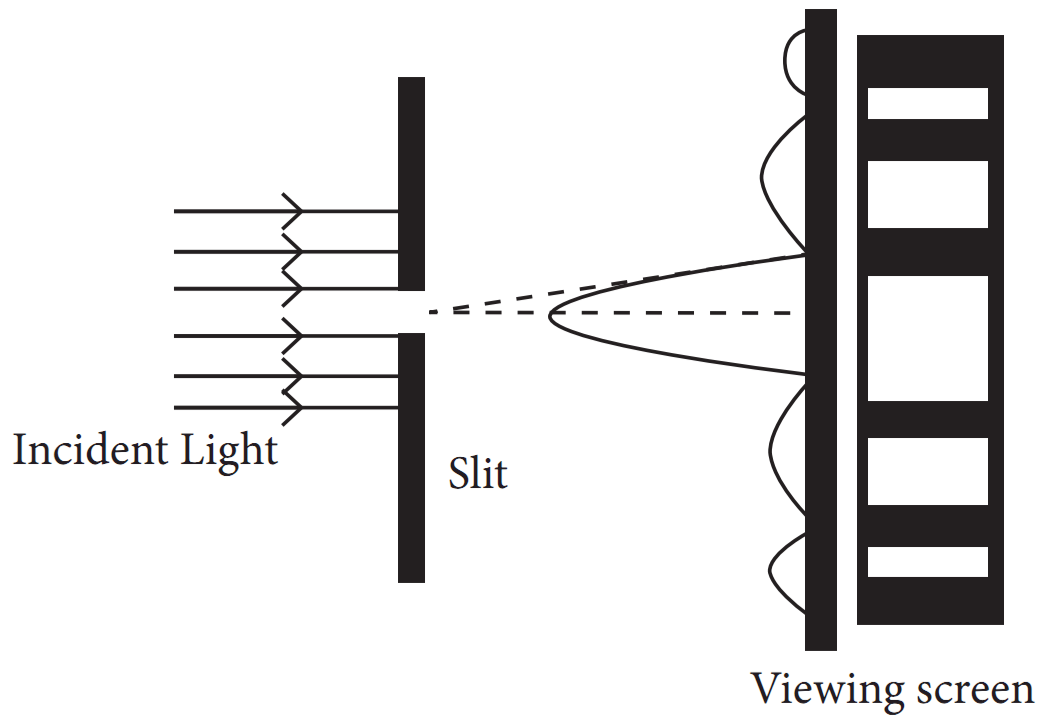
When light from a monochromatic source is incident on a single narrow slit, it gets diffracted and a pattern of ahem ate bright and dark fringes is obtained on screen, called "Diffraction Pattern" of single slit. ln diffraction pattern of single slit, it is found that.

  1. Central bright fringe is of maximum intensity and the intensity of any secondary bright fringe decreases with increase in its order.
  2. Central bright fringe is twice as wide as any other secondary bright or dark fringe.

  1. A single slit of width 0.1mm is illuminated by a parallel beam oftight of wavelength $6000\mathring{\text{A}}$ and diffraction bands are observed on a screen 0.5m from the slit. The distance of the third dark band from the central bright band is:

  1. 3mm
  2. 1.5mm
  3. 9mm
  4. 4.5mm
  1. ln Fraunhofer diffraction pattern, slit width is 0.2mm and screen is at 2m away from the lens. If wavelength of tight used is $5000\mathring{\text{A}}$ then the distance between the first minimum on either side the central maximum is:
  1. 10-1m
  2. 10-2m
  3. 2 × 10⁻²m
  4. 2 × 10⁻¹m
  1. Light of wavelength 600nm is incident normally on a slit of width 0.2mm. The angular width of central maxima in the diffraction pattern is (measured from minimum to minimum).
  1. 6 × 10⁻³rad
  2. 4 × 10⁻³rad
  3. 2.4 × 10⁻³rad
  4. 4.5 × 10⁻³rad
  1. A diffraction pattem is obtained by using a beam of red light. What will happen, if the red light is replaced by the blue light?
  1. Bands disappear
  2. Bands become broader and farther apart
  3. No change will take place
  4. Diffraction bands become narrower and crowded together.
  1. To observe diffraction, the size of the obstacle.
  1. Should be $\frac{\lambda}{2}$, where $\lambda$, is the wavelength.

  2. Should be of the order of wavelength.
  3. Has no relation to wavelength.
  4. Should be much larger than the wavelength.
Answer
  1. (c) 9mm

Explanation:

Here, $\text{d} = 0.1 \text{mm},\lambda= 6000 \mathring{\text{A}}, \text{D}=0.5\text{m}$

For third dark band, $\text{d}\sin\theta=3\lambda\ ;\ \sin\theta=\frac{3\lambda}{\text{d}}=\frac{\text{y}}{\text{D}}$

$\text{y}=\frac{3\text{D}\lambda}{\text{d}}=\frac{3\times0.5\times6\times10^{-7}}{0.1\times10^{-3}}$

$=9\times10^{-3}\text{m}=9\text{mm}$

  1. (b) 10-2m

Explanation:

Given d = 0.2mm = 0.2 × 10⁻³m, D = 2m

$\lambda=5000\mathring{\text{A}}=5\times10^{-7}\text{m}$

The distance between the first minimum on other side of the central maximum

$\text{x}=\frac{2\lambda\text{D}}{\text{d}}=\frac{2\times5\times10^{-7}\times2}{0.2\times10^{-3}}$

$\Rightarrow\text{x}=10^{-2}\text{m}$

  1. (a) 6 × 10⁻³rad

Explanation:

Here, $\lambda=600\text{nm}=6\times10^{-7}\text{m}$

$\text{a}=0.2\text{mm}=2\times10^{-4}\text{m},\theta=?$

Angular width of central maxima,

$\theta=\frac{2\lambda}{\text{a}}=\frac{2\times6\times10^{-7}}{2\times10^{-4}}=6\times10^{-3}\text{rad}$

  1. (d) Diffraction bands become narrower and crowded together.

Explanation:

When red light is replaced by blue light $(\lambda_\text{B}<\lambda_\text{R})$ the diffraction pattern bands becomes narrow and crowded together.

  1. (b) Should be of the order of wavelength.

Explanation:

To observe diffraction, the size of the obstacle should be of the order of wavelength.

View full question & answer
Question 84 Marks
Distance between two successive bright or dark fringes is called fringe width.
$\beta=\text{Y}_\text{n+1}-\text{Y}_\text{n}=\frac{(\text{n}+1)\lambda\text{D}}{\text{d}}-\frac{\text{n}\lambda\text{D}}{\text{d}}=\frac{\lambda\text{D}}{\text{d}}$
Fringe width is independent of the order of the maxima. If whole apparatus is immersed in liquid of refractive index $\mu$ then $\beta=\frac{\lambda\text{D}}{\mu\text{d}}$ (fringe width decreases). Angular fringe width $(\theta)$ is the angular separation between two consecutive maxima or minima
$\theta=\frac{\beta}{\text{D}}=\frac{\lambda}{\text{d}}$
ln the arrangement shown in figure, slit S3 and S4 are having a variable separation Z. Point O on the screen is at the common perpendicular bisector of S1S2 and S3S4.

  1. The maximum number of possible interference maxima for slit separation equal to twice the wavelength in Young's double-slit experiment, is:
  1. Infinite
  2. Five
  3. Three
  4. Zero
  1. ln Young's double - slit experiment if yellow light is replaced by blue light, the interference fringes become.
  1. Wider
  2. Brighter
  3. Narrower
  4. Darker
  1. ln Young's double slit experiment, if the separation between the slits is halved and the distance between the slits and the screen is doubled, then the fringe width compared to the unchanged one will be.
  1. Unchanged
  2. Halved
  3. Doubled
  4. Quadrupled
  1. When the complete Young's double slit experiment is immersed in water, the fringes.
  1. Remain unaltered.
  2. Become wider.
  3. Become narrower.
  4. Disappear.
  1. ln a two slit experiment with white light, a white fringe is observed on a screen kept behind the slits. When the screen is moved away by 0.05m, this white fringe.
  1. Does not move at all.
  2. Gets displaced from its earlier position.
  3. Becomes coloured.
  4. Disappears.
Answer
  1. (b) Five

Explanation:

The condition for possible interference maxima on the screen is, $\text{d}\sin\theta=\text{n}\lambda$.

where dis slit separation and $\lambda$ is the wavelength.

As $\text{d}=2\lambda$ (given) $\therefore2\lambda\sin\theta=\text{n}\lambda$ or $2\sin\theta=\text{n}$

For number of interference maxima to be maximum,

$\sin\theta=1\ \ \ \ \therefore\ \ \ \ \text{n}=2$

The interference maxima will be formed when

$\text{n}=0, \pm1,\pm2$

Hence the maximum number of possible maxima is 5.

  1. (c) Narrower

Explanation:

Fringe width, $\beta=\frac{\lambda\text{d}}{\text{d}}$

$\therefore$ If we replace yellow light with blue light, i.e., longer wavelength with shorter one, therefore the fringe width decreases.

  1. (d) Quadrupled

Explanation:

$\text{d}'=\frac{\text{d}}{2}$ and $\text{D}'=2\text{D}$

Fringe width, $\beta=\frac{\lambda\text{d}}{\text{d}}$

New fringe width $\beta'=\lambda\Bigg(\frac{2\text{D}}{\frac{\text{d}}{2}}\Bigg)=4\beta$

  1. (c) Become narrower.

Explanation:

When Young's double slit experiment is repeated in water, instead of air. $\lambda'=\frac{\lambda}{\mu}$, i.e., wave engt ecreases. $\beta=\frac{\lambda'\text{d}}{\text{d}}$ i.e., fringe width decreases.

$\therefore$ The fringe become narrower.

  1. (a) Does not move at all.

Explanation:

Using white light, we get white fringe at the centre i.e., white fringe is the central maximum. When the screen is moved, its position is not changed.

View full question & answer
Question 94 Marks
The phenomenon of bending ofli ght around the sharp corners and the spreading of light within the geometrical shadow of the opaque obstacles is called diffraction of light. The light thus deviates from its linear path. The deviation becomes much more pronounced, when the dimensions of the aperture or the obstacle are comparable to the wavelength of light.

  1. Light seems to propagate in rectilinear path because.
  1. Its spread is very large.
  2. Its wavelength is very small.
  3. Reflected from the upper surface of atmosphere.
  4. It is not absorbed by atmosphere.
  1. ln diffraction from a single slit the angular width of the central maxima does not depends on:
  1. $\lambda$ of light used.
  2. Width of slit.
  3. Distance of slits from the screen.
  4. Ratio of $\lambda$ and slit width.
  1. For a diffraction from a single slit, the intensity of the central point is:
  1. Infinite.
  2. Finite and same magnitude as the surrounding maxima.
  3. Finite but much larger than the surrounding maxima.
  4. Finite and substantially smaller than the surrounding maxima.
  1. Resolving power of telescope increases when:
  1. Wavelength of light decreases.
  2. Wavelength of light increases.
  3. Focal length of eye-piece increases.
  4. Focal length of eye-piece decreases.
  1. ln a single diffraction pattern observed on a screen placed at D metre di stance from the slit of width d metre, the ratio of the width of the central maxima to the width of other secondary maxima is:
  1. 2 : 1
  2. 1 : 2
  3. 1 : 1
  4. 3 : 1
Answer
  1. (b) Its wavelength is very small.

Explanation:

The wavelength of visible light is very small, that is hardly shows diffraction, so it seems to propagate in rectilinear path,

  1. (c) Distance of slits from the screen.

Explanation:

Angular width of central maxima, $2\theta=\frac{2\lambda}{e}$.

Thus, $\theta$ does not depend on screen i.e., distance between the slit and the screen.

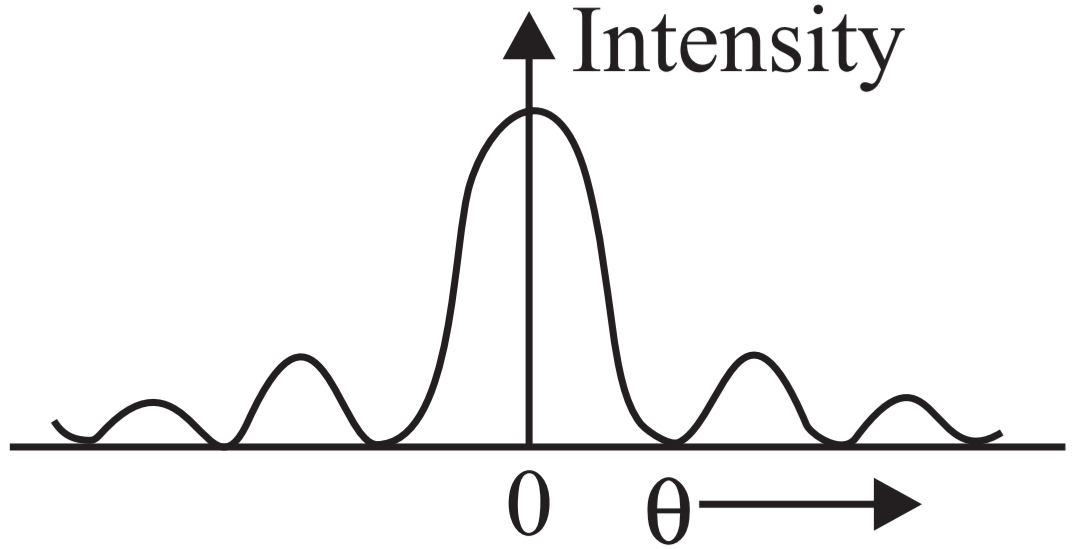
  1. (c) Finite but much larger than the surrounding maxima.

Explanation:

diffraction pattern is shown in the figure. From the graph it is clear that the intensity of the central point is finite but much larger than the surrounding maxima.

  1. (a) Wavelength of light decreases.

Explanation:

Resolving power of telescope $=\frac{\text{a}}{1.22\lambda}$

$\therefore$ It increases when wavelength of light decreases and/or objective lens of greater diameter is used.

  1. (a) 2 : 1

Explanation:

Width of central maxima $=\frac{2\lambda\text{D}}{\text{e}}$

width of other secondary maxima $=\frac{\lambda\text{D}}{\text{e}}$

$\therefore$ Width of central maxima: width ofother secondary maxima 

= 2 : 1

View full question & answer
Question 104 Marks
Wavefront is a locus of points which vibratic in same phase. A ray of light is perpendicular to the wavefront. According to Huygens principle, each point of the wavefront is the source of a secondary disturbance and the wavelets connecting from these points spread out in all directions with the speed of wave.
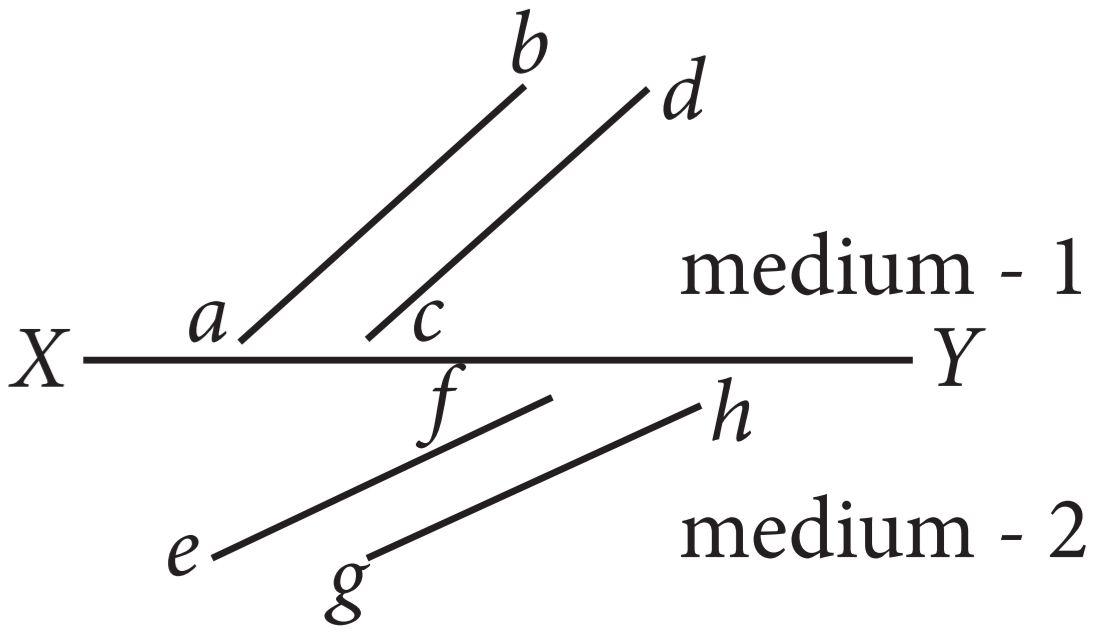
The figure shows a surface XY separating two transparent media, medium-I and medium-2. The lines ab and cd represent wavefronts of a light wave travelling in medium- 1 and incident on XY. The lines ef and gh represent wavefronts of the light wave in medium-2 after refraction.

  1. Light travels as a:
  1. Parallel beam in each medium.
  2. Convergent beam in each medium.
  3. Divergent beam in each medium.
  4. Divergent beam in one medium and convergent beam in the other medium.
  1. The phases of the light wave at c, d, e and f are $\phi_\text{c},\phi_\text{d},\phi_\text{e}$ and $\phi_\text{f}$ respectively. It is given that $\phi_\text{c}\not=\phi_\text{f}$
  1. $\phi_\text{c}$ cannot be equal $\phi_\text{d}$
  2. $\phi_\text{d}$ cannot be equal $\phi_\text{e}$
  3. $(\phi_\text{d}-\phi_\text{f})$ is equal to $(\phi_\text{c}-\phi_\text{e})$
  4. $(\phi_\text{d}-\phi_\text{c})$ is not equal to $(\phi_\text{f}-\phi_\text{e})$
  1. Wavefront is the locus of all points, where the particles of the medium vibrate with the same.
  1. Phase
  2. Amplitude
  3. Frequency
  4. Period
  1. A point source that emits waves uniformly in all directions, produces wavefronts that are:
  1. Spherical
  2. Elliptical
  3. Cylindrical
  4. Planar
  1. What are the types of wavefronts?
  1. Spherical
  2. Cylindrical
  3. Plane
  4. All of these.
Answer
  1. (a) Parallel beam in each medium.

Explanation:

Since the path difference between two waveform is equal, light traves as parallel beam in each medium.

  1. (c) $(\phi_\text{d}-\phi_\text{f})$ is equal to $(\phi_\text{c}-\phi_\text{e})$

Explanation:

Since all points on the wavefront are in the same phase,

$\phi_\text{d}=\phi_\text{c}$ and $\phi_\text{f}=\phi_\text{e}$

$\therefore\phi_\text{d}-\phi_\text{f}=\phi_\text{c}-\phi_\text{e}$

  1. (a) Phase

Explanation:

Wavefront is the locus of all points, where the particles of the medium vibrate with the same phase.

  1. (a) Spherical
  1. (d) All of these.
View full question & answer
Question 114 Marks
If double slit apparatus is immersed in a liquid of refractive index, $\mu$ the wavelength of light reduces to $\lambda$ and fringe width also reduces to $\beta=\frac{\beta}{\mu}$.
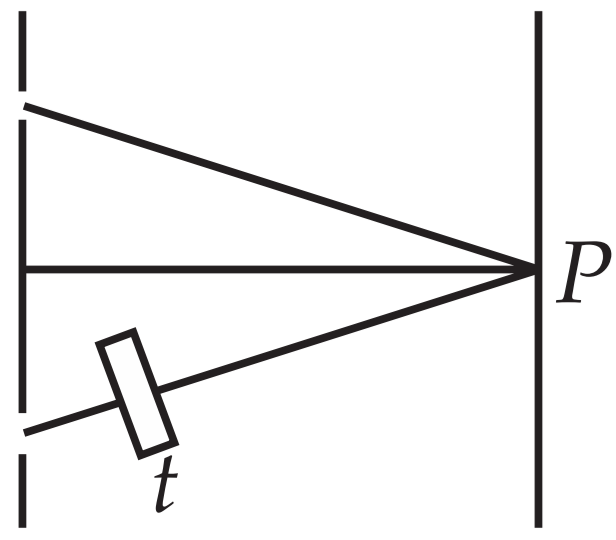
The given figure shows a double-slit experiment in which coherent monochromatic light of wavelength $\lambda$ from a distant source is incident upon the two slits, each of width $\text{w}(\text{w}>>\lambda)$ and the interference pattern is viewed on a distant screen. A thin piece of glass of thickness t and refractive index n is placed between one of the slit and the screen, perpendicular to the light path.

  1. ln Young's double slit interference pattern, the fringe width.
  1. Can be changed only by changing the wavelength of incident light.
  2. Can be changed only by changing the separation between the two slits.
  3. Can be changed either bychangingthe wavelength or by changing the separation between two sources.
  4. Is a universal constant and hence cannot be changed.
  1. If the width w ofone of the slits is increased to 2w, the become the amplitude due to slit.
  1. $1.5\text{a}$
  2. $\frac{\text{a}}{2}$
  3. $2\text{a}$
  4. No change.
  1. ln YDSE, let A and B be two slits. Films of thicknesses tA and tB and refractive indices mA and mB are placed in front of A and B, respectively. If $\mu_\text{A}\text{t}_\text{A}=\mu_\text{B}\text{t}_\text{B}$ then the central maxima will:
  1. Not shift.
  2. Shift towards A.
  3. Shift towards B.
  4. Shift towards A if tB = tA and shift towards B if tB < tA
  1. ln Young's double slit experiment, a third slit is made in between the double slits. Then:
  1. Fringes of unequal width are formed.
  2. Contrast between bright and dark fringes is reduced.
  3. Intensity of fringes totally disappears.
  4. Only bright tight is observed on the screen.
  1. ln Young's double slit experiment, if one of the slits is covered with a microscope cover slip, then:
  1. Fringe pattern disappears.
  2. The screen just gets illuminated.
  3. In the fringe pattern, the brightness of the bright fringes will decreases and the dark fringes will become more dark.
  4. Bright fringes will be more bright and dark fringes will become more dark.
Answer
  1. (c) Can be changed either bychangingthe wavelength or by changing the separation between two sources.

Explanation:

ln Young's double slit experiment, the fringe width is $\beta=\frac{\text{D}\lambda}{\text{d}}$ where D is the distance of the slits from the screen, dis the separation of the slits and $\lambda$ the wavelength. Therefore the fringe width $\beta$ can be changed either by changing the separation between the sources or the distance of the screen from the sources.

  1. (c) $2\text{a}$

Explanation:

As the width of one of the slits is increased to 2w, the amplitude due to slit become 2a.

  1. (d) Shift towards A if $\text{t}_\text{B} = \text{t}_\text{A}$ and shift towards B if $\text{t}_\text{B} <\text{t}_\text{A}$.

Explanation:

$\triangle\text{x}=(\mu_\text{A}-1)\text{t}_\text{A}-(\mu_\text{B}-1)\text{t}_\text{B}$

$=\mu_\text{A}\text{t}_\text{A}-\mu_\text{B}\text{t}_\text{B}-\text{t}_\text{A}+\text{t}_\text{B}=\text{t}_\text{B}-\text{t}_\text{A}$

If $\triangle\text{x}>0$, then fringe pattern will shift upward.

If $\triangle\text{x}<0$, then fringe pattern will shift downwards.

  1. (b) Contrast between bright and dark fringes is reduced.

Explanation:

Contrast between the bright and dark fringes will be reduced.

  1. (a) Fringe pattern disappears.

Explanation:

Since, one of the slit is covered, interference will not occur and fringe pattem will disappear.

View full question & answer
Question 124 Marks
ln Young's double slit experiment, the width of the central bright fringe is equal to the distance between the first dark fringes on the two sides of the central bright fringe.
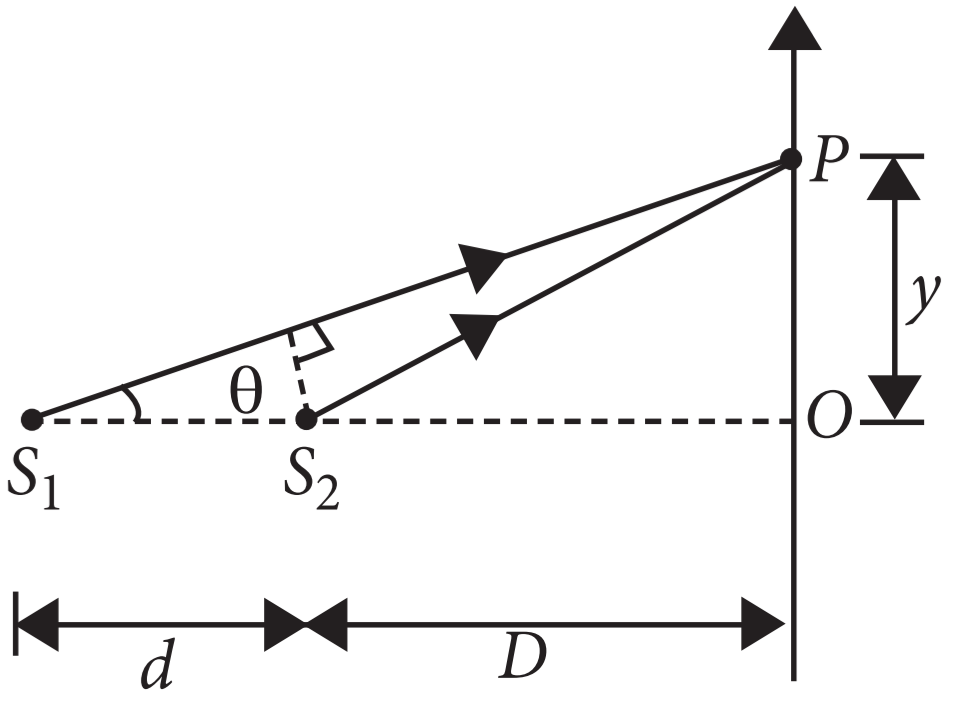
ln given figure below a screen is placed normal to the tine joining the two point coherent source S1 and S2. The interference pattern consists of concentric circles.

  1. The optical path difference at P is:
  1. $\text{d}\Big[1+\frac{\text{y}^2}{2\text{D}}\Big]$
  2. $\text{d}\Big[1+\frac{2\text{D}}{\text{y}^2}\Big]$
  3. $\text{d}\Big[1-\frac{\text{y}^2}{2\text{D}^2}\Big]$
  4. $\text{d}\Big[2\text{D}-\frac{1}{\text{y}^2}\Big]$
  1. Find the radius of the nth bright fringe.
  1. $\text{D}\sqrt{1\Big(1-\frac{\text{n}\lambda}{\text{d}}\Big)}$
  2. $\text{D}\sqrt{2\Big(1-\frac{\text{n}\lambda}{\text{d}}\Big)}$
  3. $2\text{D}\sqrt{2\Big(1-\frac{\text{n}\lambda}{\text{d}}\Big)}$
  4. $\text{D}\sqrt{2\Big(1-\frac{\text{n}\lambda}{2\text{d}}\Big)}$
  1. If $\text{d}=0.5\text{mm}.\lambda=5000\mathring{\text{A}}$ and D = 100cm, find the value of n for the closest second bright fringe.
  1. 888
  2. 830
  3. 914
  4. 998
  1. The coherence of two light sources means that the light waves emitted have.
  1. Same frequency.
  2. Same intensity.
  3. Constant phase difference.
  4. Same velocity.
  1. The phenomenon of interference is shown by:
  1. Longitudinal mechanical waves only.
  2. Transverse mechanical waves only.
  3. Electromagnetic waves only.
  4. All of these.
Answer
  1. (c) $\text{d}\Big[1+\frac{\text{y}^2}{2\text{D}}\Big]$

Explanation:

The optical path difference at P is

$\triangle\text{x}=\text{S}_1\text{P}-\text{S}_2\text{P}=\text{d}\cos\theta$

$\because\cos\theta=1-\frac{\theta^2}{2}$ for small $\theta$

$\therefore\triangle\text{x}=\text{d}\Big(1-\frac{\theta^2}{2}\Big)=\text{d}\Big[1-\frac{\text{y}^2}{2\text{D}^2}\Big]$, where D + d = D

  1. (b) $\text{D}\sqrt{2\Big(1-\frac{\text{n}\lambda}{\text{d}}\Big)}$

Explanation:

For nth maxima,

$\Rightarrow\triangle\text{x}=\text{n}\lambda$

$\text{d}\Big[1-\frac{\text{y}^2}{2\text{D}^2}\Big]=\text{n}\lambda$

y = radius of the nth bright ring

$=\text{D}\sqrt{2\Big(1-\frac{\text{n}\lambda}{\text{d}}\Big)}$

  1. (d) 998

Explanation:

At the central maxima, $\theta=0$.

$\triangle\text{x}=\text{d}=\text{n}\lambda$

$\Rightarrow\text{n}=\frac{\text{d}}{\lambda}=\frac{0.5}{0.5\times10^{-3}}=1000$

Hence, for the closet second bright fringe, n = 998.

  1. (c) Constant phase difference.

Explanation:

Light waves from two coherent sources must have a constant phase difference.

  1. (d) All of these.

Explanation:

Interference is shown by transverse as well as mechanical waves.

View full question & answer
Question 134 Marks
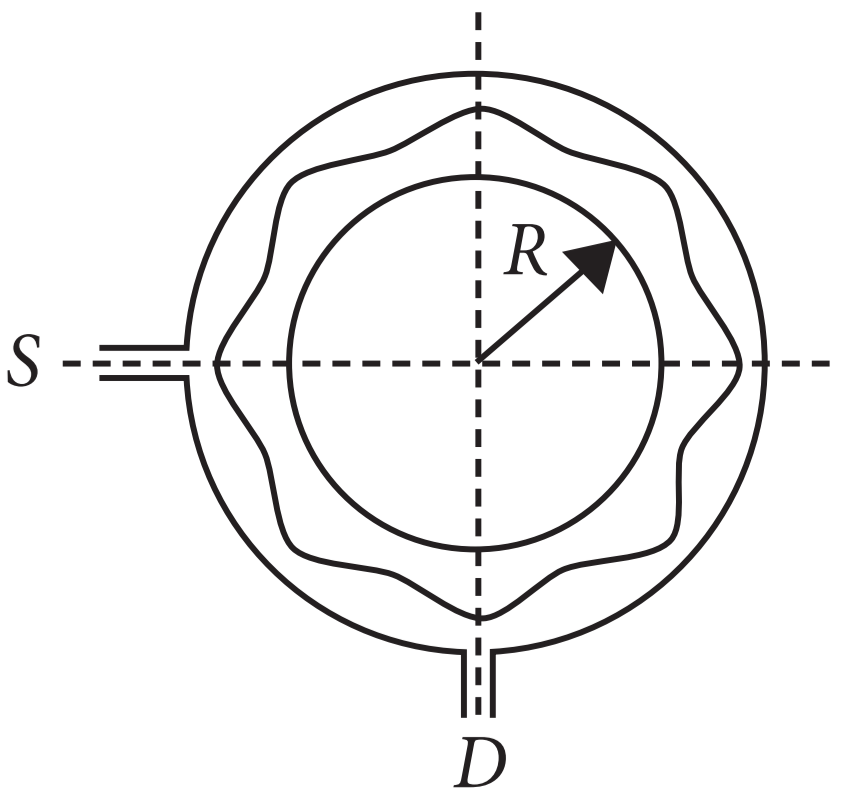
A narrow tube is bent in the form of a circle of radius R, as shown in figure. Two small holes S and D are made in the tube at the positions at right angle to each other. A source placed at S generates a wave of intensity I0 which is equally divided into two parts: one part travels along the longer path, while the other travels along the shorter path. Both the waves meet at point Dwhere a detector is place

  1. If a maxima is formed at a detector, then the magnitude of wavelength $\lambda$ of the wave produced is given by:
  1. $\pi\text{R}$
  2. $\frac{\pi\text{R}}{2}$
  3. $\frac{\pi\text{R}}{4}$
  4. All of these.
  1. If the in tensity ratio of two coherent sources used in Young's double slit experiment is 49 : 1, then the ratio between the maximum and minimum intensities in the interference pattern is:
  1. 1 : 9
  2. 9 : 16
  3. 25 : 16
  4. 16 : 9
  1. The maximum intensity produced at D is given by:
  1. 4I0
  2. 2I0
  3. I0
  4. 3I0
  1. ln a Young's double slit experiment, the intensity at a point where the path difference is $\frac{\lambda}{6}$ ($\lambda$ - wavelength of the light) is I. If I0 denotes the maximum intensity, then I/I0 is equal to:
  1. $\frac{1}{2}$
  2. $\frac{\sqrt3}{2}$
  3. $\frac{1}{\sqrt2}$
  4. $\frac{3}{4}$
  1. Two identical light waves, propagating in the same direction, have a phase differenced. After they superpose the intensity of the resulting wave will be proportional to:
  1. $\cos\delta$
  2. $\cos\Big(\frac{\delta}{2}\Big)$
  3. $\cos^2\Big(\frac{\delta}{2}\Big)$
  4. $\cos^2\delta$
Answer
  1. (d) All of these.

Explanation:

Path difference produced is

$\triangle\text{x}=\frac{3}{2}\pi\text{R}-\frac{\pi}{2}\text{R}=\pi\text{R}$

For maxi ma: $\triangle\text{x}=\text{n}\lambda$

$\therefore\text{n}\lambda=\lambda\text{R}$

$\Rightarrow\lambda=\frac{\pi\text{R}}{\text{n}},\text{n}=1,2,3,....$

Thus, the possible values of $\lambda$ are $\pi\text{R},\frac{\pi\text{R}}{2},\frac{\pi\text{R}}{3},....$

  1. (d) 16 : 9
  1. (b) 2I0

Explanation:

Maximum intensity, $\text{I}_\text{max}=\Big(\sqrt{\text{I}_1}+\sqrt{\text{I}_2}\Big)^2$

Here, $\text{I}_1=\text{I}_2=\frac{\text{I}_0}{2}$ (given)

$\therefore\text{I}_\text{max}=\Big(\sqrt{\frac{\text{I}_0}{2}}+\sqrt{\frac{\text{I}_0}{2}}\Big)^2=2\text{I}_0$

  1. (d) $\frac{3}{4}$

Explanation:

Phase difference $\phi=\frac{2\pi}{\lambda}\times$ Path difference

$\phi=\frac{2\pi}{\lambda}\times\frac{\lambda}{6}=\frac{\pi}{3}=60^\circ$

As $\text{I}=\text{I}_\text{max}\cos^2\frac{\phi}{2}$

$\therefore\text{I}=\text{I}_0\cos^2\frac{60^\circ}{2}=\text{I}_0\times\Big(\frac{\sqrt{3}}{2}\Big)^2=\frac{3}{4}\text{I}_0$

$\Rightarrow\frac{\text{I}}{\text{I}_0}=\frac{3}{4}$

  1. (c) $\cos^2\Big(\frac{\delta}{2}\Big)$

Explanation:

Here, $\text{A}^2=\text{a}^2_1+\text{a}^2_2+2\text{a}_1\text{a}_2\cos\delta\because\text{a}_1=\text{a}_2=\text{a}$

$\therefore\text{A}^2=2\text{a}^2(1+\cos\delta)=2\text{a}^2\Big(1+2\cos^2\frac{\delta}{2}-1\Big)$

or $\text{A}^2\propto\cos^2\frac{\delta}{2}$

Now $\text{I}\propto\text{A}^2\therefore\text{I}\propto\text{A}^2\propto\cos^2\frac{\delta}{2}\Rightarrow\text{I}\propto\cos^2\frac{\delta}{2}$

View full question & answer