Question
When light from a monochromatic source is incident on a single narrow slit, it gets diffracted and a pattern of ahem ate bright and dark fringes is obtained on screen, called "Diffraction Pattern" of single slit. ln diffraction pattern of single slit, it is found that.
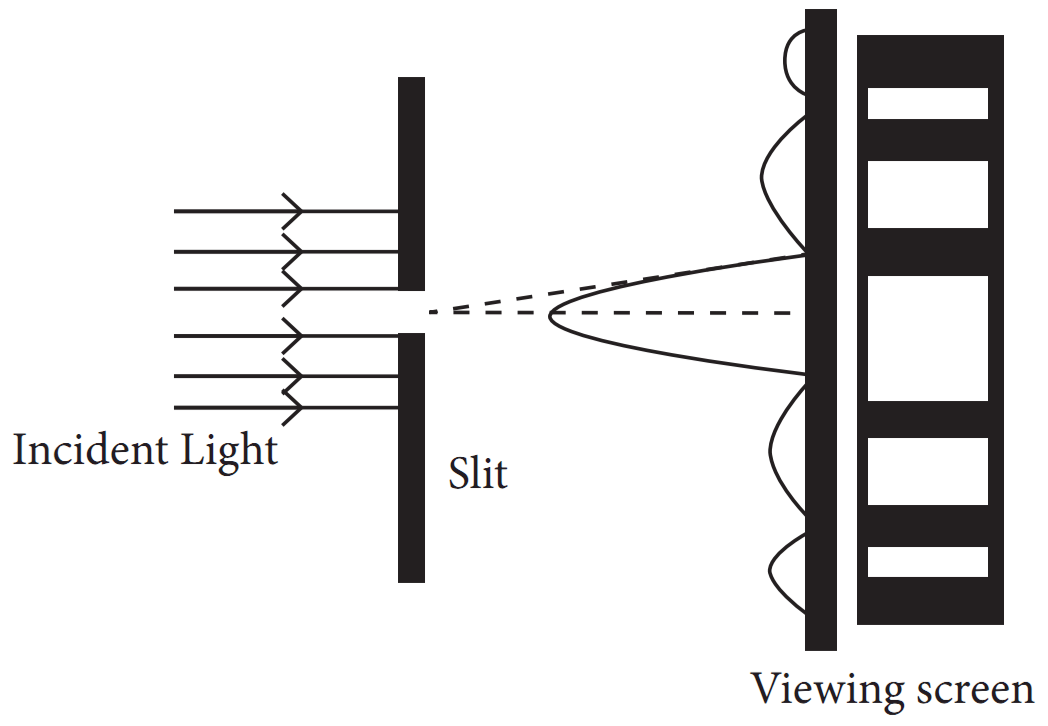
- Central bright fringe is of maximum intensity and the intensity of any secondary bright fringe decreases with increase in its order.
- Central bright fringe is twice as wide as any other secondary bright or dark fringe.
- A single slit of width 0.1mm is illuminated by a parallel beam oftight of wavelength $6000\mathring{\text{A}}$ and diffraction bands are observed on a screen 0.5m from the slit. The distance of the third dark band from the central bright band is:
- 3mm
- 1.5mm
- 9mm
- 4.5mm
- ln Fraunhofer diffraction pattern, slit width is 0.2mm and screen is at 2m away from the lens. If wavelength of tight used is $5000\mathring{\text{A}}$ then the distance between the first minimum on either side the central maximum is:
- $10^{-1}m$
- $10^{-2}m$
- $2 \times 10^{-2}m$
- $2 \times 10^{-1}m$
- Light of wavelength 600nm is incident normally on a slit of width 0.2mm. The angular width of central maxima in the diffraction pattern is (measured from minimum to minimum).
- $6 \times 10^{-3}$rad
- $4 \times 10^{-3}$rad
- $2.4 \times 10^{-3}$rad
- $4.5 \times 10^{-3}$rad
- A diffraction pattem is obtained by using a beam of red light. What will happen, if the red light is replaced by the blue light?
- Bands disappear
- Bands become broader and farther apart
- No change will take place
- Diffraction bands become narrower and crowded together.
- To observe diffraction, the size of the obstacle.
- Should be $\frac{\lambda}{2}$, where $\lambda$, is the wavelength.
- Should be of the order of wavelength.
- Has no relation to wavelength.
- Should be much larger than the wavelength.