Question
When light is refracted from air into glass

Answer

When light is refracted from air into a glass its wavelength decrease but frequency remain unchanged.

$\mu \propto \frac{1}{\lambda} \text {. As } \lambda_{ b } < \lambda_{ g }$

$\text { but } \Rightarrow f _{ b }= f _{ g }$

Need a full question paper?

Generate a complete, print-ready paper with questions like this in minutes — across 16+ boards, with answer keys.

Start Generating Free

Similar questions

The number of molecules in one litre of an ideal gas at $300 \,{K}$ and $2$ atmospheric pressure with mean kinetic energy $2 \times 10^{-9}\, {J}$ per molecules is $....\, \times 10^{11}$
Assertion : A concave mirror and convex lens both have the same focal length in air. When they are submerged in water, they will have same focal length.

Reason : The refractive index of water is smaller than the refractive index of air.
Scent sprayer is based on
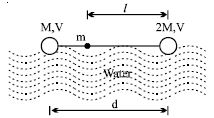
A dumbbell is placed in water of density $\rho$ . It is observed that by attaching a mass $m$ to the rod, the dumbbell floats with the rod horizontal on the surface of water and each sphere exactly half submerged as shown in the figure. The volume of the mass $m$ is negligible. The value of length $l$ is
A particle starting from rest and moving with a uniform acceleration along a straight line covers distances $a$ and $b$ in successive intervals of $p$ and $q$ second. The acceleration of the particle is
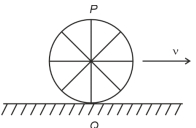
A wheel of a bullock cart is rolling on a level road as shown in the figure below. If its linear speed is $v$ in the direction shown, which one of the following options is correct ( $P$ and $Q$ are any highest and lowest points on the wheel, respectively)?
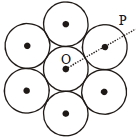
Seven identical circular planar disks, each of mass $M$ and radius $R$ are welded symmetrically as shown. The moment of inertia of the arrangement about the axis normal to the plane and passing through the point $P$ is:
Two cells of same emf but different internal resistances $I_{1}$ and $I_{2}$ are connected in series with a resistance $R$. The value of resistance $R$, for which the potential difference across second cell is zero, is
In determining the temperature of a distant star, one makes use of
$A$ block of mass $m$ moving with a velocity $v_0$ on a smooth horizontal surface strikes and compresses a spring of stiffness $k$ till mass comes to rest as shown in the figure. This phenomenon is observed by two observers:

$A$: standing on the horizontal surface

$B$: standing on the block 

According to observer $B$, the potential energy of the spring increases