Question
When light ray goes from one transparent medium to another transparent medium, it suffers a change in direction, into second medium. The extent of the change in direction suffered by the phenomenon of change in the path of light rays when going from one medium to another medium is known as refraction. Ray is a given pair of media can be expressed in terms of refractive index. The refractive index is related to an important physical quantity in the relative speed of light in different media.
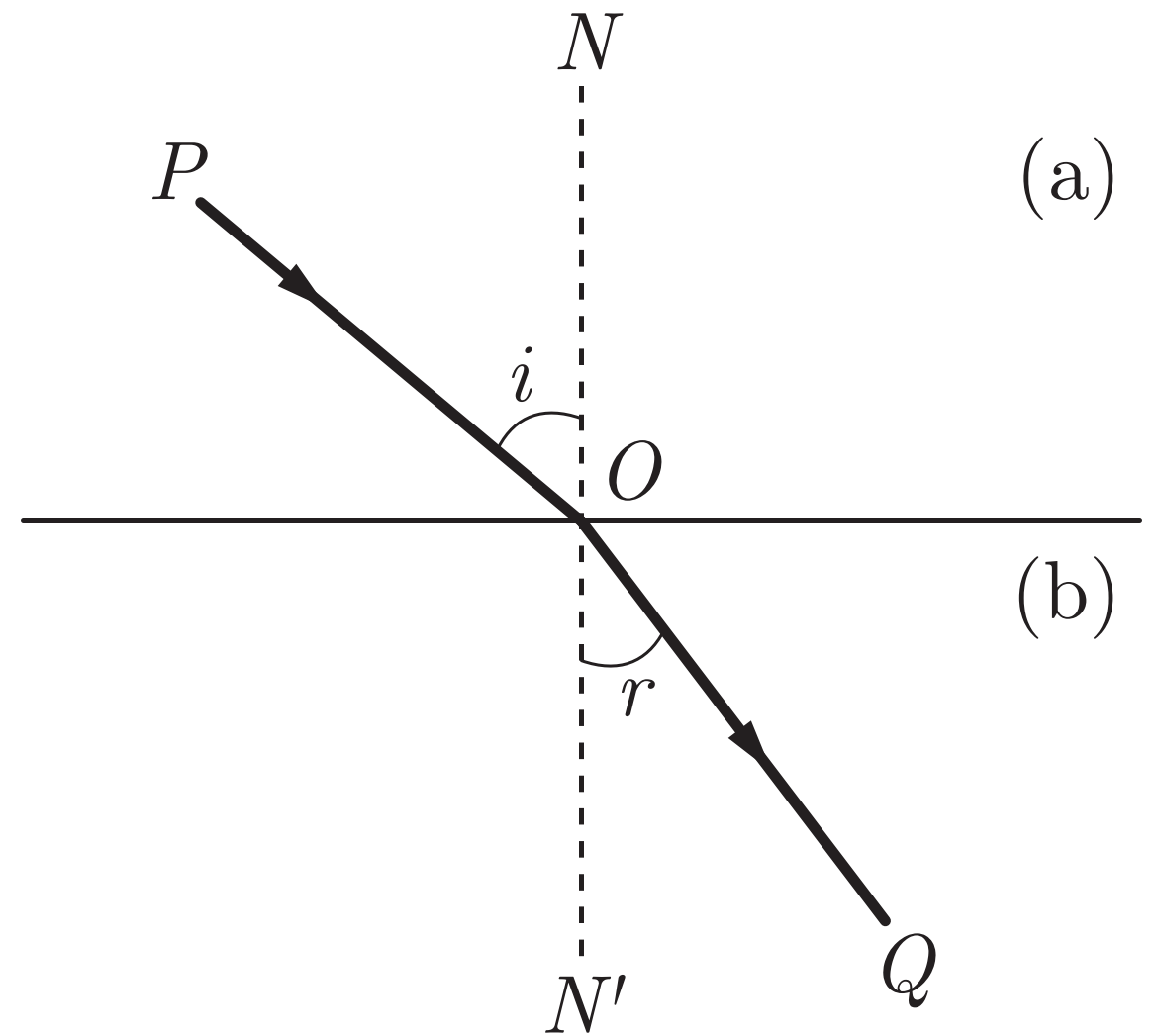
(i) A ray of light enters into the glass from air. Does it bend towards normal ?
(ii) What is the unit of refractive index?
(iii) Light enters from air to glass having refractive index 1.50. What is the speed of light in the glass? The speed of light in vacuum is $3 \times 10^3 ms ^{-1}$.
or
(iii) When light goes from one medium to another, which of the three parameters, frequency, wavelength, velocity change?
Answer

(i) Yes, it bends towards normal.
(ii) No unit.
\[n_m=\frac{\text { Speed of light in vacuum }}{\text { Speed of light in the medium }}=\frac{c}{v}\]
Speed of light in vacuum,
\[c=3 \times 10^8 ms ^{-1}\]
Refractive index of glass,
\[n_s=1.50\]
Speed of light in the glass,
\[\begin{aligned}v & =\frac{c}{n_g} \\& =\frac{3 \times 10^8}{1.50}=2 \times 10^8 ms ^{-1}\end{aligned}\]

Need a full question paper?

Generate a complete, print-ready paper with questions like this in minutes — across 16+ boards, with answer keys.

Start Generating Free

Similar questions

Read the following and answer any three questions from (i) to (iv).

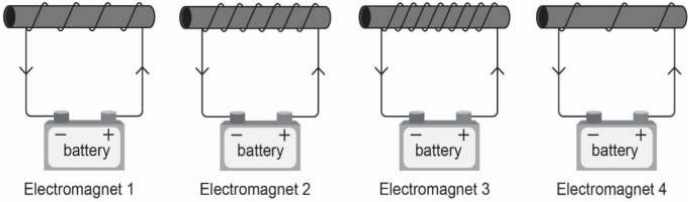
An insulated copper wire wound on a cylindrical cardboard tube such that its length is greater than its diameter is called a solenoid. When an electric current is passed through the solenoid, it produces a magnetic field around it. The magnetic field produced by a current-carrying solenoid is similar to the magnetic field produced by a bar magnet. The field tines inside the solenoid are in the form of parallel straight tines. The strong magnetic field produced inside a current-carrying solenoid can be used to magnetise a piece of magnetic material, like soft iron, when placed inside the solenoid. The strength of magnetic field produced by a current carrying solenoid is directly proportional to the number of turns and strength of current in the solenoid.

  1. The strength of magnetic field inside a long current-carrying straight solenoid is called?

  2. The north-south polarities of an electromagnet can be found easily by using which rule?

  3. Define a solenoid?

  4. A long solenoid carrying a current produces a magnetic field B along its axis. If the current is double and the number of turns per cm is halved, then new value of magnetic field will be?
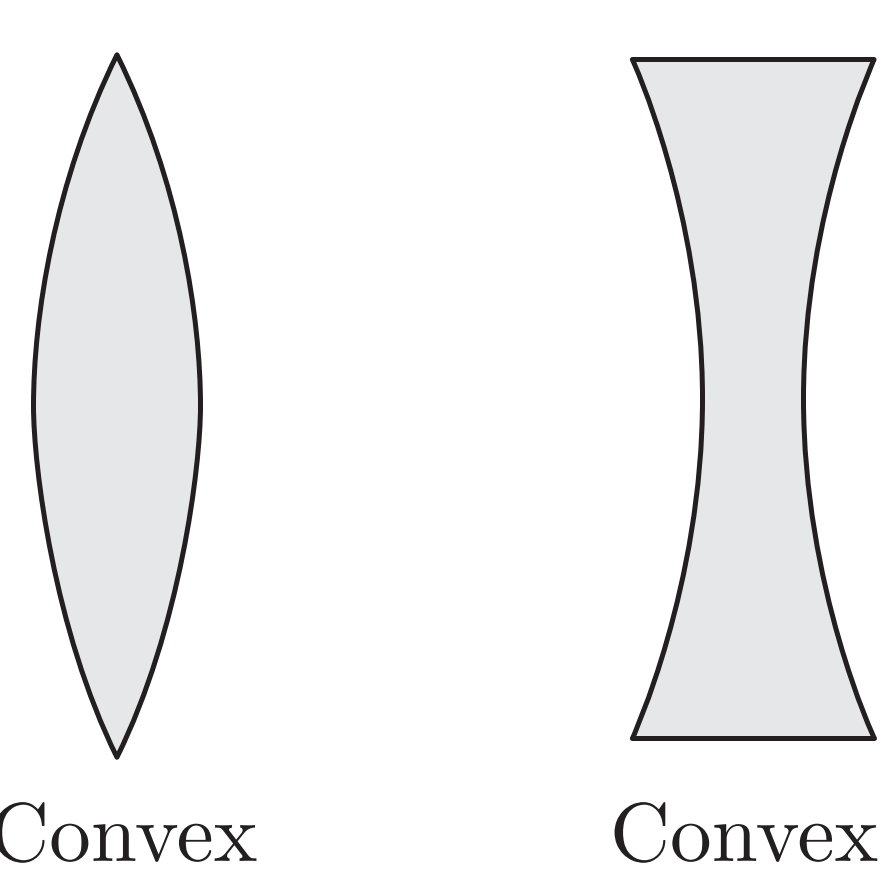
A concave lens is thick at the edges and thin at the centre, while a convex lens is thick at the centre and thin at the edges. We can distinguish between a concave lens and a convex lens without touching them. For this keep a book close to a lens and observe the image of the text of the book through the lens. If the letters appear enlarged, then it is a convex lens and if the letters appear diminished then it is a concave lens.

Convex lens converges light rays and hence known as converging lens. Similarly, concave lens diverges light rays and is known as diverging lens. Linear magnification produced by a lens is equal to the ratio of the image distance to the object distance. Power of a lens is defined as the reciprocal of its focal length.
(i) What type of image is always made by a concave lens?
(ii) If magnification produced by a spherical lens is $+0.75$, then what is the nature of the lens ?
(iii) What is the power of a convex lens with focal length $80 cm$ ?
or
(iii) What kind of lens is present in human eye?
Read the following and answer any three questions from (i) to (iv).

The obstruction offered by a conductor in the path of flow of current is called resistance. The SJ unit of resistance is ohm (Q). It has been found that the resistance of a conductor depends on the temperature of the conductor. As the temperature increases, the resistance also increases. But the resistance of alloys like mangnin, Constantin and nichrome is almost unaffected by temperature. The resistance of a conductor also depends on the length of conductor and the area of cross-section of the conductor. More be the length, more will be the resistance, more be the area of cross-section, lesser will be the resistance.

  1. Which is not will desired in material being used for making electrical wires?

  2. What is a resistance?

  3. Which resistance of alloys will unaffected by temperature?
                           OR
  4. A wire of resistance $20\Omega$ is cut into 5 equal pieces. The resistance of each part will be?
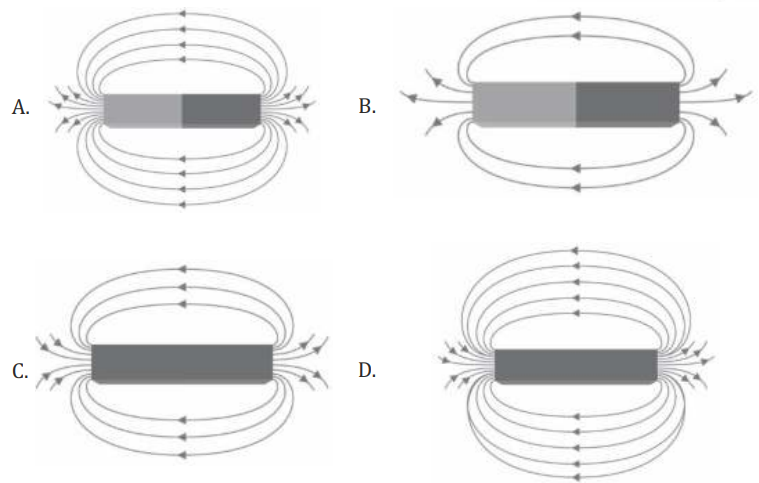
Which of these magnets has the strongest magnetic field?
Image
2. Which of these statements is true for the lines of a magnetic ield?
Circle ‘Yes’ or ‘No’ for the correct response.

Is the statement true?

Yes or No

Lines of a magnetic ield can sometimes cross each other.

Yes/No

Lines of a magnetic ield emerge from the north pole and meet at the south pole.

Yes/No

Lines of a magnetic ield can sometimes change direction.

Yes/No

Read the following and answer any three questions from (i) to (iv).

The electrical energy consumed by an electrical appliance is given by the product of its power rating and the time for which it is used. The SI unit of electrical energy is Joule. Actually, Joule represents a very small quantity of energy, and therefore it is inconvenient to use where a large quantity of energy is involved. So for commercial purposes we use a bigger unit of electrical energy which is called kilowatt-hour. 1 kilowatt-hour is equal to 3.6 × 106 joules of electrical energy.

  1. The energy dissipated by the heater is E. When the time of operating the heater is doubled, the energy dissipated will?

  2. The power of a lamp is 60W. The energy consumed in 1 minute will?

  3. The electrical refrigerator rated 400W operates 8 hours a day. The cost of electrical energy is ₹ 5 per kWh. Find the cost of running the refrigerator for one day?
                                    OR
  4. Calculate the energy transformed by a 5A current flowing through a resistor of $2\Omega$ for 30 minutes?
Study the following table for a convex lens for different positions of object and answer the following questions:
Position of objectPosition of imageRelative size of image
At infinityAt focus F_(2)Highly diminished point sized
Beyond 2F_(1)Between F_(2) and 2F_(2)Diminished
At 2F_(1)At 2F_(2)Same size
Between F_(1) and 2F_(1)Beyond 2F_(2)Enlarged
At focus F_(1)At infinityInfinitely large or highly enlarged
Between focus F_(1) and optical centre OOn the same side of the lens as the objectEnlarged

(i) What is the nature of the image, if an object is placed at infinity ?
(ii) Identify the nature of the image for which the object is between focus and optical centre.
(iii) What is position of image, when object is place at focus $\left(f_1\right)$ ?
or
(iv) What is the focal length of a lens for an object placed $50 cm$ from the lens producing virtual image at a distance of $10 cm$ in front of the lens?

Use the data in Table 12.2 to answer the following–
  1. Which among iron and mercury is a better conductor?
  2. Which matcrial is the bestconductor?
Electrical resistivity of some substances at 20°C
-MeterialResistivity ($\Omega$m)
ConductorsSilver1.60× 10-8
Copper1.60× 10-8
Aluminium2.63 × 10-8
Tungsten5.20 × 10-8
Nickel6.84 × 10-8
Iron10.0 × 10-8
Chromoium12.9 × 10-8
Mercury94.0 × 10-8
Manganese1.84 × 10-6
Constant (alloy of Cu, Mn and Ni)49× 10-6
AlloysManganin (alloy of Cu, Mn and Ni)44× 10-6
Nichrome (alloy of Ni, Cr, MN and Fe)100 × 10-6
Glass1010- 1014
InsulatorsHard rubber1013 - 1016
Ebonite1015- 1017
Diamond1012- 1013
Paper (dry)1012