Question
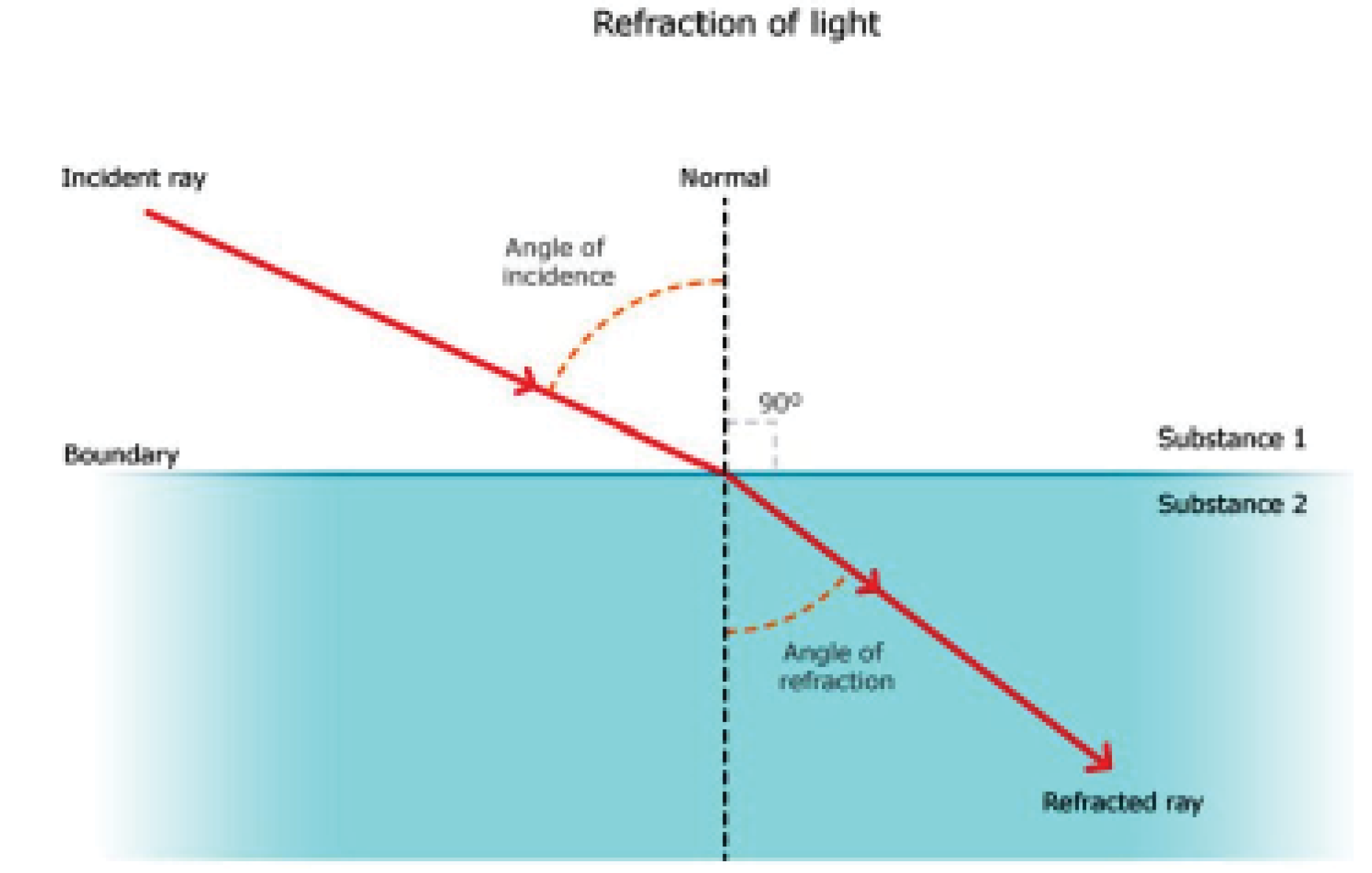
When light ray goes from one transparent medium to another transparent medium, it suffers a change in direction, into second medium. The extent of the change in direction suffered by the phenomenon of change in the path of light rays when going from one medium to another medium is known as refraction. Ray is a given pair of media can be expressed in terms of refractive index. The refractive index is related to an important physical quantity in the relative speed of light in different media.
<

(i) A ray of light enters into the glass from air. Does it bend towards normal ?
(ii) What is the unit of refractive index?
(iii) Light enters from air to glass having refractive index 1.50. What is the speed of light in the glass? The speed of light in vacuum is $3 \times 10^3 ms ^{-1}$.
or
(iii) When light goes from one medium to another, which of the three parameters, frequency, wavelength, velocity change?
Answer

(i) Yes, it bends towards normal.
(ii) No unit.
$n_m=\frac{\text { Speed of light in vacuum }}{\text { Speed of light in the medium }}=\frac{c}{v}$
Speed of light in vacuum,
$c=3 \times 10^8 ms ^{-1}$
Refractive index of glass,
$n_s=1.50$
Speed of light in the glass,
$\begin{aligned}v & =\frac{c}{n_g} \\& =\frac{3 \times 10^8}{1.50}=2 \times 10^8 ms ^{-1}\end{aligned}$

Need a full question paper?

Generate a complete, print-ready paper with questions like this in minutes — across 16+ boards, with answer keys.

Start Generating Free

Similar questions

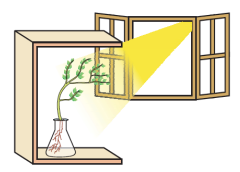
Fill a conical flask with water. Cover the neck of the flask with a wire mesh. keep two or three freshly germinated bean seeds on the wire mesh. Take a cardboard box which is open from one side. Keep the flask a wire mesh. Kin the box in such a manner that the open side of the box faces light coming from a window as shown in the given figure. After two or three days, you will notice that the shoots bend towards light and roots away from light. Now turn the flask so that the shoots are away from light and the roots towards the light. Leave it undisturbed in this condition for a few days. Plants show tropism in response to other stimuli as well. The roots of a plant always grow downwards while the shoots usually grow upwards and away from the earth. This
upward and downward growth of shoots and roots, respectively, in response to the pull of earth or gravity, is obviously, geotropism.

Image

(a) What has represented by the given activities?
(b) Do old parts of the shoot and root change direction? Is there any difference in the direction of the new growth?
(c) What can we conclude from this activity?

OR

What is geotropism?
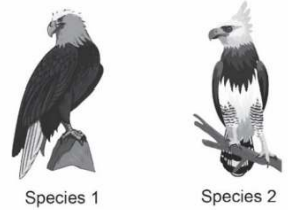
The picture shows two species of birds living in different regions.

Image
8. Which of the following is the correct genotype of the mother and the father?
A. They cannot interbreed.
B. They are not similar in shape.
C. They live in different geographical areas.
D. They have different mutations in their genes.

Read the following and answer any three questions from: (i) to (iv).Ozone layer is present in the earth's atmosphere. It is in the form of a protective shield. It contains three oxygen atoms ($O_3$) which are formed as a consequence of photochemical reactions in the environment. Ozone absorbs harmful ultraviolet radiations of the sun. In this way, it protects all living beings on the earth. The thinning of ozone layer due to various human activities allows more UV radiations to pass through it which leads to harmful effects on man, animals and plants.
  1. Ozone layer is present in which layer of the atmosphere?
     
  2. Enhanced UV-radiations would affect humans and other animals, write cause of it.
     
  3. Give some name and example of depletion of ozone layer?

    OR
  4. what is photochemical reactions?
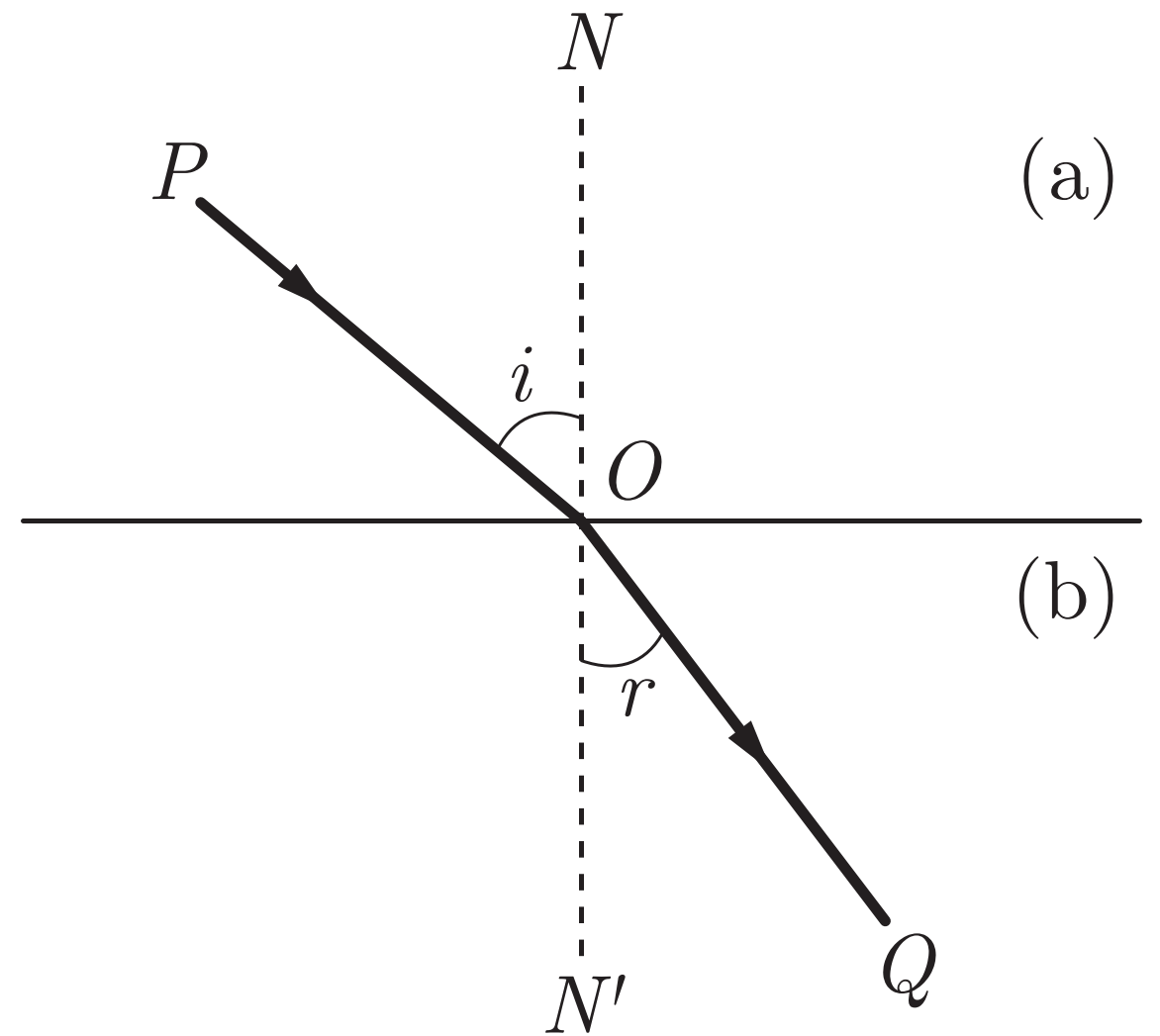
"Change in path of a light ray as it passes from one medium to another medium is called refraction of light."

When light travels from a rarer medium to a denser one, it bends towards the normal $(i>r)$ and when travels from a denser medium to a rarer one. it bends away from the normal $(i<r)$.
Where, $\quad i=$ Angle of incidence
and $\quad r=$ Angle of refraction
We can see refraction in our daily life, some of the examples are given below :
The bottom of a tank or pond containing water appears to be raised due to refraction of light which takes place when light rays pass from the pool of water into the air. The letters appear to be raised when viewed through a glass slab placed over the document because of refraction of light.
When a light ray enters in a glass slab, then the emergent ray is parallel to the incident ray but it is shifted sideward slightly.
In this case, refraction takes place twice, first when ray enters glass slab from air and second when exits from glass slab to air.
(i) What do you mean by optically rarer and denser medium ?
(ii) What is the cause of refraction?
(iii) Draw a ray diagram shotving refraction through a glass slab.
or
(iv) Give one example of refraction from our daily life experience other than the two examples given above.

Read the following and answer any three questions from (i) to (iv).Sodium chloride obtained from sea water or from lakes contains many impurities such as sulphates of sodium and magnesium, along with chlorides of calcium and magnesium. The chlorides of calcium and magnesium are particularly undesirable on account of their deliquescent nature.
For its purification, common salt is dissolved in minimum quantity of water to get a saturated solution from which insoluble impurities are filtered off. Then hydrogen chloride gas is passed through the saturated solution and the crystals of pure NaCl separate out. The soluble impurities remain in the mother liquor. The crystals are filtered, washed and dried.
  1. From were Sodium chloride is obtained?
     
  2. What is the nature of a common salt?
     
  3. Which compounds are alkaline in aqueous medium with example?

    OR
    A) What happens to hydrogen cholride in water?
    B) Hydrogen chloride gas is soluble in?
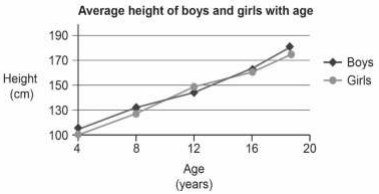
The graph shows the average height of boys and girls in a population.

Image
6. What does the graph indicate?
A. The average height of boys is always greater than that of girls.
B. The average height of girls is greater than that of boys in adulthood.
C. The average height of girls during puberty is greater than that of boys.
D. The average heights of girls and boys are the same between 4 and 20 years.
7. A student suggested a different title for the graph - ‘Height of boys and girls from birth to adulthood’.
Is the title correct? Explain your answer.
8. Which of the following statements are correct?
Circle ‘Yes’ or ‘No’ to mark your response.

Statement

Yes or No

Hormones are released directly into the bloodstream.

Yes/No

Endocrine glands use electrical impulses.

Yes/No

Sex hormones regulate changes associated with puberty.

Yes/No

9. The cerebellum in the brain controls voluntary actions of the body.
Which of these actions is controlled by the cerebellum?
A. Beating of the heart
B. Blinking of the eyes
D. Jumping from a height
C. Watering of the mouth
10. Which of these health conditions is caused by a hormonal imbalance in the body?
A. Scurvy
B. Typhoid
C. Diabetes
D. Common cold


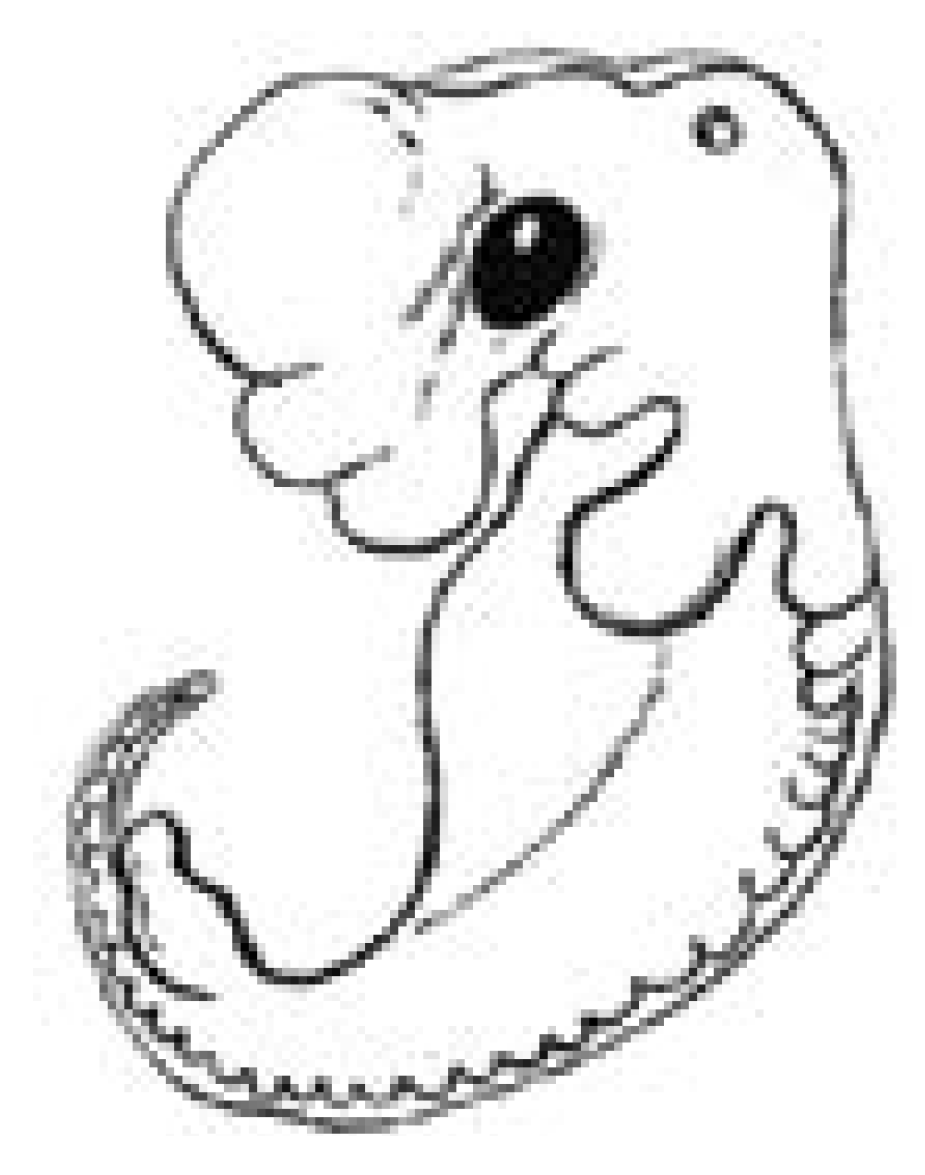
Reproduction in human beings is by sexual reproduction where both the male and female gametes fertilise to give rise to an embryo. The fertilization of the human embryo occurs inside the body of the female.

(i) Name the part of the male reproductive system where the formation of sperms takes place.
(ii) What is the placenta?
(iii) What is the other name of the oviduct?
(iv) Define the term implantation.
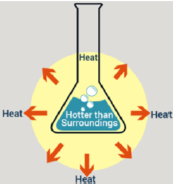
The dissolving of an acid or a base in water is a highly exothermic reaction. Care must be taken while mixing concentrated nitric acid or sulphuric acid with water. The acid must always be added slowly to water with constant stirring. If water is added to a concentrated acid, the heat generated may cause the mixture to splash out and cause burns. The glass container may also break due to excessive local heating. Look out for the warning sign on the can of concentrated sulphuric acid and on the bottle of sodium hydroxide pellets.
Image

(a) What is the exothermic reaction?
(b) Write an example of an exothermic reaction.
OR
How will you obtain sulphuric acid from an acidic oxide?
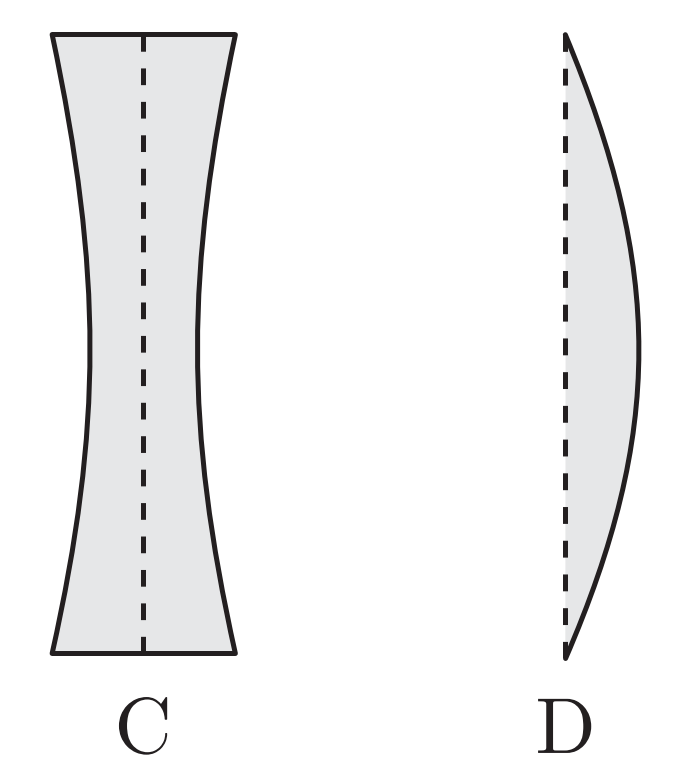
Lenses are objects made of transparent materials such as glass or clear plastic that has curved surfaces. Diverging lenses are thicker at their edges than at their centres and makes light rays passing through them spread out. Converging lenses are thicker in their middle than at this edges and make light rays passing through them focus at a point. These are used in spectacles to help people with poor vision see better. The converging lenses magnify by bending the rays of light that pass through them to meet at a point called focus. Thicker the converging lens is at its centre, the more its magnifies and closer the focus is to the lens.
(i) Ravi uses two lenses $A$ and $B$ of same size and same material as shown. $P _1$ and $P _2$ are the powers of $A$ and B. An object is kept at the same distance from the lens between $F$ and $2 F$ of each lens on the principal axis in turn. Let $I_1$ and $I_2$ be the image formed by two lenses respectively. What is the relation of image distances of both lens?
(ii) Write down the relation between the power of lens of both lenses ?
(iii) Meenakshi uses above two lenses $A$ and $B$ along with another two lenses $C$ and $D$, as shown :


She is able to see the subject matter on the black board while sitting in the front row in the classroom but is unable to see the same matter while sitting in the last row.
Which of the above four lenses will she require to correct the defect in her vision? Why ?
or
(iv) Natasha places an object on the principal axis of above given lens A. One end of this object coincides with the focus $F$ and the other end with $2 F$. What will be the nature of the image formed by the lens on the other side?

The table below shows the refractive index of different materials.

Water

Kerosene

Flint glass

Diamond

Refractive index of the material

1.33

1.44

1.65

2.42

The formula for calculating the refractive index (nm) of a material is,
$n_m=\frac{\text { Speef of light in } X}{\text { Speef of light in the medium }}$
8. What does X stand for?