Question

When light rays from the sun fall on a convex lens along a direction parallel to its axis

(a) Focal length for all colours is the same

(b) Focal length for violet colour is the shortest

(c) Focal length for yellow colour is the longest

(d) Focal length for red colour is the shortest

Answer

(b) Focal length for violet colour is the shortest

Need a full question paper?

Generate a complete, print-ready paper with questions like this in minutes — across 16+ boards, with answer keys.

Start Generating Free

Similar questions

A white screen illuminated by green and red light appears to be

(a) Green  

(b) Red

(c) Yellow

(d) White

The viscous force acting between two layers of a liquid is given by $\frac{\text{F}}{\text{A}}=-\eta\frac{\text{dv}}{\text{dz}}$ This $\frac{\text{F}}{\text{A}}$ may be called:
  1. Pressure.
  2. Longitudinal stress.
  3. Tangential stress.
  4. Volume stress.

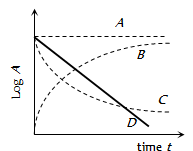
The graph which represents the correct variation of logarithm of activity (log A) versus time, in figure is

(a) A

(b) B

(c) C

(d) D

When the temperature of silicon sample is increased from 27  to 100, the conductivity of silicon will be

(a) Increased

(b) Decreased

(c) Remain same

(d) Zero

The ammeter A reads 2 A and the voltmeter V reads 20 V.  the value of resistance R is (Assuming finite resistance's of ammeter and voltmeter)

(a) Exactly 10 ohm

(b) Less than 10 ohm

(c) More than 10 ohm

(d) We cannot definitely say

If we double the radius of a coil keeping the current through it unchanged, then the magnetic field at any point at a large distance from the centre becomes approximately:

A virtual image larger than the object can be obtained by

(a) Concave mirror

(b) Convex mirror

(c) Plane mirror

(d) Concave lens

The black shapes in the figure are closed surfaces. The electric field lines are in red. For which case the net flux through the surfaces is non-zero?

Light appears to travel in straight lines since

(a) It is not absorbed by the atmosphere

(b) It is reflected by the atmosphere

(c) Its wavelength is very small

(d) Its velocity is very large

The electric field E, current density J and conductivity s  of a conductor are related as

(a) σ = E/j  

(b) σ = j/E

(c) σ = jE

(d) σ = 1/jE