MCQ
When light wave suffers reflection at the interface from air to glass, the change in phase of the reflected wave is equal to
  • A
    $0$
  • B
    $\frac{\pi }{2}$
  • $\pi $
  • D
    $2\pi $

Answer

Correct option: C.
$\pi $
c
(c) When light is reflected from denser medium, a phase difference of $\pi $always occurs.

Need a full question paper?

Generate a complete, print-ready paper with questions like this in minutes — across 16+ boards, with answer keys.

Start Generating Free

Similar questions

An inclined plane makes an angle of $30^o$ with the horizontal. $A$ solid sphere rolling  down this inclined plane from rest without slipping has a linear acceleration equal to
A particle is projected from the ground with velocity $u$ at angle $\theta$ with horizontal. The horizontal range, maximum height and time of flight are $R, H$ and $T$ respectively. They are given by $R = \frac{{{u^2}\sin 2\theta }}{g}$, $H = \frac{{{u^2}{{\sin }^2}\theta }}{{2g}}$ and $T = \frac{{2u\sin \theta }}{g}$  Now keeping $u $ as fixed, $\theta$ is varied from $30^o$ to $60^o$. Then,
$A$ man of mass $M$ stands at one end of a plank of length $L$ which lies at rest on a frictionless surface. The man walks to other end of the plank. If the mass of the plank is $\frac{M}{3}$ , then the distance that the man moves  relative to ground is :
A spring (spring constant $= k$ ) is cut into 4 equal parts and two parts are connected in parallel. What is the effective spring constant?
An object is placed at the focus of concave lens having focal length $f$. What is the magnification and distance of the image from the optical centre of the lens?
The central fringe of the interference pattern produced by light of wavelength $6000 \mathring A$ is found to shift to the position of $4^{\text {th}}$ bright fringe after a glass plate of refractive index $1.5$ is introduced in front of one slit in Young's experiment. The thickness of the glass plate will be ......... $\mu m$
A rod of length $l$ rotates with a uniform angular velocity $\omega $ about an axis passing through its middle point but normal to its length in a uniform magnetic field of induction $B$ with its direction parallel to the axis of rotation. The induced $emf$ between the two ends of the rod is
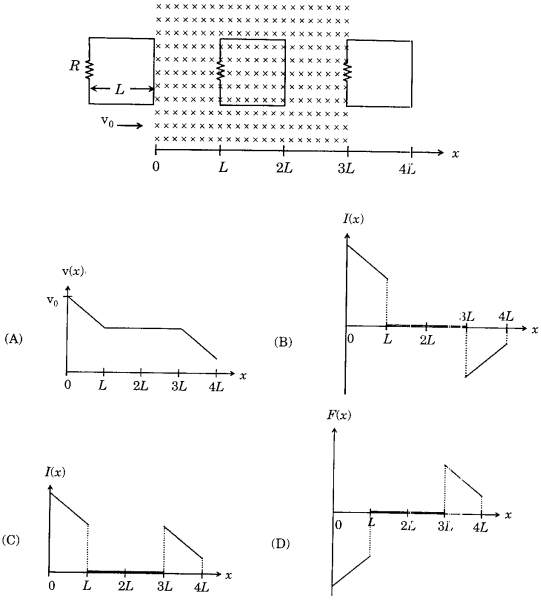
A rigid wire loop of square shape having side of length $L$ and resistance $R$ is moving along the $x$-axis with a constant velocity $\mathrm{v}_0$ in the plane of the paper. At $t=0$, th $\geqslant$ right edge of the loop enters a region of length $3 L$ where there is a uniform magnetic field $B_{i)}$ into the plane of the paper, as shown in the figure. For sufficiently large $v_0$, the loop eventually crosses the region. Let $x$ be the location of the right edge of the loop. Let $\mathrm{v}(x), I(x)$ and $F(x)$ represent the velocity of the loop, current in the loop, and force on the loop, respectively, as a function of $x$. Counter-clockwise current is taken as positive.

(image)

Which of the following schematic plot($s$) is(are) correct? (Ignore gravity)
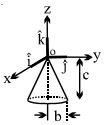
$A$ solid cone hangs from $a$ frictionless pivot at the origin $O$, as shown. If $\hat i$ , $\hat j$ and $\hat k$ are unit vectors, and $a, b$, and $c$ are positive constants, which of the following forces $F$ applied to the rim of the cone at a point $P$ results in a torque $\tau$ on the cone with a negative component $\tau_Z$ 
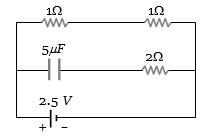
A capacitor of capacitance $5\,\mu F$ is connected as shown in the figure. The internal resistance of the cell is $0.5\,\Omega $. The amount of charge on the capacitor plate is......$\mu C$