Question
When no current is passed through a conductor:
  1. The free electrons do not move.
  2. The average speed of a free electron over a large period of time is zero.
  3. The average velocity of a free electron over a large period of time is zero.
  4. The average of the velocities of all the free electrons at an instant is zero.
Answer

  1. The average velocity of a free electron over a large period of time is zero.
  2. The average of the velocities of all the free electrons at an instant is zero.
Explanation:
No current is passed through a conductor means. That the average velocity of a free elecron over a large period of time is zero or the average of the velocity of all the free electrons at an instant is zero.

Need a full question paper?

Generate a complete, print-ready paper with questions like this in minutes — across 16+ boards, with answer keys.

Start Generating Free

Similar questions

A potentiometer consists of a wire of length 4 m and resistance 10Ω. It is connected to a cell of e.m.f. 2 V. The potential difference per unit length of the wire will be(a) 0.5 V/m(b)  2 V/m(c)  5 V/m(d) 10 V/m
       
A radioactive decay chain starts from ${ }^{93^{ Np ^{237}}}$ and produces ${ }^{93^{ Np ^{287}}}$ by successive emissions. The emitted particles can be
The photoelectric threshold wavelength for a metal surface is 6600 Å. The work function for this is(a) 1.87 V(b) 1.87 eV(c) 18.7 eV(d) 0.18 eV
       
Five balls numbered 1 to 5 are suspended using separate threads. Pairs (1, 2), (2, 4) and (4, 1) show electrostatic attraction, while pair (2, 3) and (4, 5) show repulsion. Therefore ball 1 must be(a) Positively charged(b) Negatively charged(c) Neutral(d) Made of metal
       
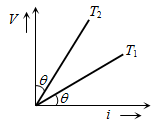
The $V-i$ graph for a conductor at temperature $T_1$ and $T_2$ are as shown in the figure. $(T_2 - T_1)$ is proportional to
The restoring couple in the moving coil galvanometer is due to:
What is the dimension of the dipole moment?
The quantity $\frac{\text{PV}}{\text{kT}}$ represents:
  1. Mass of the gas.
  2. Kinetic energy of the gas.
  3. Number of moles of the gas.
  4. Number of molecules in the gas.
In which of the following decays the element does not change?
When a current of 1 ampere is passed through a conductor whose ends are maintained at temperature difference of 1 ℃, the amount of heat evolved or absorbed is called(a) Peltier coefficient(b) Thomson coefficient(c) Thermoelectic power(d) Thermo e.m.f.