MCQ
When no current is passed through a conductor?
  • A
    The free electrons do not move.
  • B
    The average speed of a free electron over a large period of time is not zero.
  • C
    The average velocity of a free electron over a large period of time is zero.
  • The average of the velocities of all the free electrons at an instant is non zero.
Answer

Correct option: D.
The average of the velocities of all the free electrons at an instant is non zero.

Need a full question paper?

Generate a complete, print-ready paper with questions like this in minutes — across 16+ boards, with answer keys.

Start Generating Free

Similar questions

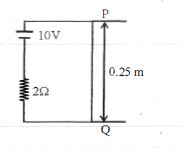
A metal wire $PQ$ slides on parallel metallic rails having separation $0.25\ m$ , each having negligible resistance .There is a $2\,\Omega $ resistor and $10\ V$ battery as shown in figure . There is a uniform magnetic field directed into the plane of the paper of magnitude $0.5\ T$ . A force of $0.5\ N$ to the left is required to keep the wire $PQ$ moving with constant speed to the right. With what speed is the wire $PQ$ moving ?........$m/s$ (Neglect self inductance of the loop)
A moving coil galvanometer has $150$ equal divisions. Its current sensitivity is $10$ divisions per milliampere and voltage sensitivity is $2$ divisions per millivolt. In order that each division reads $1\, volt$, the resistance in $ohms$ needed to be connected in series with the coil will be
Two identical positive charges $Q$ each are fixed at a distance of ' $2 a$ ' apart from each other. Another point charge qo with mass ' $m$ ' is placed at midpoint between two fixed charges. For a small displacement along the line joining the fixed charges, the charge $q_{0}$ executes $SHM$. The time period of oscillation of charge $q_{0}$ will be.
In a Young's double slit experiment, the intensities at two points, for the path difference $\frac{\lambda}{4}$ and $\frac{\lambda}{3}$ ( $\lambda$ being the wavelength of light used) are $I_1$ and $I_2$ respectively. If $I_0$ denotes the intensity produced by each one of the individual slits, then $\frac{ I _1+ I _2}{ I _0}=..............$
The magnetic potential due to a magnetic dipole at a point on its axis situated at a distance of $20 \mathrm{~cm}$ from its center is $1.5 \times 10^{-5} \  \mathrm{Tm}$. The magnetic moment of the dipole is___________ $\mathrm{Am}^2$. (Given : $\frac{\mu_0}{4 \pi}=10^{-7} \  \mathrm{TmA}^{-1}$ )
A thin slice is cut out of a glass cylinder along a plane parallel to its axis. The slice is placed on a flat glass plate as shown. The observed interference fringes from this combination shall be
In bio savart law direction of magnetic field is shown by $d\vec B = \frac{{{\mu _0}}}{{4\pi }}\frac{{I\overrightarrow {dl}  \times \vec r}}{{{r^3}}}$
A bar magnet has a magnetic moment equal to $5 \times {10^{ - 5}}\,weber \times m.$ It is suspended in a magnetic field which has a magnetic induction $(B) $ equal to $8\pi \times {10^{ - 4}}\,tesla.$ The magnet vibrates with a period of vibration equal to $15\, sec$. The moment of inertia of the magnet is
Consider a solid insulating sphere of radius $R$ with charge density varying as $\rho = \rho_0r^2$  ($\rho_0$  is a constant and r is measure from centre).Consider two points $A$ and $B$ at distance $x$ and $y$ respectively ($x < R, y > R$) from the centre. If magnitudes of electric fields at points $A$ and $B$ are equal, then
If $t_{1/2}$ is the half life of a substance then $t_{3/4}$ is the time in which substance