MCQ
When $p-n$ junction diode is forward biased
  • A
    the depletion region is reduced and barrier height is increased
  • B
     the depletion region is widened and barrier height is reduced. 
  • C
    both the depletion region and barrier height increased.
  • both the depletion region and barrier height reduced 
Answer

Correct option: D.
both the depletion region and barrier height reduced 
d
(d)In forward biasing both $V_B$ and $x$ decreases.

Need a full question paper?

Generate a complete, print-ready paper with questions like this in minutes — across 16+ boards, with answer keys.

Start Generating Free

Similar questions

Two identical balls having like charges and placed at a certain distance apart repel each other with a certain force. They are brought in contact and then moved apart to a distance equal to half their initial separation. The force of repulsion between them increases $4.5$ times in comparison with the initial value. The ratio of the initial charges of the balls is
Which of the following statement is wrong
$X-$ ray will travel minimum distance in
The depletion layer in silicon diode is $1 \ mm$ wide and the knee potential is $0.6 V,$ then the electric field in the depletion layer will be
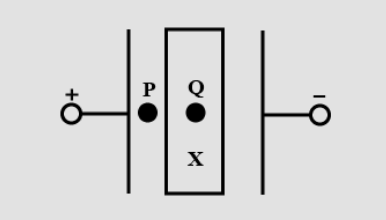
A slab $X$ is placed between the two parallel isolated charged plates as shown in the figure. If $E_p$ and $E_q$ denotes the intensity of electric field at $P$ and $Q$, then:
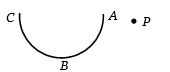
In the following diagram the work done in moving a point charge from point $P$ to point $A$, $B$ and $C$ is respectively as $W_A$, $W_B$ and $W_C$ , then
Sodium and copper have work functions $2.3\;eV$ and $ 4.5\;eV$ respectively. Then the ratio of their threshold wavelengths is nearest to
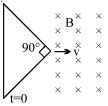
The figure shows an isosceles triangle wire frame with apex angle equal to $\pi /2$. The frame starts entering into the region of uniform magnetic field $B$ with constant velocity $v$ at $t= 0$. The longest side of the frame is perpendicular to the direction of velocity. If $i$ is the instantaneous current through the frame then choose the alternative showing the correct variation of $i$ with time.
White light is passed through a prism whose angle is 5°. If the refractive indices for rays of red and blue colour are respectively 1.64 and 1.66, the angle of deviation between the two colours will be
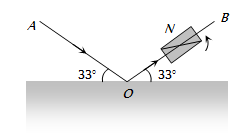
A beam of light AO is incident on a glass slab (μ = 1.54) in a direction as shown in figure. The reflected ray OB is passed through a Nicol prism on viewing through a Nicole prism, we find on rotating the prism that