Question
When pressure increases by 1%, what is the percentage decrease in the volume of a gas, if Boyle's law is obeyed?

Answer

We know PV = constant

If P is increased by 1%, then volume will decrease.

$\therefore$ (P + 0.01P)(V - dV) = PV

-PdV + 0.01PV - 0.01PdV = 0

-PdV(1 + 0.01) = -0.01PV

$\therefore\frac{\text{dV}}{\text{V}}=\frac{0.01}{1.01}$

% variation in volume = 0.98

Need a full question paper?

Generate a complete, print-ready paper with questions like this in minutes — across 16+ boards, with answer keys.
Start Generating Free

Similar questions

A hollow spherical body of inner and outer radii 6cm and 8cm respectively floats half submerged in water. Find the density of the material of the sphere.
Is it possible to place a satellite, so that it is always over New Delhi? Why?
Heat is transferred from inside a refrigerator at 287 K to a room at 310 K ideally, how much heat (in joules) will be given to the room by the expenditure of each joule of electrical energy?
The position of an object is given by x = 2t2 + 3t. Find out that its motion is uniform and non-uniform.
In what ways are the gas thermometers superior to mercury thermometers?
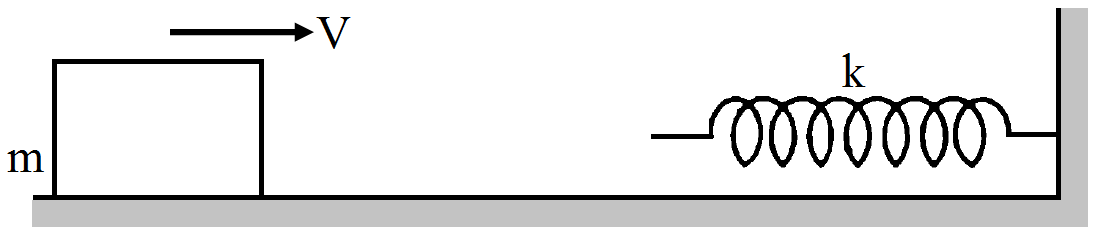
A block of massip, sliding on a smooth horizontal surface with a velocity $\vec{\text{v}}$ meets a long horizontal spring fixed at one end and having spring constant k as shown in figure. Find the maximum compression of tin spring. Will the velocity of the block be the same $\vec{\text{v}}$ when it comes back to the original position shown?

Write the number of significant digits in:
  1. 1001
  2. 100.1
  3. 100.10
  4. 0.001001
Suggest a method to produce a rainbow in your house.
On a hot summer day we want to cool our room by opening the refrigerator door and closing all the windows and doors. Will the process work ?
A copper calorimeter of mass 100g contains a lump of ice at 4°C. When 520 calories of heat are given to the calorimeter and its contents, the temperature rises from -4°C to -2°C. The addition of another 41540 calories of heat brings the temperature of the calorimeter and its contents to 2°C. Determine the specific heat capacity of copper and the mass of ice present in the calorimeter.
Given: Latent heat of fusion of ice = 80cal/ g-1
Specific heat capacity of ice = 0.5cal/ g-1(°C)-1