MCQ
When red glass is heated in dark room it will seem
  • Green
  • B
    Purple
  • C
    Black
  • D
    Yellow

Answer

Correct option: A.
Green
(a) Red and green colours are complementary to each other. When red glass is heated itabsorbs green light strongly, hence according to Kirchoff's law, the emissive power of red glassshould be maximum for green light. That's why when this heated red glass is taken in dark room it strongly emits green light and looks greenish.

Need a full question paper?

Generate a complete, print-ready paper with questions like this in minutes — across 16+ boards, with answer keys.
Start Generating Free

Similar questions

A magnetic needle lying parallel to a magnetic field requires $W$ units of work to turn it through $60^{\circ}$. The torque required to maintain the needle in this position will be
$1 kWh =$
Of the following the one which emits sound of higher pitch is
To get the maximum current from a parallel combination of $n$ identical cells each of internal resistance $r$ in an external resistance $R$, when
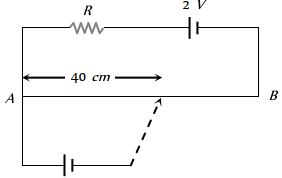
$A B$ is a potentiometer wire of length $100 \mathrm{~cm}$ and its resistance is $10$ ohms. It is connected in series with a resistance $R=40 \mathrm{ohms}$ and a battery of e.m.f. $2 V$ and negligible internal resistance. If a source of unknown e.m.f. $E$ is balanced by $40 \mathrm{~cm}$ length of the potentiometer wire, the value of $E$ is
Image
Two liquids $A$ and $B$ are at $32^{\circ} \mathrm{C}$ and $24^{\circ} \mathrm{C}$. When mixed in equal masses the temperature of the mixture is found to be $28^{\circ} \mathrm{C}$. Their specific heats are in the ratio of
A wire of length $100 \mathrm{~cm}$ is connected to a cell of emf $2 \mathrm{~V}$ and negligible internal resistance. The resistance of the wire is $3 \Omega$. The additional resistance required to produce a potential drop of 1 milli volt per $\mathrm{cm}$ is
In a semiconductor the separation between conduction band and valence band is of the order of
Ultraviolet light of wavelength $300 \mathrm{~nm}$ and intensity $1.0 \mathrm{watt} / \mathrm{m}$ falls on the surface of a photosensitive material. If $1 \%$ of the incident photons produce photoelectrons, then the number of photoelectrons emitted from an area of $1.0 \mathrm{~cm}$ of the surface is nearly
A train is moving towards east and a car is along north, both with same speed. The observed direction of car to the passenger in the train is