MCQ
When sound travels from air to water, which parameter does not change?
  • A
    all of these
  • B
    wavelength
  • C
    frequency
  • D
    velocity

Need a full question paper?

Generate a complete, print-ready paper with questions like this in minutes — across 16+ boards, with answer keys.

Start Generating Free

Similar questions

Acceleration of a body is given by $\frac{\text{dv}}{\text{dt}}=4-2\text{v}.$ The body started from rest t = 0. Then:
A sine wave of wavelength $\lambda $ is travelling in a medium. The minimum distance between the two particles, always having same speed, is
A metal ball of surface area $200\;c{m^2}$ and temperature ${527^o}C$ is surrounded by a vessel at ${27^o}C$. If the emissivity of the metal is $0.4$ , then the rate of loss of heat from the ball is .......... $joules $ approx. $(\sigma = 5.67 \times {10^{ - 8}}J/{m^2}\; - s - {k^4})$
Which of the following statements is incorrect?
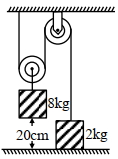
The boxes of masses $2\, {kg}$ and $8\, {kg}$ are connected by a massless string passing over smooth pulleys. Calculate the time taken by box of mass $8\; {kg}$ to strike the ground starting from rest. (use $\left.{g}=10\, {m} / {s}^{2}\right)$ (in ${s}$)
A smooth sphere $A$ is moving on a frictionless horizontal plane with angular speed $\omega $ and center of mass with velocity $v$. It collides elastically and head-on with an identical sphere $B$ at rest. Neglect friction everywhere. After the collision, their angular speeds are ${\omega _A}$ and ${\omega _B}$ respectively. Then
If we can throw a ball upto a maximum height $H$, the maximum horizontal distance to which we can throw it is
An object of mass $M$ is at rest on smooth horizontal surface. Objects of different masses collide head on elastically to the object of mass $M$ . All colliding objects are having fixed same kinetic energy and in each case mass $M$ is supposed to be at rest initially. In this experiment the kinetic energy transferred to stationary mass $(M)$ depend on linear momentum of incoming colliding mass then energy transferred to $M$ in a collision is
Heat is associated with:
  1. Kinetic energy of random motion of molecules.
  2. Kinetic energy of orderly motion of molecules.
  3. Total kinetic energy of random and orderly motion of molecules.
  4. Kinetic energy of random motion in some cases and kinetic energy of orderly motion in other.
Water falls from a height $500m$. What is the rise in temperature of water at bottom if whole energy remains in the water ........... $^\circ \mathrm{C}$