Question
When subatomic particles undergo reactions, energy is conserved, but mass is not necessarily conserved. However, a particle's mass “contributes” to its total energy, in accordance with Einstein's famous equation, $E = mc^2$ In this equation, E denotes the energy carried by a particle because of its mass. The particle can also have additional energy due to its motion and its interactions with other particles. Consider a neutron at rest and well separated from other particles. It decays into a proton, an electron and an undetected third particle as given here: Neutron → proton + electron + ???
The given table summarizes some data from a single neutron decay. Electron volt is a unit of energy. Column 2 shows the rest mass of the particle times the speed of light squared.
Particle
$Mass\times c^2$ (MeV)
Kinetic energy (MeV)
Neutron
940.97
0.00
Proton
939.67
0.01
Electron
0.51
0.39
  1. From the given table, which properties of the undetected third particle can be calculate?
  1. Total energy, but not kinetic energy.
  2. Kinetic energy, but not total energy.
  3. Both total energy and kinetic energy.
  4. Neither total energy nor kinetic energy.
  1. Assuming the table contains no major errors, what can we conclude about the $(mass \times c^2)$ of the undetected third particle?
  1. It is 0. 79 MeV
  2. It is 0.39 MeV
  3. It is less than or equal to 0.79 MeV; but we cannot be more precise.
  4. It is less than or equal to 0.40 MeV; but we cannot be more precise.
  1. Could this reaction occur?
Proton → neutron + other particles
  1. Yes, if the other particles have much more kinetic energy than mass energy.
  2. Yes, but only if the proton has potential energy (due to interactions with other particles).
  3. No, because a neutron is more massive than a proton.
  4. No, because a proton is positively charged while a neutron is electrically neutral.
  1. How much mass has to be converted into energy to produce electric power of 500MW for one hour?
  1. $2 \times 10^{-5}kg$
  2. $1 \times 10^{-5}kg$
  3. $3 \times 10^{-5}kg$
  4. $4 \times 10^{-5}kg$
  1. The equivalent energy of 1g of substance is.
  1. $9 \times 10^{13}J$
  2. $6 \times 10^{12}J$
  3. $3 \times 10^{13}J$
  4. $6 \times 10^{13}J$

Answer

  1. (a) Total energy, but not kinetic energy.
Explanation:
As just shown, energy conservation allows us to calculate the third particle's total energy. But we do not know what percentage of that total is mass energy.
  1. (d) It is less than or equal to 0.40 MeV, but we cannot be more precise.
Explanation:
According to the passage, subatomic reactions do not conserve mass. So, we cannot find the third particle's mass by setting $\text{m}_\text{neutron}$equal to $\text{m}_\text{proton}+\text{m}_\text{electron}+\text{E}_\text{thrid particle}$
The neutron has energy 940.97 MeV. The proton has energy 939.67 MeV + 0.01 MeV = 939.69 MeV. The electron has energy 0.51 MeV + 0.39 MeV = 0.90 MeV. Therefore, the third particle has energy.
$\text{E}_\text{third particle}=\text{E}_\text{neutron}-\text{E}_\text{proton}-\text{E}_\text{electron}$
$= 940.97 - 939.67 - 0.90 = 0.40$ MeV
We just found the third particle's total energy, the sum of its mass energy and kinetic energy. Without more information, we cannot figure out how much of that energy is mass energy.
  1. (b) Yes, but only if the proton has potential energy (due to interactions with other particles).
  2. (a) $2 \times 10^{-5}kg$
Explanation:
Here, $P = 500MW = 5 \times 10^8W,$
$t = 1h = 3600s$
Energy produced, $E = P \times t = 5 \times 10^8 \times 3600 = 18 \times 10^{11}J$
$\text{As}\ \text{E}=\Delta\text{mc}^2$
$\therefore\Delta\text{m}=\frac{\text{E}}{\text{c}^2}=\frac{18\times10^{11}}{(3\times10^8)^2}$
$=\frac{18\times10^{11}}{(3\times10^8)^{16}}=2\times10^{-5}\text{kg}$
  1. (a) $9 \times 10^{13}J$
Explanation:
Using, $E = mc^2$
Here, $m = 1g = 1 \times 10^{-3}kg, c = 3 \times 10^8m s^{-1}$
$\therefore E = 10^{-3} \times 9 \times 10^{16} = 9 \times 10^{13}J$

Need a full question paper?

Generate a complete, print-ready paper with questions like this in minutes — across 16+ boards, with answer keys.

Start Generating Free

Similar questions

The density of nuclear matter is the ratio of the mass of a nucleus to its volume. As the volume of a nucleus is directly proportional to its mass number A, so the density of nuclear matter is independent of the size of the nucleus. Thus, the nuclear matter behaves like a liquid of constant density. Different nuclei are like drops of this liquid, of different sizes but of same density. Let A be the mass number and R be the radius of a nucleus. If m is the average mass of a nucleon, then.Mass of nucleus = mA
$\text{Volume of nucleus }=\frac{4}{3}\pi\text{R}^3=\frac{4}{3}\pi\big(\text{R}_0\text{A}\frac{1}{3}\big)=\frac{4}{3}\pi\text{R}^3_0\text{A}$
$\therefore\text{Nuclear density},\rho\text{nu}=\frac{\text{Mass of nucleus}}{\text{Volume of nucleus}}\text{or}\ \rho\text{nu}$
$=\frac{\text{MA}}{\frac{4}{3}\pi\text{R}_0^3\text{A}}=\frac{3\text{m}}{4\pi\text{R}_0^3}$
Clearly, nuclear density is independent of mass number A or the size of the nucleus. The nuclear mass density is of the order $10^{17}kg\ m^{-3}$ This density is very large as compared to the density of ordinary matter, say water, for which $\rho = 1.0 \times 10^3kg m^{-3}$
  1. The nuclear radius of $_8^{16}\text{O}$ is $3 \times 10^{-15}m$. The density of nuclear matter is.
  1. $2.9 \times 10^{34}kg\ m^{-3}$
  2. $1.2 \times 10^{17}kg\ m^{-3}$
  3. $16 \times 10^{27}kg\ m^{-3}$
  4. $2.4 \times 10^{17}kg\ m^{-3}$
  1. What is the density of hydrogen nucleus in SI units? Given $R_o= 1.1$ fermi and $m_P = 1.007825$ amu.
  1. $1.2 \times 10^{17}kg\ m^{-3}$
  2. $3.0 \times 10^{34}kg\ m^{-3}$
  3. $1.99 \times 10^{11}kg\ m^{-3}$
  4. $7.85 \times 10^{17}kg\ m^{-3}$
  1. Density of a nucleus is.
  1. More for lighter elements and less for heavier elements.
  2. More for heavier elements and less for lighter elements.
  3. Very less compared to ordinary matter.
  4. A constant.
  1. The nuclear mass of $_{23}^{56}\text{Fe}$ is 55.85 amu. The its nuclear density is.
  1. $5.0 \times 10^{19}kg\ m^{-3}$
  2. $1.5 \times 10^{19}kg\ m^{-3}$
  3. $2.9 \times 10^{17}kg\ m^{-3}$
  4. $9.2 \times 10^{26}kg\ m^{-3}$
  1. If the nucleus of $_{13}^{27}\text{Al}$ has s a nuclear radius of about 3.6 fm, then $_{52}^{125}\text{Te}$ would have its radius approximately as.
  1. 9.6fm
  2. 12fm
  3. 4.8fm
  4. 6fm
A van is standing on a frictionless portion of a horizontal road. To start the engine, the vehicle must be set in motion in the forward direction. How can the persons sitting inside the van do it without coming out and pushing from behind?
A kid of mass M stands at the edge of a platform of radius R which can be freely rotated about its axis. The moment of inertia of the platform is I. The system is at rest when a friend throws a ball of mass m and the kid catches it. If the velocity of the ball is v horizontally along the tangent to the edge of the platform when it was caught by the kid, find the angular speed of the platform after the event.
Two submarines are approaching each other in a calm sea. The first submarine travels at a speed of 36km/h and the other at 54km/h relative to the water. The first submarine sends a sound signal (sound waves in water are also called sonar) at a frequency of 2000Hz.
  1. At what frequency is this signal received by the second submarine?
  2. The signal is reflected from the second submarine. At what frequency is this signal received by the first submarine. Take the speed of the sound wave in water to be 1500m/s.
A long bar magnet has a pole strength of 10A-m. Find the magnetic field at a point on the axis of the magnet at a distance of 5cm from the north pole of the magnet.
The nucleus was first discovered in 1911 by Lord Rutherford and his associates by experiments on scattering of $\alpha$-particles by atoms. He found that the scattering results could be explained, if atoms consist of a small, central, massive and positive core surrounded by orbiting electrons. The experimental results indicated that the size of the nucleus is of the order of $10^{-14}m$ and is thus 10000 times smaller than the size of atom.
  1. Ratio of mass of nucleus with mass of atom is approximately.
  1. $1$
  2. $10$
  3. $10^3$
  4. $10^{10}$
  1. Ratio of mass of nucleus with mass of atom is approximately.
  1. $1 : 2 : 3$
  2. $1 : 1 : 1$
  3. $1 : 1 : 2$
  4. $1 : 2 : 4$
  1. Nuclides with same neutron number but different atomic number are.
  1. Isobars
  2. Isotopes
  3. Isotones
  4. none of these
  1. If R is the radius and A is the mass number, then log R versus log A graph will be.
  1. A straight line
  2. A straight line
  3. An ellipse
  4. None of these.
  1. The ratio of the nuclear radii of the gold isotope $_{79}^{197}\text{Au}$ and silver isotope $_{47}^{107}\text{Au}$ is.
  1. $1.23$
  2. $0.216$
  3. $2.13$
  4. $3.46$
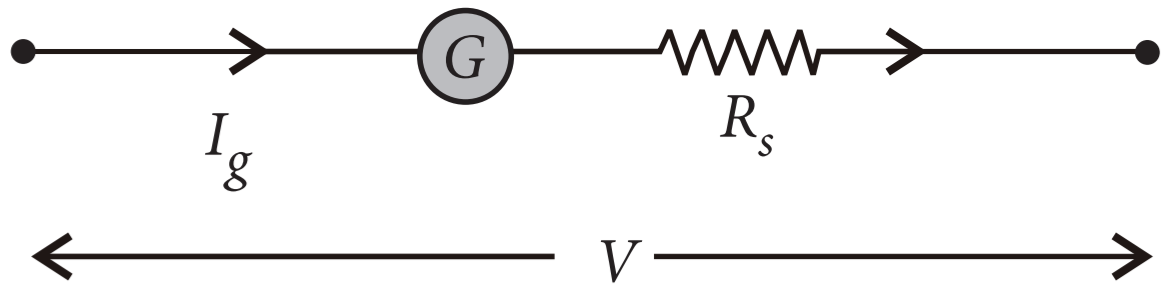
A galvanometer can be converted into voltmeter of given range by connecting a suitable resistance R, in series with the galvanometer, whose value is given by,
$\text{R}_\text{s}=\frac{\text{V}}{\text{I}_\text{g}}-\text{G}$
where Vis the voltage to be measured, lg is the current for full scale deflection of galvanometer and G is the resistance of galvanometer.

Series resistor(R,) increases range of voltmeter and the effective resistance of galvanometer. It also protects the galvanometer from damage due to large current. Voltmeter is a high resistance instrument and it is always connected in parallel with the circuit element across which potential difference is to be measured. An ideal voltmeter has infinite resistance. In order to increase the range of voltmeter n times the value of resistance to be connected in series with galvanometer is $R_s = (n - 1)G.$
  1. 10mA current can pass through a galvanometer of resistance $25\Omega$ What resistance in series should be connected through it, so that it is converted into a voltmeter of 100V?
  1. $0.975\Omega$
  2. $99.75\Omega$
  3. $975\Omega$
  4. $9975\Omega$
  1. There are 3 voltmeter A, B, C having the same range but their resistance are $15000\Omega,10000\Omega$, and $5000\Omega$ respectively. 'Tile best voltmeter amongst them is the one whose resistance is
  1. $5000\Omega$
  2. $10000\Omega$
  3. $15000\Omega$
  4. all are equally good.
  1. A milliammeter of range 0 to 25mA and resistance of $10\Omega$ is to be converted into a voltmeter with a range of 0 to 25V. 'Tile resistance that should be connected in series will be:
  1. $930\Omega$
  2. $960\Omega$
  3. $990\Omega$
  4. $1010\Omega$
  1. To convert a moving coil galvanometer (MCG) into a voltmeter:
  1. A high resistance R is connected in parallel with MCG.
  2. A low resistance R is connected in parallel with MCG.
  3. A low resistance R is connected in series with MCG.
  4. A high resistance R is connected in series with MCG.
  1. To increase the current sensitivity of a moving coil galvanometer, we should decrease:
  1. Zero.
  2. Low.
  3. High.
  4. Infinity.
Indian style of cooling drinking water is to keep it in a pitcher having porous walls. Water comes to the outer surface very slowly and evaporates. Most of energy needed for evaporation is taken from the water itself and the water is cooled down. Assume that a pitcher contains 10kg of water and 0.2g of water comes out per second. Assuming no backward heat transfer from the atmosphere to the water, calculate the time in which the temperature decrease by 5°C. Specific heat capacity of water $= {4200J kg^{-1}}^\circ C^{-1}$ and latent heat of vaporization of water $= 2.27 \times 10^6\ J\ kg^{-1}.$
A child has near point at 10cm. What is the maximum angular magnification the child can have with a convex lens of focal length 10cm?
A magnetic dipole of magnetic moment $0.72A-m^2$ is placed horizontally with the north pole pointing towards bsouth. Find the position of the neutral point if the horizontal component of the earth's magnetic field is $18\mu\text{T.}$