MCQ
When temperature increases, the frequency of a tuning fork
  • A
    Increases
  • Decreases
  • C
    Remains same
  • D
    Increases or decreases depending on the material

Answer

Correct option: B.
Decreases
b
(b) With temperature rise frequency of tuning fork decreases. Because, the elastic properties are modified when temperature is changed
also, ${n_t} = {n_s}(1 - 0.00011t)$
where ${n_t} = $ frequency at $t^\circ C$, ${n_0}$= frequency at $0^\circ C$

Need a full question paper?

Generate a complete, print-ready paper with questions like this in minutes — across 16+ boards, with answer keys.
Start Generating Free

Similar questions

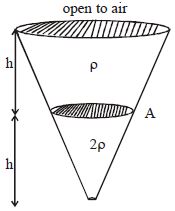
Two immiscible liquid are filled in conical flask as shown in figure. The area of cross section is shown, a small hole of area a is made in lower end of cone. Find speed of liquid flow from hole
The moment of inertia of a regular circular disc of mass $0.4\, kg$ and radius $100\, cm$ about an axis perpendicular to the plane of the disc and passing through its centre is ...... $kg\, m^2$
Pick out the statement which is not true
An open glass tube is immersed in mercury in such a way that a length of $8\ cm$ extends above the mercury level. The open end of the tube is then closed and sealed and the tube is raised vertically up by additional $46\ cm$. What will be length of the air column above mercury in the tube now ....... $cm$ ?

( Atmospheric pressure = $76\ cm$ of $Hg$)
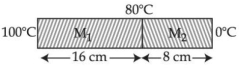
Two metallic blocks $M_{1}$ and $M_{2}$ of same area of cross-section are connected to each other (as shown in figure). If the thermal conductivity of $M _{2}$ is $K$ then the thermal conductivity of $M _{1}$ will be ]...............$K$ [Assume steady state heat conduction]
Pascal's law states that pressure in a fluid at rest is the same at all points, if:
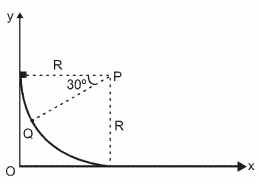
$40 \ m$. The block slides along the track without toppling and a frictional force acts on it in the direction opposite to the instantaneous velocity. The work done in overcoming the friction up to the point $Q$, as shown in the figure below, is $150 \ J$. (Take the acceleration due to gravity, $g =10 \ m s ^{-2}$ )

$1.$ The speed of the block when it reaches the point $Q$ is :

$(A)$ $5 \ ms ^{-1}$ $(B)$ $10 \ ms ^{-1}$$(C)$ $10 \sqrt{3} \ ms ^{-1}$ $(D)$ $20 \ ms ^{-1}$

$2.$ The magnitude of the normal reaction that acts on the block at the point $Q$ is :

$(A)$ $7.5 \ N$ $(B)$ $8.6 \ N$ $(C)$ $11.5 \ N$ $(D)$ $22.5 \ N$

Give the answer question $1$ and $2.$
The hour hand of a clock is $6\,cm$ long. The magnitude of the displacement of the tip of hour between $1:00\,PM$ to $5:00\,PM$ is
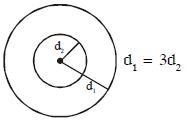
A circular disc is shown. On heating, $d_1$ increases by $0.3\%$ , then $d_2$ will
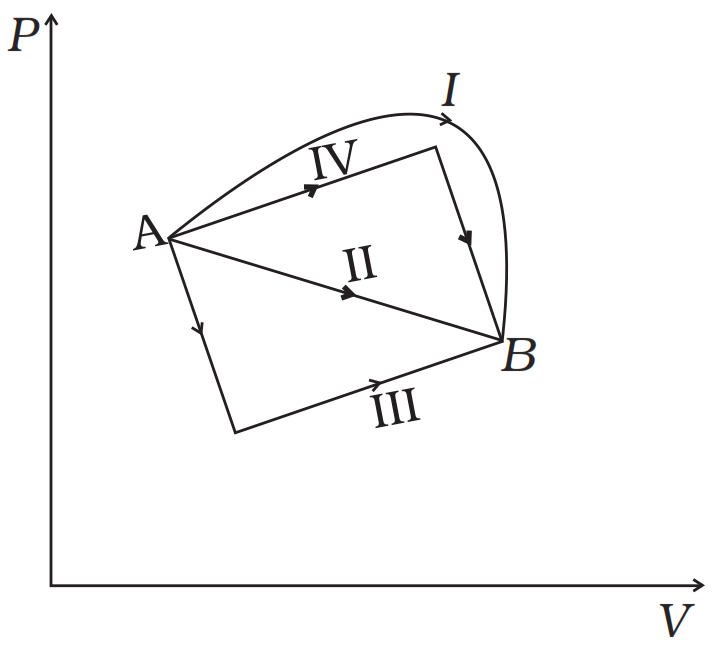
Figure. shows the $\text{P-V}$ diagram of an ideal gas undergoing a change of state from $A$ to $B$. Four different parts $\text{I, II, III}$ and $\text{IV}$ as shown in the figure may lead to the same change of state.
  1. Change in internal energy is same in $\text{IV}$ and $\text{III}$ cases, but not in $\text{I}$ and $\text{II.}$
  2. Change in internal energy is same in all the four cases.
  3. Work done is maximum in case $\text{I}$
  4. Work done is minimum in case $\text{II.}$