Question

When the accelerating voltage applied on the electrons increased beyond a critical value

(a) Only the intensity of the various wavelengths is increased

(b) Only the wavelength of characteristic relation is affected

(c) The spectrum of white radiation is unaffected

(d) The intensities of characteristic lines relative to the white spectrum are increased but there is no change in their wavelength

Answer

(d) The intensities of characteristic lines relative to the white spectrum are increased but there is no change in their wavelength

Need a full question paper?

Generate a complete, print-ready paper with questions like this in minutes — across 16+ boards, with answer keys.

Start Generating Free

Similar questions

The focal lengths of convex lens for red and blue light are 100 cm and 96.8 cm respectively. The dispersive power of material of lens is

(a) 0.325

(b) 0.0325

(c) 0.98   

(d) 0.968

If a charged particle is projected perpendicular to a uniform magnetic field, then:
  1. It revolves in circular path
  2. Its K.E. remains constant
  3. Its momentum remains constant
  4. Its path is spiral
    According to Bohr’s theory of H atom, an electron can revolve around a proton indefinitely, if its path is:

    A radioactive nucleus undergoes a series of decay according to the scheme A   If the mass number and atomic number of A are 180 and 72  respectively, then what are these number for A4

    (a) 172 and 69

    (b) 174 and 70

    (c) 176 and 69

    (d) 176 and 70

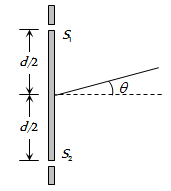
    In an interference arrangement similar to Young's double slit experiment, the slits S1 and S2 are illuminated with coherent microwave sources each of frequency 106 Hz. The sources are synchronized to have zero phase difference. The slits are separated by distance d = 150 m. The intensity I (𝜃) is measured as a function of q, where q is defined as shown. If I0 is maximum intensity, then I(θ)  for 0 ≤ θ ≤ 90° is given by

    (a) I(θ) =   for  θ = 0°

    (b) I(θ) =   for θ = 30°

    (c) I(θ) =    for θ =  90°

    (d) a, b

    A battery of e.m.f. 10 V is connected to resistance as shown in figure. The potential difference   between the points A and B is

    (a) -2V

    (b) 2V

    (c) 5V

    (d)  

    Ultraviolet light of wavelength 300 nm and intensity 1.0 watt/m2 falls on the surface of a photosensitive material. If 1% of the incident photons produce photoelectrons, then the number of photoelectrons emitted from an area of 1.0 cm2  of the surface is nearly

    (a) 9.61  per sec

    (b) 4.12  per sec

    (c) 1.51  per sec

    (d) 2.13  per sec

    A current of 0.1 A circulates around a coil of 100 turns and having a radius equal to 5cm. The magnetic field set up at the centre of the coil is (m0 = 4π × 10–7 weber/amp-metre)

    (a) 2 × 10⁻⁵ Tesla

    (b) 4 × 10⁻⁵ Tesla

    (c) 8π × 10–5 Tesla

    (d) 4π ×  10–5 Tesla

    What is the ratio of wavelength of radiations emitted when an electron in hydrogen atom jump from fourth orbit to second orbit and from third orbit to second orbit

    (a) 27 : 25

    (b) 20 : 27

    (c) 20 : 25

    (d) 25 : 27

    The property which differentiate the two kinds of charges is called as: