Question
When the base current in a transistor is changed from $30\mu\text{A}$ to $80\mu\text{A},$ the collector current is changed from 1.0mA to 3.5mA. Find the current gain $\beta.$

Answer

$\delta\text{I}_\text{b}=80\mu\text{A}-30\mu\text{A}=50\mu\text{A}=50\times10^{-6}\text{A}$

$\delta\text{I}_\text{c}=3.5\text{mA}-1\text{mA}$ $=-2.5\text{mA}=2.5\times10^{-3}\text{A}$

$\beta=\Big(\frac{\delta\text{I}_\text{c}}{\delta\text{I}_\text{b}}\Big)\text{V}_\text{ce}$ = constant

$\Rightarrow\frac{2.5\times10^{-3}}{50\times10^{-6}}=\frac{2500}{50}=50$

Current gain = 50.

Need a full question paper?

Generate a complete, print-ready paper with questions like this in minutes — across 16+ boards, with answer keys.
Start Generating Free

Similar questions

What is the direction of areal velocity of the earth around the sun?
In one-dimensional motion the velocity of a particle depends on time in the following manner :
$
v=(5 t+7) m / s
$
If the particle is at the origin at $t=0$, then what will be the position of the particle at $t=2 sec$ ?
To determine acceleration due to gravity, the time of 20 oscillations of a simple pendulum of length 100cm was observed to be 40s. Calculate the value of g and maximum percentage error in the measured value of g.
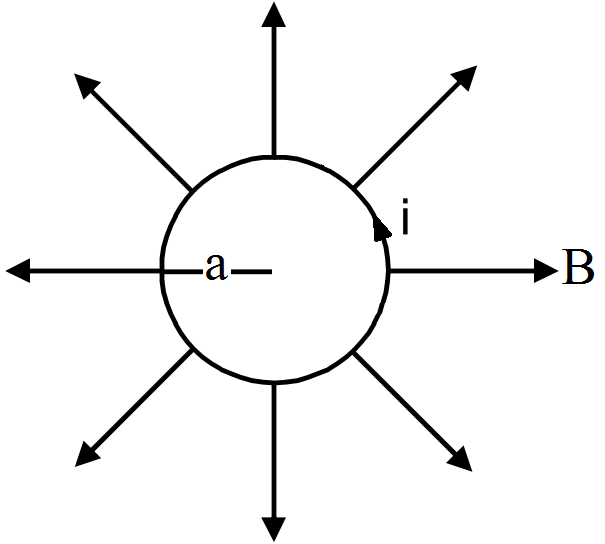
A circular loop of radius a, carrying a current i, is placed in a two-dimensional magnetic field. The centre of the loop coincides with the centre of the field The strength of the magnetic field at the periphery of the loop is B. Find the magnetic force on the wire.

Derive an expression for the height to which the liquid rises in a capillary tube of radius r.
A sphere is dropped under gravity through a fluid of viscosity $\eta$. Taking the average acceleration as half of the initial acceleration, show that the time taken to attain the terminal velocity is independent of the fluid density.
Earth also moves in circular orbit around sun once every year with on orbital radius of 1.5 × 10¹¹m. What is the acceleration of earth (or any object on the surface of the earth) towards the centre of the sun? How does this acceleration compare with g = 9.8m/ s2?
$\Big(\text{Hint: acceleration}\frac{\text{V}^2}{\text{R}}=\frac{4\pi^2\text{R}}{\text{T}^2}\Big)$
The electric field in a region is given by $\overrightarrow{\text{E}}=\frac{3}{5}\text{E}_0\overrightarrow{\text{i}}+\frac{4}{5}\text{E}_0\overrightarrow{\text{j}}$ with $\text{E}_0=2.0\times10^3\text{NC}^{-1}.$ Find the flux of this field through a rectangular surface of area 0.2m2 parallel to the y-z plane.
A hydrogen atom emits ultraviolet radiation of wavelength 102.5nm. What are the quantum numbers of the states involved in the transition?
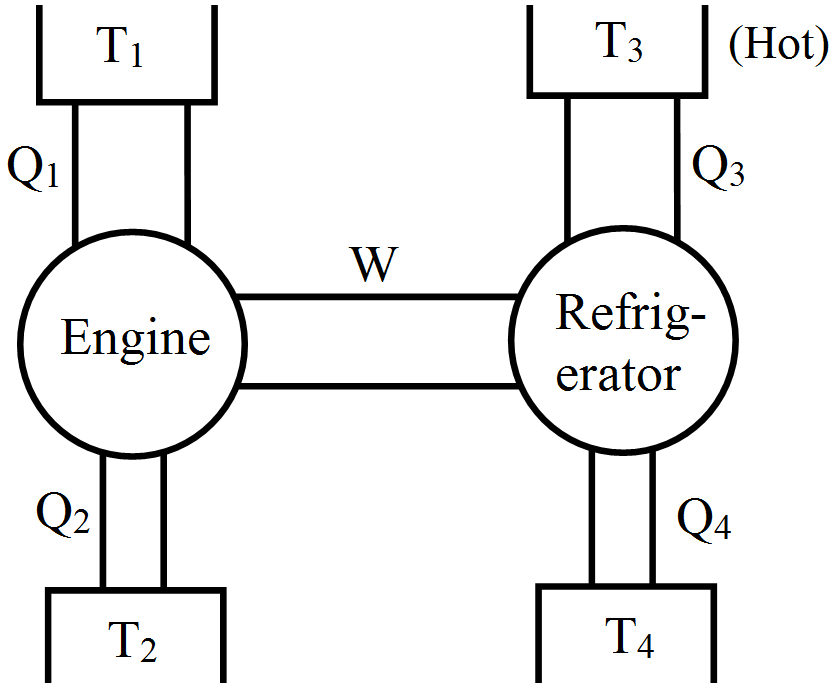
An ideal engine works between temperatures T1 and T2. It derives an ideal refrigerator that works between temperatures T3 and T4. Find the ratio $\frac{\text{Q}_3}{\text{Q}_1}$ in terms of T1, T2, T3 and T4.