MCQ
When the capillarly tube is inserted into water, the value of pressure difference between the points above and below the meniscus will be:
  • A
    $\frac{4 T}{r}$
  • $\frac{2 T}{r}$
  • C
    ${2 T}{r}$
  • D
    $4 T r$

Answer

Correct option: B.
$\frac{2 T}{r}$
B

Need a full question paper?

Generate a complete, print-ready paper with questions like this in minutes — across 16+ boards, with answer keys.

Start Generating Free

Similar questions

Dimensional formula for torque is
Velocity of sound in air is
The acceleration of a body due to the attraction of the earth (radius $R$) at a distance $2 \,R$ from the surface of the earth is ($g =$ acceleration due to gravity at the surface of the earth)
A force of $50$ dynes is acted on a body of mass $5$ g which is at rest for an interval of $3$ seconds, then impulse is
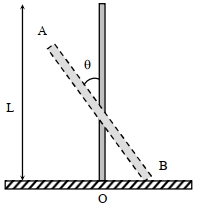
A rigid uniform bar $A B$ of length $L$ is slipping from its vertical position on a frictionless floor (as shown in the figure). At some instant of time, the angle made by the bar with the vortical is $\theta$. Which of the following statements about its motion is/are correct?

(image)

$[A]$ The midpoint of the bar will fall vertically downward

$[B]$ The trajectory of the point $\mathrm{A}$ is a parabola

$[C]$ Instantaneous torque about the point in contact with the floor is proportional to $\sin \theta$

$[D]$ When the bar makes an angle $\theta$ with the vertical, the displacement of its midpoint from the initial position is proportional to $(1-\cos \theta)$
Abarometer tube, containing mercury, is lowered in a vessel containing mercury until only $50\,\, cm$ of the tube is above the level of mercury in the vessel. If the atmospheric pressure is $75 \,\,cm$ of mercury, what is the pressure at the top of the tube?
The equation of the stationary wave is

$y = 2A\,\,\sin \,\left( {\frac{{2\pi ct}}{\lambda }} \right)\,\cos \,\,\,\left( {\frac{{2\pi x}}{\lambda }} \right)$

Which statement is not true?
When two small bubbles join to form a bigger one, energy is
Velocity of a body moving along a straight line with uniform acceleration $a$ reduces by $\frac{3}{4}$ of its initial velocity in time $t_0$. The total time of motion of the body till its velocity becomes zero is
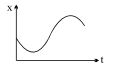
The graph of position $x$ versus time $t$ represents the motion of a particle. If $b$ and $c$ are both positive constants, which of the following expressions best describes the acceleration $a$ of the particle?