MCQ
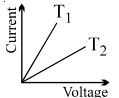
The current in a metallic conductor is plotted against voltage at two different temperatures $T_1$ and $T_2$. Which is correct
- A$T_1 > T_2$
- ✓$T_1 < T_2$
- C$T_1 = T_2$
- Dnone
Where $R=$ resistance $V=$ Voltage $I=$ Current
Also $R$ is directly proportional to temperature $T$ and inversely proportional to the slope.
$\therefore$ from the above example
$R_{1} \propto T_{1}$ and $R_{2} \propto T_{2}$
but from given figure $R_{1} < R_{2}$
$\therefore T_{1} < T_{2}$
Generate a complete, print-ready paper with questions like this in minutes — across 16+ boards, with answer keys.
Statement $I:$ If the Brewster's angle for the light propagating from air to glass is $\theta_{ B }$, then Brewster's angle for the light propagating from glass to air is $\frac{\pi}{2}-\theta_B$.
Statement $II:$ The Brewster's angle for the light propagating from glass to air is $\tan ^{-1}\left(\mu_{ g }\right)$ where $\mu_{ g }$ is the refractive index of glass.
In the light of the above statements, choose the correct answer from the options given below :
statement$-1$ : The temperature dependence of resistance is usually given as $R=R_{0}(1+\alpha \Delta t)$. The resistance of a wire changes from $100\; \Omega$ to $150\; \Omega$ when its temperature is increased from $27^{\circ} C$ to $227^{\circ} C$. This implies that $\alpha=2.5$ $\times 10^{-3} /{ }^{\circ} C$
statement$-2\;: R=R_{0}(1+\alpha \Delta t)$ is valid only when the change in the temperature $\Delta T$ is small and $\Delta R=\left(R-R_{0}\right) < < R_{0}$