Question
When the diode shows saturated current, dynamic place resistance is:
  1. Zero.
  2. Infinity.
  3. Indeterminate.
  4. Different for different diodes.

Answer

  1. Infinity.

Explanation:

Saturated current is the maximum current beyond which, there is no effect of plate voltage (VP) on the plate current (IP). At this stage, dynamic resistance is infinite.

Need a full question paper?

Generate a complete, print-ready paper with questions like this in minutes — across 16+ boards, with answer keys.

Start Generating Free

Similar questions

Read the passage given below and answer the following questions from i to v.
If an object moving along the straight line covers equal distances in equal intervals of time, it is said to be in uniform motion along a straight line. Distance and displacement are two quantities that seem to mean the same but are different with different meanings and definitions. Distance is the measure of actual path length travelled by object. It is scalar quantity having SI unit of metre while displacement refers to the shortest distance between initial and final position of object. It is vector quantity. The magnitude of the displacement for a course of motion may be zero but the corresponding path length is not zero. using this data answer following questions.
  1. Can path length be zero for motion of body from one point to other point?
  1. Yes
  2. No
  1. For any given motion from point A to B, displacement =10m and distance = 5m. Is it possible?
  1. Yes
  2. No
  1. For rectilinear motion displacement can be
  1. Positive only
  2. Negative only
  3. Can be zero
  4. All of the above
  1. Define distance and displacement of particle.
  1. Write difference between distance and displacement.
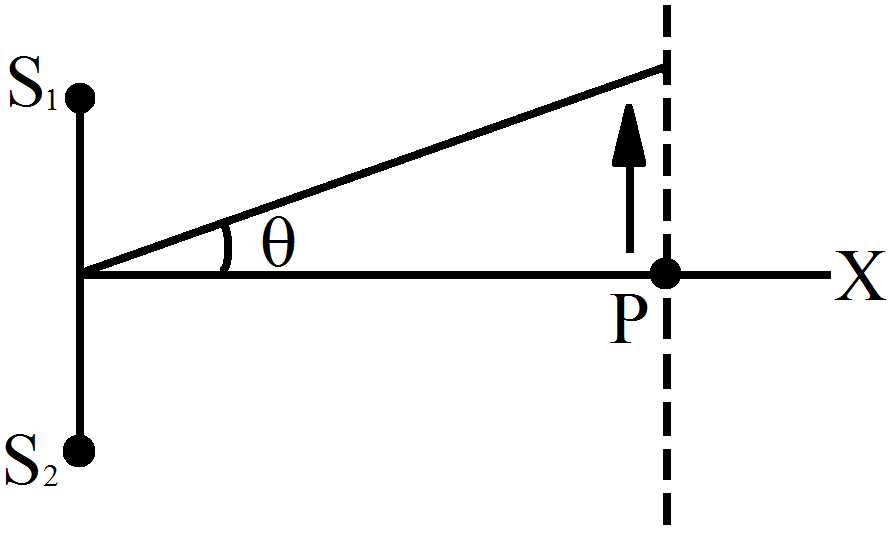
Two speakers S1 and S2, driven by the same amplifier, are placed at y = 1.0m and y = -1.0m figure, The speakers vibrate in phase at 600Hz. A man stands at a point on the X-axis at a very large distance from the origin and starts moving parallel to the Y-axis. The speed of sound in air is 330m/s.

  1. At what angle $\theta$ will the intensity of sound drop to a minimum for the first time?
  2. At what angle will he hear a maximum of sound intensity for the first time?
  3. If he continues to walk along the line, how many more maxima can he hear?

Suppose the density of air at Madras is P0 and atomospheric pressure is P0. If we go up, the density and the pressure both decrease. Suppose we wish to calculate the pressure at a height 10km above Madras. If we use the equation P- P = pogz, will we get a pressure more than the actual or less than the actual? Neglect the variation in g. Does your answer change if you also consider the variation in g?
A diode value is connected to a battery and a load resistance. The filament is heated, so that a constant current is obtained in the circuit. As the cathode continuously emits electrons, does it become more and more positively charged?
Read the passage given below and answer the following questions from (i) to (v).
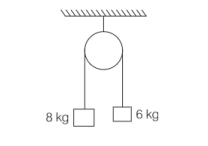
Force of Friction on Connected Bodies When bodies are in contact, there are mutual contact forces satisfying the third law of motion. The component of contact force normal to the surfaces in contact is called normal reaction. The component parallel to the surfaces in contact is called friction

In the above figure, 8 kg and 6 kg are hanging stationary from a rough pulley and are about to move. They are stationary due to roughness of the pulley.
  1. Which force is acting between pulley and rope?
  1. Gravitational force
  2. Tension force
  3. Frictional force
  4. Buoyant force
  1. The normal reaction acting on the system is
  1. 8g
  2. 6g
  3. 2g
  4. 4g
  1. The tension is more on side having mass of:
  1. 8kg
  2. 6kg
  3. Same on both
  4. Nothing can be said
  1. The force of friction acting on the rope is:
  1. 20N
  2. 30N
  3. 40N
  4. 50N
  1. Coefficient of friction of the pulley is
  1. $\frac{1}{6}$
  2. $\frac{1}{7}$
  3. $\frac{1}{5}$
  4. $\frac{1}{4}$
A transverse harmonic wave on a string is described by
$y(x, t)=3.0 \sin \left(36 t+0.018 x+\frac{\pi}{4}\right)$
where x and y are in cm and t in s. The positive direction of x is from left to right.
For the wave, plot the displacement ($y$) versus ($t$) versus ($t$) graphs for x = 0, 2 and 4 cm . What are the shapes of these graphs? In which aspects does the oscillatory motion in travelling wave differ from one point to another : amplitude, frequency or phase?
Read the passage given below and answer the following questions from 1 to 5.
For small deformations within elastic limit the stress and strain are proportional to each other. This is known as
Hooke’s law. Thus, stress α strain
Stress = k × strain
Where k is the proportionality constant and is known as modulus of elasticity. Hooke’s law is an empirical law and is found to be valid for most materials. However, there are some materials which do not exhibit this linear relationship.
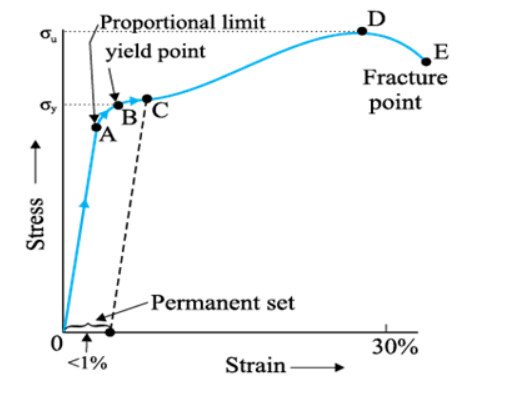
In the region from A to B, stress and strain are not proportional. Nevertheless, the body still returns to its original dimension when the load is removed. The point B in the curve is known as yield point (also known as elastic limit) and the corresponding stress is known as yield strength (σy) of the material.
If the load is increased further, the stress developed exceeds the yield strength and strain increases rapidly even for a small change in the stress. The portion of the curve between B and D shows this. When the load is removed, say at some point C between B and D, the body does not regain its original dimension. In this case, even when the stress is zero, the strain is not zero. The material is said to have a permanent set. The deformation is said to be plastic deformation. The point D on the graph is the ultimate tensile strength (σu) of the material. Beyond this point, additional strain is produced even by a reduced applied force and fracture occurs at point E. If the ultimate strength and fracture points D and E are close, the material is said to be brittle. If they are far apart, the material is said to be ductile.
  1. Stress is directly proportional to strain this is valid:
  1. Above elastic limit
  2. Within elastic limit
  3. Above plastic limit
  4. None of these
  1. SI unit of modulus of elasticity is:
  1. N/m2
  2. N
  3. No unit
  4. None of these
  1. Define modulus of elasticity.
  1. State hooks law.
  1. Write note on stress strain curve for ductile material.
Read the passage given below and answer the following questions from (i) to (v).
The velocity of an object, in general, changes during its course of motion. Initially, at the time of Galileo, it was thought that, this change m could be described by the rate of change of velocity with distance. But, through his studies of motion of freely falling objects and motion of objects on an inclined plane, Galileo concluded that, the rate of change of velocity with time is a constant of motion for all objects in free fall. This led to the concept of acceleration as the rate of change of velocity with time.
The motion in which the acceleration remains constant is known as to be uniformly accelerated motion. There are certain equations which are used to relate the displacement (x), time taken (t), initial velocity (u), final velocity (v) and acceleration (a) a for such a motion and are known as kinematics equations for uniformly accelerated motion.
  1. The displacement of a body in 8s starting from rest with an acceleration of 20 cms-2 is:
  1. 64m
  2. 640m
  3. 64cm
  4. 0.064m
  1. A particle starts with a velocity of 2ms-1 and moves in a straight line with a retardation of 0.1ms-2. The first time at which the particle is 15 m from the starting point is:
  1. 10s
  2. 20s
  3. 30s
  4. 40s
  1. If a body starts from rest and travels 120cm in 6th second, then what is its acceleration?
  1. 0.20 ms-2
  2. 0.027ms-2
  3. 0.218ms-2
  4. 003. ms-2
  1. An object starts from rest and moves with uniform acceleration a. The final velocity of the particle in terms of the distance x covered by it is given as:
  1. $\sqrt{2\text{ax}}$
  2. $2\text{ax}$
  3. $\sqrt{\frac{\text{ax}}{2}}$
  4. $\sqrt{\text{ax}}$
  1. A body travelling with uniform acceleration crosses two points A and B with velocities 20ms-1 and 30ms-1 , respectively. The speed of the body at mid-point of A and B is:
  1. $25\text{ms}^{-1}$
  2. $25.5\text{ms}^{-1}$
  3. $24\text{ms}^{-1}$
  4. $10\sqrt{6}\text{ms}^{-1}$
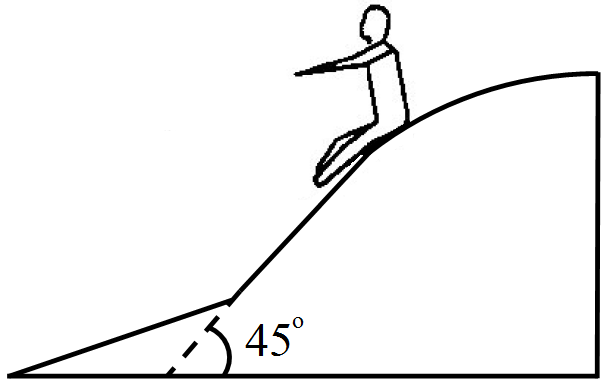
In a children-park an inclined plane is constructed with an angle of incline 45° in the middle part. Find the acceleration of a boy sliding on it if the friction coefficient between the cloth of the boy and the incline is 0.6 and g = 10m/s2.