MCQ
When the distance between the charged particles is halved, the force between them becomes
  • A
    One-fourth
  • B
    Half
  • C
    Double
  • Four times

Answer

Correct option: D.
Four times
d
(d)$F \propto \frac{1}{{{r^2}}}$; so when $r$ is halved the force becomes four times.

Need a full question paper?

Generate a complete, print-ready paper with questions like this in minutes — across 16+ boards, with answer keys.
Start Generating Free

Similar questions

Comment on the statement given below: In self$-$inductionWhen the current in a coil is increasing, induced emf opposes it
When the current in a coil is decreasing, induced emf supports it
By increasing the temperature, the specific resistance of a conductor and a semiconductor
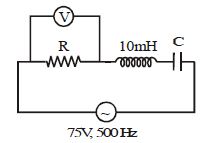
In the circuit of Figure, the volmeter reads $75\, V$. Value of $C$ is.......$ \mu F$
In winter season, a mild spark is often seen when a man touches somebody else's skin. Why?
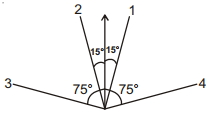
If declination at a place is known to be $15^{\circ} \,E$. And a compass needle points as shown, then geographic north is represented by the direction numbered.
Assertion : Free electrons always keep on moving in a conductor even then no magnetic force act on them in magnetic field unless a current is passed through it.

Reason : The average velocity of free electron is zero.
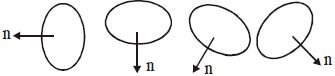
Figure represents four positions of a current carrying coil is a magnetic field directed towards right. $\hat n$ represent the direction of area of vector of the coil. The correct order of potential energy is
Assertion : The number of electrons in a $p-$ type silicon semiconductor is less than the number of electrons in a pure silicon semiconductor at room temperature.
Reason : It is due to law of mass action
A ray of light makes an angle of $10^o$ with the horizontal above it and strikes a plane mirror which is inclined at an angle $\theta$  to the horizontal. The angle $\theta$  for which the reflected ray becomes vertical is......$^o$
A wooden object floats in water kept in a beaker. The object is near a side of the beaker. Let $P_1, P_2, P_3$ be the pressures at the three points $A, B$ and $C$ of bottom as shown in the figure.