Question
When the frequency of ac supply is such that the inductive reactance and capacitive reactance become equal, the impedance of the series LCR circuit is equal to the ohmic resistance in the circuit. Such a series LCR circuit is known as resonant series LCR circuit and the frequency of the ac supply is known as resonant frequency. Resonance phenomenon is exhibited by a circuit only if both Land Care present in the circuit. We cannot have resonance in a RL or RC circuit.
A series LCR circuit with L = 0.12H, C = 480nF, $\text{R} = 23\Omega$ is connected to a 230V variable frequency supply.
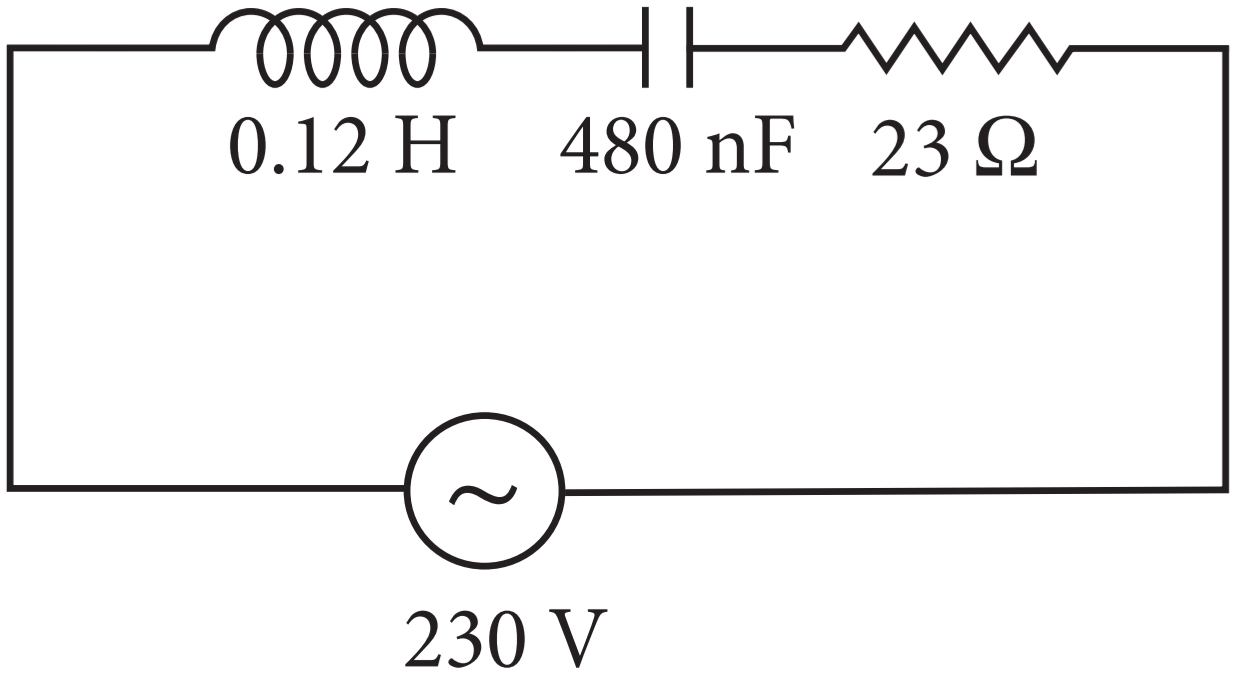
  1. Find the value of source frequency for which current amplitude is maximum.
  1. 222.32Hz
  2. 550.52Hz
  3. 663.48Hz
  4. 770Hz
  1. The value of maximum current is:
  1. 14.14A
  2. 22.52A
  3. 50.25A
  4. 47.41A
  1. The value of maximum power is:
  1. 2200W
  2. 2299.3W
  3. 5500W
  4. 4700W
  1. What is the Q-factor of the given circuit?
  1. 25
  2. 42.21
  3. 35.42
  4. 21.74
  1. At resonance which of the following physical quantity is maximum?
  1. Impedance
  2. Current
  3. Both (a) and (b)
  4. Neither (a) nor (b)

Answer

  1. (c) $663.48Hz$
Explanation:
Here, $L = 0.12H, e = 480nF = 480 \times 10^{-9}F$
$\text{R} = 23\Omega,$ V = 230V
$\text{V}_0=\sqrt{2}\times230=325.22\text{V}$
$\text{I}_0=\frac{\text{V}_0}{\sqrt{\text{R}^2+\Big(\omega\text{L}-\frac{1}{\omega\text{C}}\Big)^2}}$
At resonance, $\omega\text{L}-\frac{1}{\omega\text{C}}=0$
$\omega=\frac{1}{\sqrt{\text{LC}}}=\frac{1}{\sqrt{0.12\times480\times10^9}}=4166.67\ \text{rad}\ \text{s}^{-1}$
$\upsilon_\text{R}=\frac{4166.67}{2\times3.14}=663.48\text{H}_\text{z}$
  1. (a) $14.14A$
Explanation:
Current, $\text{I}_0=\frac{\text{V}_0}{\text{R}}=\frac{325.22}{23}=14.14\text{A}$
  1. (b)$ 2299.3W$
Explanation:
Maximum power, $\text{P}_\text{max}=\frac{1}{2}(\text{I}_0)^2\text{R}$
$=\frac{1}{2}\times(14.14)^2\times23=2299.3\text{W}$
  1. (d) $21.74$
Explanation:
Quality factor, $\text{Q}=\frac{\text{X}_\text{R}}{\text{R}}=\frac{\omega_\text{r}\text{L}}{\text{R}}$
$=\frac{4166.67\times0.12}{23}=21.74$
  1. (b) Current

Need a full question paper?

Generate a complete, print-ready paper with questions like this in minutes — across 16+ boards, with answer keys.

Start Generating Free

Similar questions

Two submarines are approaching each other in a calm sea. The first submarine travels at a speed of 36km/h and the other at 54km/h relative to the water. The first submarine sends a sound signal (sound waves in water are also called sonar) at a frequency of 2000Hz.
  1. At what frequency is this signal received by the second submarine?
  2. The signal is reflected from the second submarine. At what frequency is this signal received by the first submarine. Take the speed of the sound wave in water to be 1500m/s.
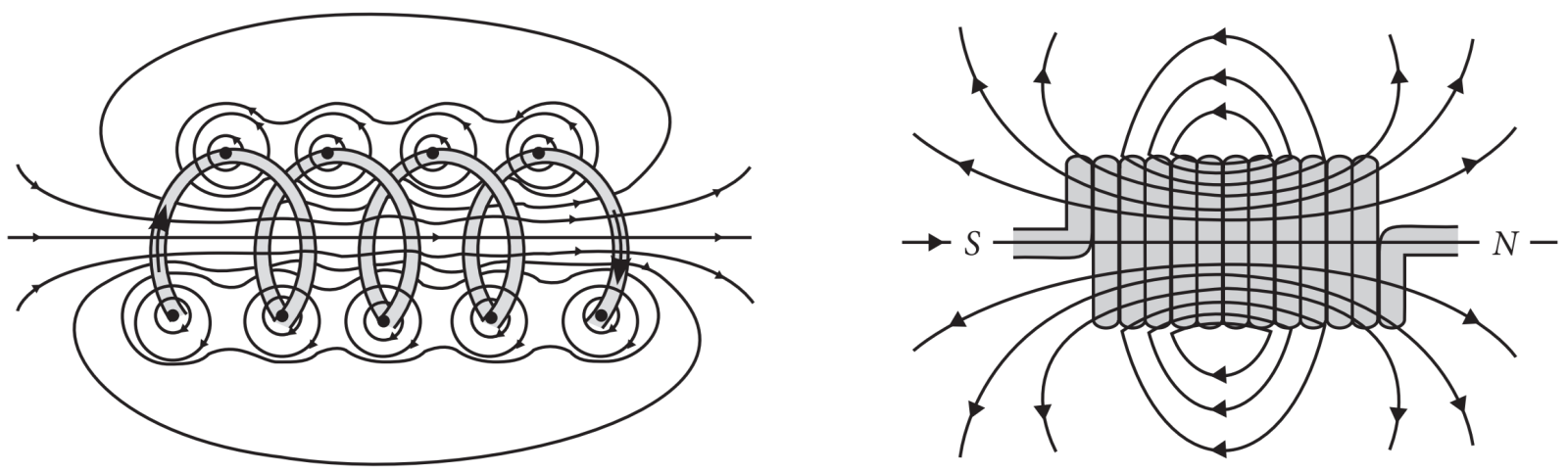
A solenoid is a long coil of wire tightly wound in the helical form. Solenoid consists of closely stacked rings electrically insulated from each other wrapped around a non-conducting cylinder.
Figure below shows the magnetic field lines of a solenoid carrying a steady current I. We see that if the turns are closely spaced, the resulting magnetic field inside the solenoid becomes fairly uniform, provided that the length of the solenoid is much greater than its diameter. for an "ideal" solenoid, which is infinitely long with turns tightly packed, the magnetic field inside the solenoid is uniform and parallel to the axis, and vanishes outside the solenoid.
  1. A long solenoid has 800 turns per metre length of solenoid. A current of 1.6A flows through it. The magnetic induction at the end of the solenoid on its axis is
  1. $10 \times 10^{-4}T$
  2. $8 \times 10^{-4}T$
  3. $32 \times 10^{-4}T$
  4. $4 \times 10^{-4}T$
  1. Choose the correct statement in the following.
  1. The magnetic field inside the solenoid is less than that of outside.
  2. The magnetic field inside an ideal solenoid is not at all uniform.
  3. The magnetic field at the centre, inside an ideal solenoid is almost twice that at the ends.
  4. The magnetic field at the centre, inside an ideal solenoid is almost half of that at the ends.
  1. The magnetic field (B) inside a long solenoid having n turns per unit length and carrying current I when iron core is kept in it is ($\mu_0$ = permeability of vacuum, = magnetic susceptibility)
  1. $\mu_0\text{ nI}(\text{l}-\chi)$
  2. $\mu_0\text{ nI }\chi$
  3. $\mu_0\text{ nI}^2(\text{1}+\chi)$
  4. $\mu_0\text{ nI}(\text{1}+\chi)$
  1. A solenoid oflength land having l turns carries a current I is in anticlockwise direction. The magnetic field is:
  1. $\mu_0\text{ nI}$
  2. $\mu_0\frac{\text{ nI}}{\text{l}^2}$
  3. A​​​​​​along the axis of solenoid.
  4. Perpendicular to the axis of coil.
  1. The magnitude of the magnetic field inside a long solenoid is increased by:
  1. Decreasing its radius.
  2. Decreasing the current through it.
  3. Increasing its area of cross-section.
  4. Introducing a medium of higher permeability.
A closed bottle contains some liquid. The bottle is shaken vigorously for 5 minutes. It is found that the temperature of the liquid is increased. Is heat transferred to the liquid? Is work done on the liquid? Neglect expansion on heating.
When light of sufficiently high frequency is incident on a metallic surface, electrons are emitted from the metallic surface. TI1is phenomenon is called photoelectric emission. Kinetic energy of the emitted photoelectrons depends on the wavelength of incident tight and is independent of the intensity of light. Number of emitted photoelectrons depends on intensity. $(\text{h}\upsilon-\phi)$ is the maximum kinetic energy of emitted photoelectrons (where $\phi$ is the work function of metallic surface). Reverse effect of photo emission produces X-ray. X-ray is not deflected by electric and magnetic fields. Wavelength of a continuous X-ray depends on potential difference across the tube. Wavelength of characteristic X-ray depends on the atomic number.
  1. Einstein's photoelectric equation is:
  1. $\text{E}_\text{max}=\text{h}\upsilon-\phi$
  2. $\text{E}=\text{mc}^2$
  3. $\text{E}^2=\text{p}^2\text{c}^2+\text{m}_0^2\text{c}^4$
  4. $\text{E}=\frac{1}{2}\text{mv}^2$
  1. Light of wavelength $\lambda$ which is less than threshold wavelength is incident on a photosensitive material. If incident wavelength is decreased so that emitted photoelectrons are moving with some velocity then stopping potential will:
  1. Increase.
  2. Decrease.
  3. Be zero.
  4. Become exactly half.
  1. When ultraviolet rays incident on metal plate then photoelectric effect does not occur, it occur by incident of:
  1. Infrared rays
  2. X-rays
  3. Radio wave
  4. Micro wave
  1. If frequency $(\upsilon>\upsilon_0)$ of incident light becomes n times the initial frequency $(\upsilon)$, then K.E. of the emitted photoelectrons becomes ($\upsilon_0$ threshold frequency).
  1. N times of the initial kinetic energy.
  2. More than n times of the initial kinetic energy.
  3. Less than n times of the initial kinetic energy.
  4. Kinetic energy of the emitted photoelectrons remains unchanged.
  1. A monochromatic light is used in a photoelectric experiment. The stopping potential.
  1. Is related to the mean wavelength.
  2. Is related to the shortest wavelength.
  3. Is not related to the minimum kinetic energy of emitted photoelectrons.
  4. Intensity of incident tight.
A photodiode is an optoelectronic device in which current carriers are generated by photons through photo-excitation i.e., photo conduction by light. It is a p-n junction fabricated from a photosensitive semiconductor and provided with a transparent window so as allow light to fall on its function. A photodiode can turn its current ON and OFF in nanoseconds. So, it can be used as a fastest photo-detector.
  1. A p-n photodiode is fabricated from a semiconductor with a band gap of 2.5eV. It can detect a signal of wavelength:
  1. 4000nm.
  2. 6000nm.
  3. 4000Â.
  4. 6000Â.
  1. Three photo diodes $D_1, D_2$ and $D_3$ are made of semiconductors having band gap of 2.5eV, 2eV, and 3 eV, respectively. Which one will be able to detect light of wavelength 6000Â?
  1. $D_1$
  2. $D_2$
  3. $D_3$
  4. $D_1$ and $D_2$ both.
  1. Photodiode is a device:
  1. Which is always operated in reverse bias.
  2. Which of always operated in forward bias.
  3. In which photo current is independent of intensity of incident radiation.
  4. Which may be operated in forward or reverse bias.
  1. To detect light of wavelength 500nm, the photodiode must be fabricated from a semiconductor of minimum bandwidth of:
  1. 1.24eV
  2. 0.62eV
  3. 2.48eV
  4. 3.2eV
  1. Photodiode can be used as a photodetector to detect:
  1. Optical signals.
  2. Electrical signals.
  3. Both (a) and (b).
  4. None of these.
Two point charges $+3 \mu C$ and $-3 \mu C$ are kept at a distance of 20 cm from each other in vacuum. (i) What will be the electric field at the mid-point of the line joining the two charges? (ii) If a charge of $1.5 \times 10^{-9} C$ is placed at this mid-point, then how much force will be applied on this charge?
If double slit apparatus is immersed in a liquid of refractive index, $\mu$ the wavelength of light reduces to $\lambda$ and fringe width also reduces to $\beta=\frac{\beta}{\mu}$.
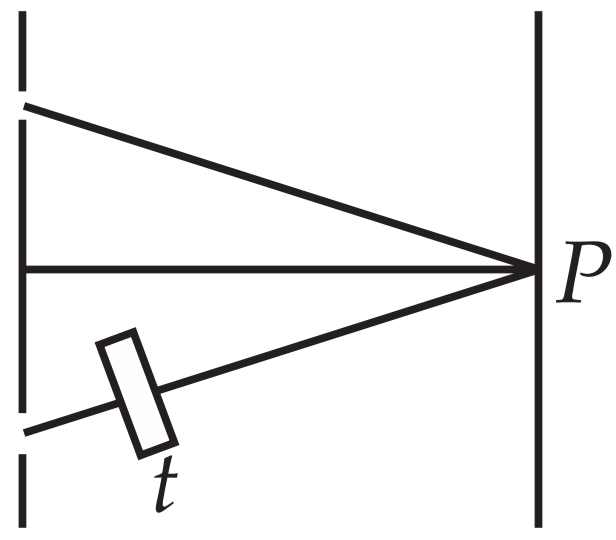
The given figure shows a double-slit experiment in which coherent monochromatic light of wavelength $\lambda$ from a distant source is incident upon the two slits, each of width $\text{w}(\text{w}>>\lambda)$ and the interference pattern is viewed on a distant screen. A thin piece of glass of thickness t and refractive index n is placed between one of the slit and the screen, perpendicular to the light path.
  1. ln Young's double slit interference pattern, the fringe width.
  1. Can be changed only by changing the wavelength of incident light.
  2. Can be changed only by changing the separation between the two slits.
  3. Can be changed either bychangingthe wavelength or by changing the separation between two sources.
  4. Is a universal constant and hence cannot be changed.
  1. If the width w ofone of the slits is increased to 2w, the become the amplitude due to slit.
  1. $1.5\text{a}$
  2. $\frac{\text{a}}{2}$
  3. $2\text{a}$
  4. No change.
  1. ln YDSE, let A and B be two slits. Films of thicknesses $t_A$  and $t_B$ and refractive indices $m_A$ and $m_B$ are placed in front of A and B, respectively. If $\mu_\text{A}\text{t}_\text{A}=\mu_\text{B}\text{t}_\text{B}$ then the central maxima will:
  1. Not shift.
  2. Shift towards A.
  3. Shift towards B.
  4. Shift towards A if $t_B = t_A$ and shift towards B if $t_B < t_A$
  1. ln Young's double slit experiment, a third slit is made in between the double slits. Then:
  1. Fringes of unequal width are formed.
  2. Contrast between bright and dark fringes is reduced.
  3. Intensity of fringes totally disappears.
  4. Only bright tight is observed on the screen.
  1. ln Young's double slit experiment, if one of the slits is covered with a microscope cover slip, then:
  1. Fringe pattern disappears.
  2. The screen just gets illuminated.
  3. In the fringe pattern, the brightness of the bright fringes will decreases and the dark fringes will become more dark.
  4. Bright fringes will be more bright and dark fringes will become more dark.
Why is it found experimentally difficult to detect neutrinos in nuclear $\beta$-decay?
Photoelectric effect
It is the phenomenon of emission of electrons from a metallic surface when light of a suitable frequency is incident on it. The emitted electrons are called photoelectrons.
Nearly all metals exhibit this effect with ultraviolet light but alkali metals like lithium, sodium, potassium, cesium etc. show this effect even with visible light. It is an instantaneous process i.e. photoelectrons are emitted as soon as the light is incident on the metal surface. The number of photoelectrons emitted per second is directly proportional to the intensity of the incident radiation.
The maximum kinetic energy of the photoelectrons emitted from a given metal surface is independent of the intensity of the incident light and depends only on the frequency of the incident light. For a given metal surface there is a certain minimum value of the frequency of the incident light below which emission of photoelectrons does not occur. 
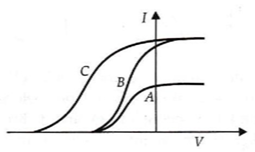
(I) In a photoelectric experiment plate current is plotted against anode potential.


Image

(A) A and B will have same intensities while B and C will have different frequencies.
(B) B and C will have different intensities while A and B will have different frequencies.
(C) A and B will have different intensities while B and C will have equal frequencies.
(D) B and C will have equal intensities while A and B will have same frequencies

(II) Photoelectrons are emitted when a zinc plate is
(A) Heated (B) hammered (C) Irradiated by ultraviolet light (D) subjected to a high pressure

(III) The threshold frequency for photoelectric effect on sodium corresponds to a wavelength of 500 nm. Its work function is about
(A) $4 \times 10^{-19} J$ (B) $2 \times 10^{-19} J$ (D) $3 \times 10^{-19} J$

(IV) The maximum kinetic energy of photoelectrons emitted from a surface when photons of energy 6 eV fall on it is 4 eV. The stopping potential is
(A) 2 V (B) 4 V (C) 6 V (D) 10 V

OR

The minimum energy required to remove an electron from a substance is called its
(A) work function (B) kinetic energy (C) stopping potential (D) potential energy
A small coin is placed on a record rotating at $33\frac{1}{3}$ rev/ minute. The coin does not slip on the record. Where does it get the required centripetal force from?