Question
A photodiode is an optoelectronic device in which current carriers are generated by photons through photo-excitation i.e., photo conduction by light. It is a p-n junction fabricated from a photosensitive semiconductor and provided with a transparent window so as allow light to fall on its function. A photodiode can turn its current ON and OFF in nanoseconds. So, it can be used as a fastest photo-detector.

  1. A p-n photodiode is fabricated from a semiconductor with a band gap of 2.5eV. It can detect a signal of wavelength:
  1. 4000nm.
  2. 6000nm.
  3. 4000Â.
  4. 6000Â.
  1. Three photo diodes $D_1, D_2$ and $D_3$ are made of semiconductors having band gap of 2.5eV, 2eV, and 3 eV, respectively. Which one will be able to detect light of wavelength 6000Â?
  1. $D_1$
  2. $D_2$
  3. $D_3$
  4. $D_1$ and $D_2$ both.
  1. Photodiode is a device:
  1. Which is always operated in reverse bias.
  2. Which of always operated in forward bias.
  3. In which photo current is independent of intensity of incident radiation.
  4. Which may be operated in forward or reverse bias.
  1. To detect light of wavelength 500nm, the photodiode must be fabricated from a semiconductor of minimum bandwidth of:
  1. 1.24eV
  2. 0.62eV
  3. 2.48eV
  4. 3.2eV
  1. Photodiode can be used as a photodetector to detect:
  1. Optical signals.
  2. Electrical signals.
  3. Both (a) and (b).
  4. None of these.

Answer

  1. (c) 4000Â.
Explanation:
$\lambda_\text{max}=\frac{\text{hc}}{\text{E}}=\frac{6.6\times10^{-34}\times3\times10^8}{2.5\times1.6\times10^{-19}}$
= 5000Â
$\therefore\lambda=4000\widehat{\text{A}}<\lambda_\text{max}$
  1. (b) $D_2$
Explanation:
Energy of incident photon, $\text{E}=\frac{\text{hc}}{\lambda}$
$=\frac{6.6\times10^{-34}\times3\times10^8}{6\times10^{-7}\times1.6\times10^{-19}}=2.06\text{eV}$
The incident radiation can be detected by a photodiode if energy of incident photon is greater than the band gap.
As $D_2 = 2eV,$ therefore $D_2$ will detect these radiations.
  1. (a) Which is always operated in reverse bias.
Explanation:
Photodiode is a device which is always operated in reverse bias.
  1. (c) 2.48eV
Explanation:
Let $E_g$ be the required bandwidth. Then
$\text{E}_\text{g}=\frac{\text{hc}}{\lambda}$
Here, he = 1240eV nm,
$\lambda=500\text{nm}$
$\therefore\text{E}_\text{g}=\frac{1240\text{eVnm}}{500\text{nm}}=2.48\text{eV}.$
  1. (a) Optical signals.
Explanation:
A photodiode is a device which is used to detect optical signals.

Need a full question paper?

Generate a complete, print-ready paper with questions like this in minutes — across 16+ boards, with answer keys.

Start Generating Free

Similar questions

Two submarines are approaching each other in a calm sea. The first submarine travels at a speed of 36km/h and the other at 54km/h relative to the water. The first submarine sends a sound signal (sound waves in water are also called sonar) at a frequency of 2000Hz.
  1. At what frequency is this signal received by the second submarine?
  2. The signal is reflected from the second submarine. At what frequency is this signal received by the first submarine. Take the speed of the sound wave in water to be 1500m/s.
A deflection magnetometer is placed with its arms in north-south direction. How and where should a short magnet having $\frac{\text{M}}{\text{B}_\text{H}}=40\text{A-m}^2\text{T}$ be placed so that the needle can stay in any position?
A tangent galvanometer shows a deflection of 45° when 10mA of current is passed through it. If the horizontal component of the earth's magnetic field is $B_H = 3.6\times 10^{-5} T$ and radius of the coil is 10cm, find the number of turns in the coil.
Explain Bohr's atomic model.
###
State three postulates of Bohr's atomic model.
The density of nuclear matter is the ratio of the mass of a nucleus to its volume. As the volume of a nucleus is directly proportional to its mass number A, so the density of nuclear matter is independent of the size of the nucleus. Thus, the nuclear matter behaves like a liquid of constant density. Different nuclei are like drops of this liquid, of different sizes but of same density. Let A be the mass number and R be the radius of a nucleus. If m is the average mass of a nucleon, then.Mass of nucleus = mA
$\text{Volume of nucleus }=\frac{4}{3}\pi\text{R}^3=\frac{4}{3}\pi\big(\text{R}_0\text{A}\frac{1}{3}\big)=\frac{4}{3}\pi\text{R}^3_0\text{A}$
$\therefore\text{Nuclear density},\rho\text{nu}=\frac{\text{Mass of nucleus}}{\text{Volume of nucleus}}\text{or}\ \rho\text{nu}$
$=\frac{\text{MA}}{\frac{4}{3}\pi\text{R}_0^3\text{A}}=\frac{3\text{m}}{4\pi\text{R}_0^3}$
Clearly, nuclear density is independent of mass number A or the size of the nucleus. The nuclear mass density is of the order $10^{17}kg\ m^{-3}$ This density is very large as compared to the density of ordinary matter, say water, for which $\rho = 1.0 \times 10^3kg m^{-3}$
  1. The nuclear radius of $_8^{16}\text{O}$ is $3 \times 10^{-15}m$. The density of nuclear matter is.
  1. $2.9 \times 10^{34}kg\ m^{-3}$
  2. $1.2 \times 10^{17}kg\ m^{-3}$
  3. $16 \times 10^{27}kg\ m^{-3}$
  4. $2.4 \times 10^{17}kg\ m^{-3}$
  1. What is the density of hydrogen nucleus in SI units? Given $R_o= 1.1$ fermi and $m_P = 1.007825$ amu.
  1. $1.2 \times 10^{17}kg\ m^{-3}$
  2. $3.0 \times 10^{34}kg\ m^{-3}$
  3. $1.99 \times 10^{11}kg\ m^{-3}$
  4. $7.85 \times 10^{17}kg\ m^{-3}$
  1. Density of a nucleus is.
  1. More for lighter elements and less for heavier elements.
  2. More for heavier elements and less for lighter elements.
  3. Very less compared to ordinary matter.
  4. A constant.
  1. The nuclear mass of $_{23}^{56}\text{Fe}$ is 55.85 amu. The its nuclear density is.
  1. $5.0 \times 10^{19}kg\ m^{-3}$
  2. $1.5 \times 10^{19}kg\ m^{-3}$
  3. $2.9 \times 10^{17}kg\ m^{-3}$
  4. $9.2 \times 10^{26}kg\ m^{-3}$
  1. If the nucleus of $_{13}^{27}\text{Al}$ has s a nuclear radius of about 3.6 fm, then $_{52}^{125}\text{Te}$ would have its radius approximately as.
  1. 9.6fm
  2. 12fm
  3. 4.8fm
  4. 6fm
Cloudy nights are warmer than the nights with clean sky. Explain.
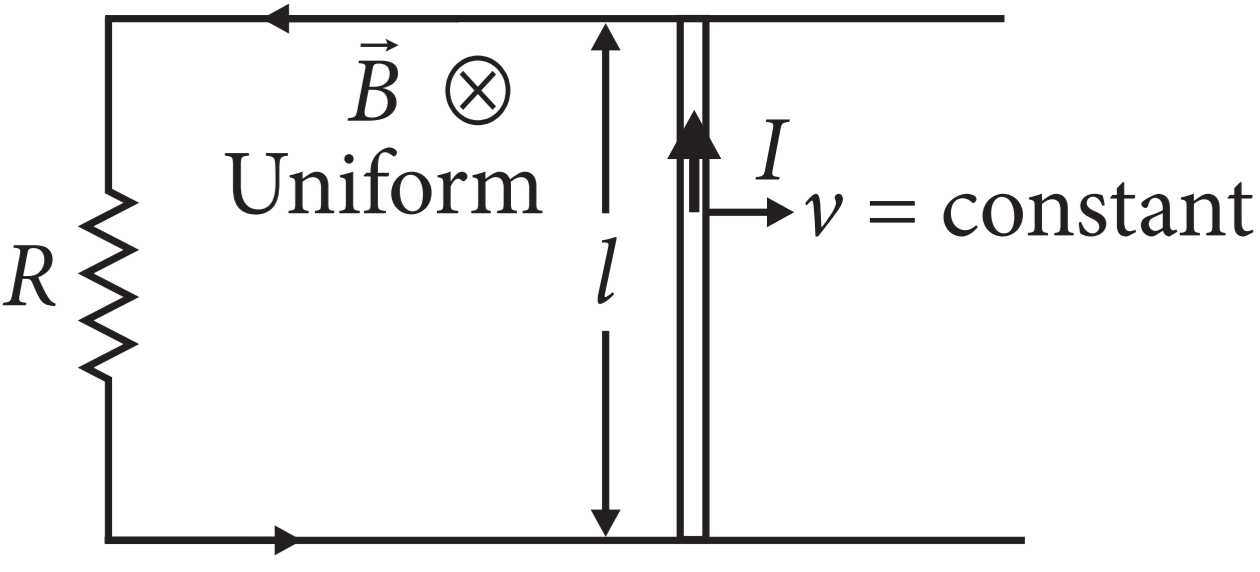
The emf induced across the ends of a conductor due to its motion in a magnetic field is called motional emf. It is produced due to the magnetic Lorentz force acting on the free electrons of the conductor. For a circuit shown in figure, if a conductor of length l moves with velocity v in a magnetic field B perpendicular to both its length and the direction of the magnetic field, then all the induced parametres are possible in the circuit.
  1. Direction of current induced in a wire moving in a magnetic field is found using
  1. Fleming's left hand rule.
  2. Fleming's right hand rule.
  3. Ampere's rule.
  4. Right hand clasp rule.
  1. A conducting rod of length l is moving in a transverse magnetic field of strength B with velocity v. The resistance of the rod is R. The current in the rod is:
  1. $\frac{\text{Blv}}{R}$
  2. $\frac{\text{B}^2\text{v}^2\text{l}^2}{\text{R}}$
  3. Blv
  4. Zero
  1. A 0.1m long conductor carrying a current of SO A is held perpendicular to a magnetic field of 1.25mT. The mechanical power required to move the conductor with a speed of I m $s^{-1}$​​​​​​​ is:
  1. 62.5 mW
  2. 625 mW
  3. 6.25 mW
  4. 12.5 mW
  1. A bicycle generator creates 1.5 Vat 15km/ hr. The EMF generated at 10km/ hr is:
  1. 1.5 volts
  2. 2 volts
  3. 0.5 volts
  4. 1 volt
  1. The dimensional formula for emf E in MKS system will be:
  1. $[ML^2T^{-3}A^{-1}]$
  2. $[ML^2T^{-1}A]$
  3. $[ML^2A]$
  4. $[MLT^-^3A^{-1}]$
An astronomical telescope is an optical instrument which is used for observing distinct images of heavenly bodies libe stars, planets etc. It consists of two lenses. In normal adjustment of telescope, the final image is formed at infinity. Magnifying power of an astronomical telescope in normal adjustment is defined as the ratio of the angle subtended at the eye by the angle subtended at the eye by the final image to the angle subtended at the eye, by the object directly, when the final image and the object both lie at infinite distance from the eye. It is given by, $\text{m}=\frac{\text{f}_0}{\text{f}_\text{g}}.$ To increase magnifying power of an astronomical telescope in normal adjustment, focal length of objective lens should be large and focal length of eye lens should be small.
  1. An astronomical telescope of magnifying power 7 consists of the two thin lenses 40cm apart, in normal adjustment. The focal lengths of the lenses are
  1. 5cm, 35cm
  2. 7cm, 35cm
  3. 17cm, 35cm
  4. 5cm, 30cm
  1. An astronomical telescope has a magnifying power of 10. In normal adjustment, distance between the objective and eye piece is 22cm. The focal length of objective lens is:
  1. 25cm
  2. 10cm
  3. 15cm
  4. 20cm
  1. In astronomical telescope compare to eye piece, objective lens has:
  1. Negative focal length.
  2. Zero focal length.
  3. Small focal length.
  4. Large focal length.
  1. To see stars, use:
  1. Simple microscope.
  2. Compound microscope.
  3. Endoscope.
  4. Astronomical telescope.
  1. For large magnifying power of astronomical telescope.
  1. $f_0 << f_e$
  2. $f_0 << f_e$
  3. $f_0 << f_e$
  4. None of these.
What is power factor? Explain.
Show that the magnetic field at a point due to a magnetic dipole is perpendicular to the magnetic axis if the line joining the point with the centre of the dipole makes an angle of $\tan^{-1}(\sqrt{2})$ with the magnetic axis.