Question
When the projectile is moving at an angle $\theta$, then what can be the maximum and minimum angle in instantaneous velocity and instantaneous acceleration?

Answer

$\frac{\pi}{2}+\theta, \frac{\pi}{2}-\theta$.

Need a full question paper?

Generate a complete, print-ready paper with questions like this in minutes — across 16+ boards, with answer keys.
Start Generating Free

Similar questions

Write the value of that temperature which is same on Fahrenheit and Kelvin scale.
Can a body be accelerated without increasing or decreasing it body?
Calculate the force acting on a body whose linear momentum changes from 20kg ms-1 to 40kg ms-1 in 10s.
Every SHM is periodic motion, but every periodic motion need not to be a simple harmonic motion. Do you agree? Give an example to justify your statement.
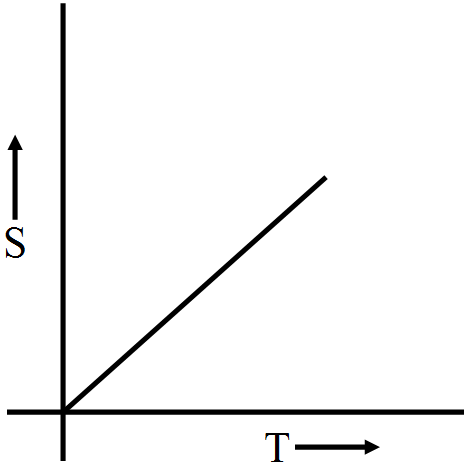
Displacement-time (S-T) graph of any object is shown in figure. Draw velocity-time graph for this motion.

Three stars A, B, C appear as green, red and blue respectively. Which star has minimum temperature?
One C.S.L. is equal to how many times the mass of the sun?
A transverse harmonic wave on a string is described by
$\text{y}(\text{x, t})=3.0\sin\big(36\text{t}+0.018\text{x}+\frac{\pi}{4}\big)$
where x and y are in cm and t in s. The positive direction of x is from left to right.
What is the initial phase at the origin?
A man is standing on top of a building 100m high. He throws two balls vertically, one at t = 0 and other after a time interval (less than 2 seconds). The later ball is thrown at a velocity of half the first. The vertical gap between first and second ball is +15m at t = 2s. The gap is found to remain constant. Calculate the velocity with which the balls were thrown and the exact time interval between their throw.
A force $\Big(\frac{\text{mv}^2}{\text{r}^2}\Big)$ is acting on a body of mass m moving with a velocity v in a circle of radius r. What is the work done by the force in moving the body over half the circumference of the circle?
  1. $\frac{\text{mv}^2}{\text{r}}\times\pi\text{r}$
  2. $\text{Zero}$
  3. $\frac{\text{mv}^2}{\text{r}^2}$
  4. $\frac{\pi\text{r}^2}{\text{mv}^2}$