MCQ
When the switch S is closed in the figure given below, the pointer of the galvanometer moves to the right.
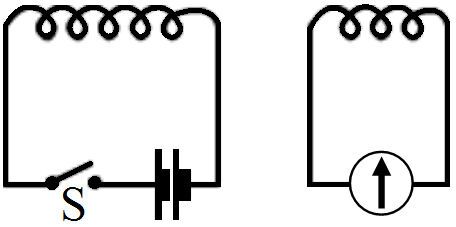
If S is kept closed, will the pointer:
  • A
    Return to zero?
  • B
    Stay over on the right?
  • C
    Move to the left and stay there.
  • D
    Move to and fro until S is opened.

Answer

  1. Return to zero.

Explanation:

After some time, the magnetic field gets constant; this means that there is no relative change in the value of magnetic field. Therefore, the circuit will have zero induced current.

Need a full question paper?

Generate a complete, print-ready paper with questions like this in minutes — across 16+ boards, with answer keys.

Start Generating Free

Similar questions

A rectangular loop carrying a current is situated near a long straight wire such that the wire is parallel to one of the sides of the loop and is in the plane of the loop. If a steady current its created in wire as shown in figure below, then the loop will
Which colour is used for earth wire?
The north pole of earth's magnet is in the:
The force experienced by a current-carrying conductor placed in a magnetic field is the largest when the angle between the conductor and the magnetic field is:
  1. 45°
  2. 60°
  3. 90°
  4. 180°
A magnetic field is produced by the current passing through a long straight wire. When will the strength of the magnetic field increase?
When three identical bulb of 60 W- 220V rating are connected in series to a 220V supply, the power drawn by them will be.
The phenomenon of electromagnetic induction is:
  1. The process of charging a body.
  2. The process of generating magnetic field due to a current passing through a coil.
  3. Producing induced current in a coil due to relative motion between a magnet and the coil.
  4. The process of rotating a coil of an electric motor.
An electric heater is rated 100W and 220V. If it is operated on 110V. The power consumption will be:
The angle of reflection is equal to the angle of incidence:
  1. Always.
  2. Sometimes.
  3. Under special conditions.
  4. Never.