MCQ
When the temperature is increased the angle of contact of a liquid
  • A
    Increases
  • Decreases
  • C
    Remains the same
  • D
    First increases and then decreases

Answer

Correct option: B.
Decreases
b
(b)Cohesive force decreases so angle of contact decreases.

Need a full question paper?

Generate a complete, print-ready paper with questions like this in minutes — across 16+ boards, with answer keys.
Start Generating Free

Similar questions

A body of mass $5\, gm$ is executing $S.H.M.$ about a point with amplitude $10 \,cm$. Its maximum velocity is $100\, cm/sec$. Its velocity will be $50\, cm/sec$ at a distance
Consider the situation of the previous problem. The force on the central charge due to the shell is:
For an ideal liquid
A body of mass $1.0\,kg$ is falling with an acceleration of $10 \,m/se{c^2}$. Its apparent weight will be ......... $kg\,wt$ $(g = 10\,m/{\sec ^2})$ 
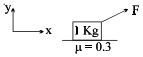
A $\vec F\,\, = \,\,\hat i\, + \,4\hat j\,$ acts on block shown. The force of friction acting on the block is :
In a thermodynamics process, pressure of a fixed mass of a gas is changed in such a manner that the gas releases $20 J$ of heat and $8J$ of work is done on the gas. If the initial internal energy of the gas was $30J.$ The final internal energy will be ...... $J$
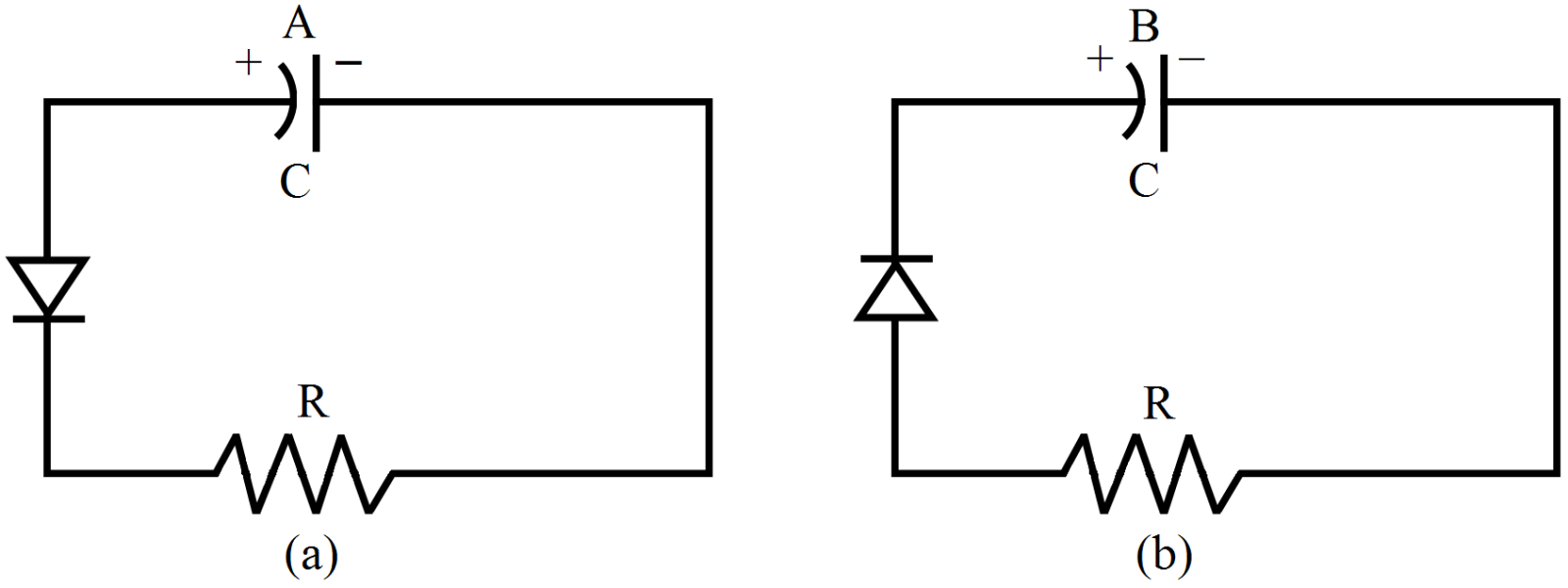
Two identical capacitors A and B are charged to the same potential V and are connected in two circuits at t = 0 as shown in figure. The charges on the capahltors at a time t = CR are, respectively:
Quantities which remain constant in a collision:
If $\rho$ is the density and $\eta$ is coefficient of viscosity of fluid which flows with a speed $v$ in the pipe of diameter $d$, the correct formula for Reynolds number $R _{ e }$ is ..............
The position vectors of points $A, B, C$ and $D$ are $\vec A = 3\hat i + 4\hat j + 5\hat k,\,\vec B = 4\hat i + 5\hat j + 6\hat k,\,\vec C = 7\hat i + 9\hat j + 3\hat k$ and $\vec D = 4\hat i + 6\hat j$ then the displacement vectors $\overrightarrow {AB} $ and $\overrightarrow {CD} $ are