When there is an electric current through a conducting wire along its length, then an electric field must exist
Easy


Download our appand get started for free
Experience the future of education. Simply download our apps or reach out to us for more information. Let's shape the future of learning together!No signup needed.*
Similar Questions
- 1On interchanging the resistances, the balance point of a meter bridge shifts to the left by $10\ cm$. The resistance of their series combination is $1\ k\Omega$. How much was the resistance on the left slot before interchanging the resistances? .................. $\Omega$View Solution
- 2Coefficient of linear expansion of material of resistor is $\alpha$. Its temperature coefficient of resistivity and resistance are $\alpha_\rho$ and $\alpha_R$ respectively, then correct relation isView Solution
- 3A $2\, volt$ battery, a $15\,\Omega $ resistor and a potentiometer of $100\, cm$ length, all are connected in series. If the resistance of potentiometer wire is $5\,\Omega $, then the potential gradient of the potentiometer wire is ............... $V/cm$View Solution
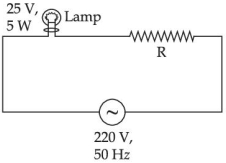
- 4A $220 \; V , 50 \; Hz$ AC source is connected to a $25 \; V$, $5 \; W$ lamp and an additional resistance $R$ in series (as shown in figure) to run the lamp at its peak brightness, then the value of $R$ (in ohm) will beView Solution
- 5View SolutionConstantan wire is used in making standard resistances because its
- 6View SolutionElectroplating does not help in
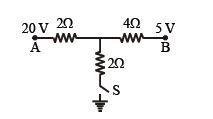
- 7As the switch $S$ is closed in the circuit shown in figure, current passing through it is ................ $\mathrm{A}$View Solution
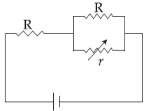
- 8In the circuit shown, the resistance $r$ is a variable resistance. If for $r = fR,$ the heat generation in $r$ is maximum then the value of $f$ isView Solution
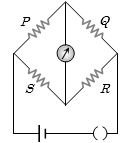
- 9In the Wheatstone's bridge shown, $P = 2\,\Omega ,$ $Q = 3\,\Omega ,$ $R = 6\,\Omega $ and $S = 8\,\Omega $. In order to obtain balance, shunt resistance across '$S$' must be .............. $\Omega$View Solution
- 10A rod of length $l$ with thermally insulated lateral surface is made of a material whose thermal conductivity $K$ varies as $K = C/T$ , where $C$ is a constant. The ends are at temperatures $T_1$ and $T_2$ . The heat current density isView Solution