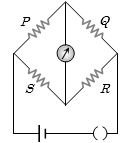
In the Wheatstone's bridge shown, $P = 2\,\Omega ,$ $Q = 3\,\Omega ,$ $R = 6\,\Omega $ and $S = 8\,\Omega $. In order to obtain balance, shunt resistance across '$S$' must be .............. $\Omega$
Medium


Download our appand get started for free
Experience the future of education. Simply download our apps or reach out to us for more information. Let's shape the future of learning together!No signup needed.*
Similar Questions
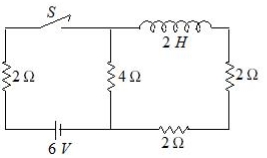
- 1For the given circuit the current through battery of $6\,V$ just after closing the switch ' $S$ ' will be$.......A$.View Solution
- 2View SolutionCorrect set up to verify Ohm's law is
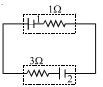
- 3In the figure shown, battery $1$ has $\mathrm{emf}$ $= 6\, V$ and internal resistance $= 1 \,\Omega$. Battery $2$ has $\mathrm{emf}$ $= 2\,V$ and internal resistance $= 3\, \Omega$ . The wires have negligible resistance. What is the potential difference across the terminals of battery $2$ ? ................ $V$View Solution
- 4Water of volume $2\, litre$ in a container is heated with a coil of $1\, kW$ at $27 \,^oC$. The lid of the container is open and energy dissipates at rate of $160\, J/s$. In how much time temperature will rise from $27\,^oC$ to $77\,^oC$ $[$ Given specific heat of water is $4.2\, kJ/kg$ $]$View Solution
- 5In the diagram resistance between any two junctions is $R$. Equivalent resistance across terminals $A$ and $B$ isView Solution

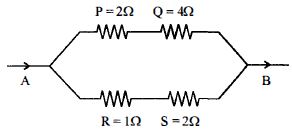
- 6Which of the four resistances $P, Q, R$ and $S$ generate the greatest amount of heat when a current flows from $A$ to $B$ ?View Solution
- 7$A$ total charge $Q$ flows across a resistor $R$ during a time interval $= T$ in such a way that the current vs. time graph for $0 \rightarrow T$ is like the loop of a sin curve in the range $0 \rightarrow \pi$ . The total heat generated in the resistor isView Solution
- 8Two resistances equal at $0\,^oC$ with temperature coefficient of resistance $\alpha _1$ and $\alpha _2$ joined in series act as a single resistance in a circuit. The temperature coefficient of their single resistance will beView Solution
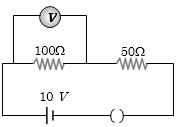
- 9In the given circuit, the voltmeter records $5\, volts$. The resistance of the voltmeter in $ohms$ isView Solution
- 10Every atom makes one free electron in copper. If $1.1$ $ampere$ current is flowing in the wire of copper having $1\, mm$ diameter, then the drift velocity (approx.) will be (Density of copper $ = 9 \times {10^3}\,kg\,{m^{ - 3}}$ and atomic weight = $63$)View Solution