When three identical bulbs of $60 \;W, 200\;V$ rating are connected in series to a $200 \;V$ supply, the power drawn by them will be ....... $Watt$
AIPMT 2004, Easy


Download our appand get started for free
Experience the future of education. Simply download our apps or reach out to us for more information. Let's shape the future of learning together!No signup needed.*
Similar Questions
- 1On an electric heater $220\, volt$ and $1100\, watt$ are marked. On using it for $4$ hours, the energy consumed in $kWh$ will beView Solution
- 2In a potentiometer circuit a cell of $EMF$ $1.5\, {V}$ gives balance point at $36\, {cm}$ length of wire. If another cell of $EMF$ $2.5\, {V}$ replaces the first cell, then at what length of the wire, the balance point occurs ? (in $cm$)View Solution
- 3Two wires each of radius of cross section $r$ but of different materials are connected together end to end (in series). If the densities of charge carriers in the two wires are in the ratio $1 : 4$, the drift velocity of electrons in the two wires will be in the ratio:View Solution
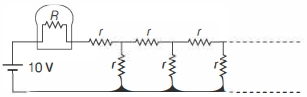
- 4A light bulb of resistance $R=16 \,\Omega$ is attached in series with an infinite resistor network with identical resistances $r$ as shown below. A $10 \,V$ battery drives current in the circuit. ............. $\Omega$ the value of $r$ such that the bulb dissipates about $1 \,W$ of power.View Solution
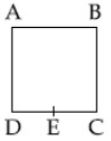
- 5A wire of resistance $R$ is bent to form a square $ABCD$ as shown in the figure. The effective resistance between $E$ and $C$ is ( $E$ is mid-point of arm $CD$ )View Solution
- 6The resistance of a $5\, cm$ long wire is $10\, \Omega$. It is uniformly stretched so that its length becomes $20\, cm$. The resistance of the wire is ............. $\Omega$View Solution
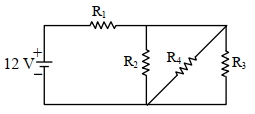
- 7In the given figure $R_1=10 \Omega, R_2=8 \Omega, R_3=4 \Omega$ and $R_4=8 \Omega$. Battery is ideal with emf $12 \mathrm{~V}$. Equivalent resistant of the circuit and current supplied by battery are respectively.View Solution
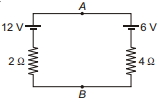
- 8Potential difference across $A B$ i.e., $V_A-V_B$ is ......... $V$View Solution
- 9A current of $10\, amp$ is passing through a metallic wire of cross sectional area $4 \times 10^{-6}\, m ^{2}$. If the density of the aluminum conductor is $2.7\, gm / cc$ considering aluminum gives $1$ electrons per atom for conduction find the drift speed of the electrons is ......... $\times 10^{-4} \,m / s$ if molecular weight of aluminum is $27 \,gm$.View Solution
- 10A uniform heating wire of resistance $36\, \Omega$ is connected across a potential difference of $240\, {V}$ The wire is then cut into half and potential difference of $240\, {V}$ is applied across each half separately. The ratio of power dissipation in first case to the total power dissipation in the second case would be $1: {x}$, where ${x}$ is........... .View Solution