MCQ
When torque applied on a system is zero, which of the following will be constant?
  • A
    Moment of inertia
  • B
    Angular velocity
  • C
    Kinetic energy
  • Moment of linear momentum

Answer

Correct option: D.
Moment of linear momentum
d
(d)

When the torque acting upon a system is zero, the angular momentum is constant and hence is conserved. This is analogous to the linear counterpart i.e. when the force on the system is zero, the momentum is conserved.

Need a full question paper?

Generate a complete, print-ready paper with questions like this in minutes — across 16+ boards, with answer keys.
Start Generating Free

Similar questions

A small spherical ball of radius $r$, falling through a viscous medium of negligible density has terminal velocity ' $v$ '. Another ball of the same mass but of radius $2 r$, falling through the same viscous medium will have terminal velocity:
The internal energy of one mole of an ideal gas depend upon:
Three liquids of equal masses are taken in three identical cubical vessels $A, B$ and $C .$ Their densities are $\rho_{A}, \rho_{B}$ and $\rho_{C} \cdot$ The force exerted by the liquid on the base of the cubical vessel is
Consider a bowl filled with water on which some black pepper powder have been sprinkled uniformly. Now, a drop of liquid soap is added at the centre of the surface of water. The picture of the surface immediately after this will look like
A car travels $6\, km$ towards north at an angle of $45^o$ to the east and then travels distance of $4\, km$ towards north at an angle $135^o$ to east. How far is the point from the starting point? What angle does the straight line joining its initial and final position makes with the east?
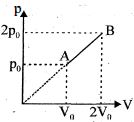
An enclosed one mole of a monoatomic gas is taken through a process $A$ to $B$ as shown in figure. The molar heat capacity of the gas for this process is
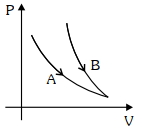
Choose the correct statement for processes $A$  & $B$ shown in figure.
In an adiabatic change, the pressure P and temperature T of a diatomic gas are related by the relation $\text{P}\propto\text{T}^\text{C}$ where C equals:
Find the gravitational field at a distance of $2000\, km$ from centre of earth. (in $m / s ^{2}$)

(Given $\left.R_{\text {earth }}=6400 km , r =2000 km , M _{\text {earth }}=6 \times 10^{24} kg \right)$

Consider a system of two identical particles. One of the particles is at rest and the other has an acceleration $\vec{f}$. The centre of mass has an acceleration