MCQ
When treated with ammoniacal cuprous chloride, which one among the following forms copper derivative
- A${C_2}{H_6}$
- B${C_2}{H_4}$
- ✓${C_2}{H_2}$
- D${C_6}{H_6}$
$N{{H}_{4}}OH+CuOH\to \underset{\begin{smallmatrix}
\text{Diammine copper} \\
\text{ }\left( I \right)\text{ hydroxide}
\end{smallmatrix}}{\mathop{[Cu{{(N{{H}_{3}})}_{2}}]OH}}\,$
$2[Cu{{(N{{H}_{3}})}_{2}}]\,OH+HC\equiv CH\to $ $\mathop {Cu - C \equiv C - Cu}\limits_{{\text{copper acetylide Red ppt}}{\text{.}}} + 4N{H_3} + 2{H_2}O$
Generate a complete, print-ready paper with questions like this in minutes — across 16+ boards, with answer keys.
Statement $I$: Nitration of benzene involves the following step -
(Image)
Statement $II$: Use of Lewis base promotes the electrophilic substitution of benzene.
In the light of the above statements, choose the most appropriate answer from the options given below: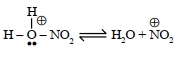
$(i)\, 6C(s) + 3H_2(g) \to C_6H_6(l) ; \Delta H = +45.9\,kJ$
$(ii)\, H_2(g) +\frac {1}{2}O_2(g) \to H_2O(l) ; \Delta H = -285.9\,kJ$
$(iii) \,C(s) + O_2(g) \to CO_2(g) ; \Delta H = -393.5\,kJ$
.....$kJ$
$\mathrm{Cd}_{(s)}+\mathrm{Hg}_{2} \mathrm{SO}_{4(s)}+\frac{9}{5} \mathrm{H}_{2} \mathrm{O}_{(l)} \rightleftharpoons \mathrm{CdSO}_{4} \cdot \frac{9}{5} \mathrm{H}_{2} \mathrm{O}_{(s)}+2 \mathrm{Hg}_{(l)}$
The value of $\mathrm{E}_{\text {cell }}^{0}$ is $4.315\, \mathrm{~V}$ at $25^{\circ} \mathrm{C}$. If $\Delta \mathrm{H}^{\circ}=-825.2\, \mathrm{~kJ} \,\mathrm{~mol}^{-1}$, the standard entropy change $\Delta \mathrm{S}^{\circ}$ in $\mathrm{J} \,\mathrm{K}^{-1}$ is ........ . (Nearest integer) [Given : Faraday constant $=96487\, \mathrm{C}\, \mathrm{mol}^{-1}$ ]
