MCQ
When two bodies collide elastically, then
  • A
    Kinetic energy of the system alone is conserved
  • B
    Only momentum is conserved
  • Both energy and momentum are conserved
  • D
    Neither energy nor momentum is conserved

Answer

Correct option: C.
Both energy and momentum are conserved
c
(c) In collisions in absence of any external force the momentum is conserved.

As the collision is elastic so there will not be any deformation in the shapes of the bodies so there will not be any

 loss in energy so the energy will remain constant.

Need a full question paper?

Generate a complete, print-ready paper with questions like this in minutes — across 16+ boards, with answer keys.
Start Generating Free

Similar questions

Two satellites $\mathrm{P}$ and $\mathrm{Q}$ are moving in different circular orbits around the Earth (radius $R$ ). The heights of $\mathrm{P}$ and $\mathrm{Q}$ from the Earth surface are $h_{\mathrm{p}}$ and $h_{\mathrm{Q}}$, respectively, where $h_{\mathrm{p}}=\mathrm{R} / 3$. The accelerations of $\mathrm{P}$ and $\mathrm{Q}$ due to Earth's gravity are $g_{\mathrm{p}}$ and $g_{\mathrm{Q}}$, respectively. If $g_{\mathrm{p}} / g_{\mathrm{Q}}=36 / 25$, what is the value of $h_Q$ ?
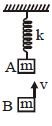
Block $A$ is hanging from a vertical spring and it is at rest. Block $'B'$ strikes the block $'A'$ with velocity $v$ and stick to it. Then the velocity $v$ for which the spring just attains natural length is:
A thin convex lens made from crown glass $\left( {\mu = \frac{3}{2}} \right)$ has focal length $f$. When it is measured in two different liquids having refractive indices $\frac{4}{3}$ and $\frac{5}{3}$ it has the focal lengths $f_1$ and $f_2$ respectively. The correct relation between the focal lengths is:
It is not possible to write directly on blotting paper or newspaper with ink pen
A man suffering from myopia can read a book placed at $10 cm$ distance. For reading the book at a distance of $60 cm$ with relaxed vision, focal length of the lens required will be......$cm$
A $0.1 \mathrm{~kg}$ mass is suspended from a wire of negligible mass. The length of the wire is $1 \mathrm{~m}$ and its crosssectional area is $4.9 \times 10^{-7} \mathrm{~m}^2$. If the mass is pulled a little in the vertically downward direction and released, it performs simple harmonic motion of angular frequency $140 \ \mathrm{rad} \mathrm{s}^{-1}$. If the Young's modulus of the material of the wire is $\mathrm{n} \times 10^9 \mathrm{Nm}^{-2}$, the value of $\mathrm{n}$ is
A Carnot’s engine is made to work between $200°C$ and $0°C$ first and then between $0°C$ and $-200°C.$ The ratio of efficiencies of the engine in the two cases is
What is the unit vector perpendicular to the following vectors $2\hat i + 2\hat j - \hat k$ and $6\hat i - 3\hat j + 2\hat k$
A $100\%$ efficient transformer has $100$ turns in the primary and $25$ turns in its secondary coil. If the current in the secondary coil is $4$ amp, then the current in the primary coil is.....$ amp$
An $\alpha$ particle and a proton are accelerated from rest by a potential difference of $200\, V$. After this, their de Broglie wavelengths are $\lambda_{\alpha}$ and $\lambda_{p}$ respectively. The ratio $\frac{\lambda_{p}}{\lambda_{a}}$ is