When two identical batteries of internal resistance $1 \Omega$ each are connected in series across a resistor $\mathrm{R}$, the rate of heat produced in $R$ is $J_1$. When the same batteries are connected in parallel across $R$, the rate is $\mathrm{J}_2$. If $\mathrm{J}_1=2.25 \mathrm{~J}_2$ then the value of $\mathrm{R}$ in $\Omega$ is
IIT 2010, Advanced
Download our app for free and get started
$ \mathrm{~J}_1=\left(\frac{2 \mathrm{E}}{\mathrm{R}+2}\right)^2 \mathrm{R} $
$ \mathrm{J}_2=\left(\frac{\mathrm{E}}{\mathrm{R}+1 / 2}\right)^2 \mathrm{R} \text { since } \mathrm{J}_1 / \mathrm{J}_2=2.25 $
$ \mathrm{R}=4 \Omega .$

Download our appand get started for free
Experience the future of education. Simply download our apps or reach out to us for more information. Let's shape the future of learning together!No signup needed.*
Similar Questions
- 1Potentiometer wire of length $1 \,m$ is connected in series with $490\,\Omega $ resistance and $2\,V$ battery. If $0.2\, mV/cm $ is the potential gradient, then resistance of the potentiometer wire is ................ $\Omega$View Solution
- 2A conducting wire of length $ l$ area of cross-section $A$ and electric resistivity $\rho$ is connected between the terminals of a battery. $A$ potential difference $V$ is developed between its ends, causing an electric current.If the length of the wire of the same material is doubled and the area of cross-section is halved, the resultant current would beView Solution
- 3A wire of resistance $R$ and radius $r$ is stretched till its radius became $r / 2$. If new resistance of the stretched wire is $x R$, then value of $x$ is $\qquad$View Solution
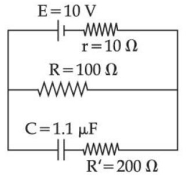
- 4As show in the figure, in steady state, the charge stored in the capacitor is....... $\times 10^{-6}\,C$.View Solution
- 5View SolutionWhich of the following will NOT be observed when a multimeter (operating in resistance measuring mode) probes connected across a component, are just reversed?
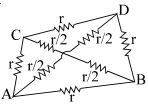
- 6The figure shows a tetrahedron, each side of which has a resistance $r$ Choose the correct statement $(s)$ related to the resistance between any two points.View Solution
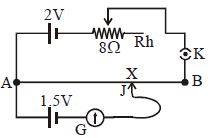
- 7In a potentiometer experiment shown here, for the position $X$ of the jockey $J,$ there occurs a null deflection in the galvanometer. Then the potential difference between points $A$ and $X$ is ................ $V$View Solution
- 8In the given current distribution what is the value of $I$ .............. $A$View Solution
- 9In the figure shown, battery $1$ has $\mathrm{emf}$ $= 6\, V$ and internal resistance $= 1 \,\Omega$. Battery $2$ has $\mathrm{emf}$ $= 2\,V$ and internal resistance $= 3\, \Omega$ . The wires have negligible resistance. What is the potential difference across the terminals of battery $2$ ? ................ $V$View Solution
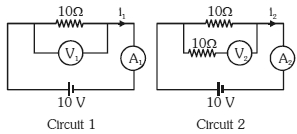
- 10View SolutionIn the circuits shown below, the readings of the voltmeters and the ammeters will be